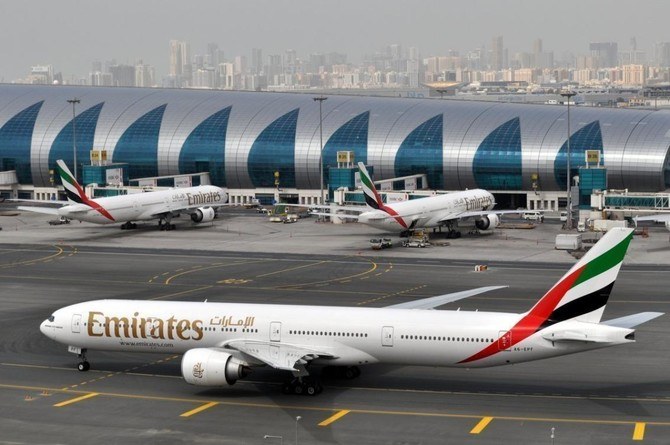
ISLAMABAD: Emirates announced that it has resumed flight operations from Pakistan after temporarily suspending them more than two months ago due to the coronavirus outbreak, a statement released by the Dubai-based airline said on Tuesday.
However, flights leaving Pakistan for Dubai will only carry UAE residents and air freight, while operations from Dubai to Pakistan are currently available for cargo only, the statement added.
The airline further announced to run daily flights from Karachi while capital Islamabad will have the service on Thursdays and Saturdays with Lahore enjoying the route throughout the week with exception to Wednesday and Saturday, according to the official handout.
In addition to resuming scheduled services to Dubai, Emirates said is also working closely with Pakistan government to facilitate select flights for repatriation of Pakistani citizens from the UAE.
Last week the airline operated “two special flights from Dubai to Karachi and Islamabad repatriating Pakistani nationals stranded in the UAE,” airline said.
On May 31 Gulf Air resumed its operations to Pakistan with a direct flight from the Islamabad International Airport to its hub in Bahrain. Etihad Airways also resumed transit flights to Pakistan this month.
The resumption of international airlines came after Pakistan's aviation sector announced on May 30 that it has reopened its commercial airspace for outbound international flights after temporarily closing it in March.

Several Gulf airliners resume flights from Pakistan as anti-virus measures ease
https://arab.news/zxq2w
Several Gulf airliners resume flights from Pakistan as anti-virus measures ease
- Emirates says it's working closely with Islamabad to facilitate repatriation of Pakistani citizens
- Earlier Gulf Air and Etihad also resumed transit flights to Pakistan
No casualties as blast derails Jaffar Express train in Pakistan’s south
- Passengers were stranded and railway staffers were clearing the track after blast, official says
- In March 2025, separatist militants hijacked the same train with hundreds of passengers aboard
QUETTA: A blast hit Jaffar Express and derailed four carriages of the passenger train in Pakistan’s southern Sindh province on Monday, officials said, with no casualties reported.
The blast occurred at the Abad railway station when the Peshawar-bound train was on its way to Sindh’s Sukkur city from Quetta, according to Pakistan Railways’ Quetta Division controller Muhammad Kashif.
No group immediately claimed responsibility for the bomb attack, but passenger trains have often been targeted by Baloch separatist outfits in the restive Balochistan province that borders Sindh.
“Four bogies of the train were derailed due to the intensity of the explosion,” Kashif told Arab News. “No casualty was reported in the latest attack on passenger train.”
Another railway employee, who was aboard the train and requested anonymity, said the train was heading toward Sukkur from Jacobabad when they heard the powerful explosion, which derailed power van among four bogies.
“A small piece of the railway track has been destroyed,” he said, adding that passengers were now standing outside the train and railway staffers were busy clearing the track.
In March last year, fighters belonging to the Balochistan Liberation Army (BLA) separatist group had stormed Jaffar Express with hundreds of passengers on board and took them hostage. The military had rescued them after an hours-long operation that left 33 militants, 23 soldiers, three railway staff and five passengers dead.
The passenger train, which runs between Balochistan’s provincial capital of Quetta and Peshawar in the country’s northwest, had been targeted in at least four bomb attacks last year since the March hijacking, according to an Arab News tally.
Pakistan Railways says it has beefed up security arrangements for passenger trains in the province and increased the number of paramilitary troops on Jaffar Express since the hijacking in March, but militants have continued to target them in the restive region.
Balochistan, Pakistan’s southwestern province that borders Iran and Afghanistan, is the site of a decades-long insurgency waged by Baloch separatist groups who often attack security forces and foreigners, and kidnap government officials.
The separatists accuse the central government of stealing the region’s resources to fund development elsewhere in the country. The Pakistani government denies the allegations and says it is working for the uplift of local communities in Balochistan.