Two journalists arrested in Turkey over ‘military espionage’

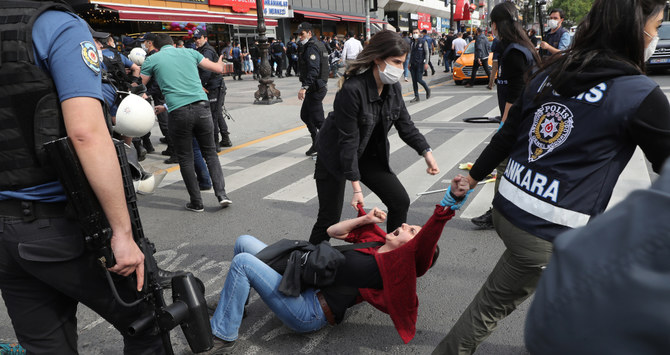
Turkey is ranked as one the top jailers of journalists worldwide. (FILE/AFP)
Short Url
Updated 09 June 2020
Follow

Two journalists arrested in Turkey over ‘military espionage’

  • No details were disclosed about which nations they were spying for, or the alleged spying activities they were conducting.

JEDDAH: Two dissident Turkish journalists, Ismail Dukel and Muyesser Yildiz, had their digital materials seized and were detained over allegations of military espionage early on Monday.

The news came amid a new crackdown on media in Turkey, which is ranked as one the top jailers of journalists worldwide.

Yildiz, the Ankara bureau chief of the pro-opposition ODA TV news portal, and Dukel, the Ankara representative of TELE 1 TV channel, were taken into custody following investigations by the Ankara Prosecution Office.

No details were disclosed about which nations they were spying for, or the alleged spying activities they were conducting.

However, pro-government newspaper Sabah claimed that Yildiz spoke to a military personnel 29 times by her own phone — sparking debate about whether the phone callings of journalists are wiretapped.

“The Mafia is free outside, the gangs are outside, the harassers are outside, the scammers are outside, the killers are outside, the thieves are outside, but journalists and politicians are kept inside,” said Alpay Antmen, a lawmaker from the main opposition Republican People’s Party (CHP).

Three other journalists from ODA TV have been held since March over a report about the identity of two Turkish spies killed in Libya, despite their names being revealed in the Turkish parliament a week earlier.

“The arrest of a journalist who could have given his testimony upon invitation from a prosecutor doesn’t and shouldn’t exist in democracies,” said Merdan Yanardag, chief editor of TELE 1 TV, adding that the detentions were meant to threaten independent media in the country.

Yildiz, who was fined for a story she wrote in March, was a vocal critic of the government, which she accused of mishandling counterterrorism efforts.

Turkish Interior Minister Suleyman Soylu responded to her work, claiming she is “pro-PKK (Kurdistan Workers’ Party) terror group.”

He said: “What I am disappointed in is not your affection for the PKK, but the fact that you’re doing business with those in the state.”

The Parliamentary Assembly of the Council of Europe reported on May 22 that there were 95 journalists jailed in Turkey, more than in any country in the world.

Press in Arrest, a volunteer group monitoring investigations and trials of journalists, recently released its Press Freedom report for May.

“Although court hearings were postponed due to the coronavirus outbreak, prosecution of journalists and fines on critical news outlets continued in May,” the report said.

It added that debates about press freedom turned around the penalties imposed by the Radio and Television Supreme Council and Press Advertisement Institution, more than the criminal prosecution of journalists.

“However, having become the government’s instrument of oppression, the judiciary continued to prosecute journalists relentlessly,” the report added.

Advertisements are a significant source of income for opposition media. Cumhuriyet newspaper was recently deprived of publishing tender notices from the government for three months following a row with Turkish presidential communications chief Fahrettin Altun. The paper was accused of violating press ethics.

On June 4, the International Press Institute and 19 other international press freedom and freedom of expression groups sent a joint letter to Turkey’s advertisement agency to call for a fair distribution of public ads in local and national newspapers.


Israeli journalists warn of media crackdown as UK billionaire prepares Channel 13 sale

Updated 13 February 2026
Follow

Israeli journalists warn of media crackdown as UK billionaire prepares Channel 13 sale

  • The Union of Journalists in Israel has condemned the transaction as “an unlawful deal”

LONDON: Israeli journalists and media unions have voiced serious concern over a proposed sale of a major stake in Israel’s Channel 13, warning that the move could deal a devastating blow to independent journalism in the country amid a broader campaign to reshape the media landscape ahead of elections.

According to The Guardian, British billionaire Sir Leonard Blavatnik is preparing to sell a 15 percent stake in Channel 13, one of Israel’s few mainstream channels critical of Prime Minister Benjamin Netanyahu, to telecom tycoon Patrick Drahi, a French-Israeli businessman who already owns media outlets perceived as sympathetic to the current government.

Journalists and free press advocates said the sale risked consolidating pro-government influence in a media environment already under pressure from financial sanctions, lawsuits, and regulatory threats.

The Union of Journalists in Israel has condemned the transaction as “an unlawful deal,” describing it as part of a broader “master plan to capture the media” ahead of the country’s scheduled elections.

Channel 13 has aired critical coverage of Netanyahu in recent years, including reporting on his corruption cases.

Drahi’s reported acquisition would make him a significant stakeholder at a time when Blavatnik is pulling back after years of financial losses, reported The Guardian.

Although the stake falls within the legal threshold for media ownership, critics argued that Drahi’s financial power as the only investor currently willing to inject funds would give him de facto control of editorial direction.

“While Patrick Drahi is only buying 15 percent, our fear is that by buying 15 percent, he gets 100 percent hold of the policy of the channel,” Anat Saragusti, a senior official at the Union of Journalists, told The Guardian. “It’s a lose-lose for the Israeli public, in terms of freedom of speech and diversity of opinions.”

A separate offer from a group of liberal Israeli tech entrepreneurs, reportedly valued at up to $120 million over three years, was also on the table, but ultimately rejected. A spokesperson for Blavatnik’s Access Industries insisted there was no political influence behind the deal and that Drahi’s bid was “the stronger, faster option” of the two.

“Any suggestion that the preferred offer has been selected for political reasons is entirely false,” the spokesperson said, adding that the transaction would allow Channel 13 to invest in high-quality content and digital innovation.

The Netanyahu government has come under growing scrutiny for actions seen as hostile to independent media, including imposing sanctions on the newspaper Haaretz and initiating defamation lawsuits against investigative reporters. The prime minister is also on trial for alleged efforts to trade regulatory favors for favorable press coverage, one of several corruption charges he faces.

“If Channel 13 falls, this would be the end of the free press in Israel,” Saragusti warned. “It’s the tipping point.”