

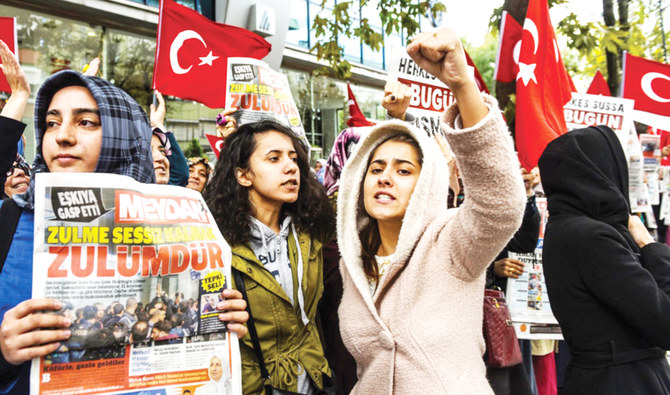

JEDDAH: Seven people from a Turkish newspaper including six journalists have been convicted of terror-related charges. An Istanbul court convicted the group from Sözcü newspaper on Friday, handing down prison terms of two years or more.
The charges relate to a failed coup attempt in 2016 to oust the Turkish government and remove President Recep Tayyip Erdogan.
Ankara blamed the coup attempt on Fethullah Gülen, a Turkish preacher who has lived in self-imposed exile in the US since 1999.
The seven individuals were convicted of helping the coup perpetrators through their reporting.
Columnists Emin Colasan and Necati Dogru were handed down sentences of three years and six months. The paper’s chief editor Metin Yilmaz and its online edition’s managing editor, Mustafa Cetin, were given three years. Online news editor Yucel Ari, financial manager Yonca Yucelan and journalist Gokmen Ulu were sentenced to two years each.
They will appeal the verdict and have denied the charges against them. Sözcü denounced the verdict as a “black stain.”
Turkey is ranked the second highest jailer of journalists in the world according to data from the Committee to Protect Journalists (CPJ).
Currently 108 journalists are incarcerated in Turkey, where the media industry is either controlled directly by the government or by conglomerates which are dependent on government contracts and therefore back the state’s position.
“Turkey’s daily Sözcü is and always has been openly critical of the group which the journalists were found guilty of helping,” Ozgur Ogret, the CPJ’s Turkey representative, told Arab News. “This trial has always been an absurd one from the very beginning by that fact alone.”
HIGHLIGHT
The seven individuals were convicted of helping the coup perpetrators through their reporting.
Dozens of media outlets were shut down following the coup attempt and, as many newspapers depend on advertising revenue that the Press Advertising Agency allocates from state resources, there emerged another trigger for self-censorship and restrictions on the space for independent journalism.
Sözcü is a staunch opposition of the domestic and foreign policies of Erdogan’s ruling Justice and Development Party’s (AKP), enraging pro-government circles through critical headlines especially those regarding the president.
Colasan recently criticized Erdogan over his decision to send troops to Libya’s Government of National Accord, asking how could the president speak so irresponsibly, while Dogru has written about government corruption.
The newspaper also disclosed where Erdogan was on the day of the coup attempt, infuriating pro-Ankara figures who said the president had been made into a target.
“Turkish authorities have tried and imprisoned many journalists since the failed coup attempt of 2016 with highly questionable evidence of links to Gülen and his network, like in the Cumhuriyet trial,” said Ogret. “The guilty verdict of the Sözcü trial is the latest example of this misguided approach.”
Kemal Kilicdaroglu, who leads the main opposition CHP, also condemned the verdict. “It is a decision made upon the instruction of the political authority,” he told Arab News. “They cannot tolerate that Sözcü enlightens Turkey and says the truth.”


