Thousands of Saudi volunteers pull together to fight coronavirus

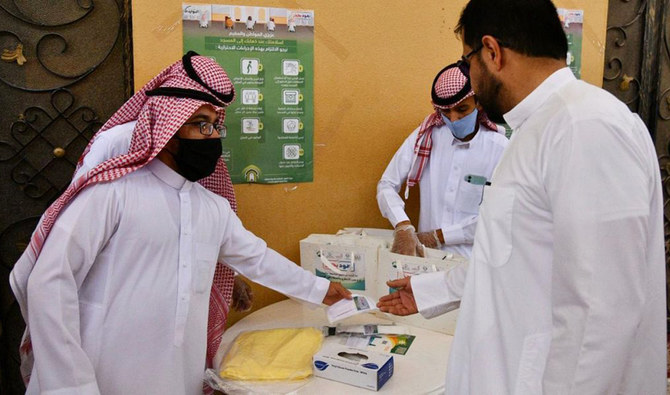
Saudi health care volunteers are assisting in different areas. (SPA)
Short Url
Updated 07 June 2020
Follow

Thousands of Saudi volunteers pull together to fight coronavirus

  • Volunteers are from varying backgrounds; 32 percent of volunteers are female while 68 percent are male

RIYADH: Saudi volunteers are part of the worldwide army of health care workers on the front line in the battle against the coronavirus.
In April, the Saudi Health Ministry called for volunteers to support the community response against COVID-19 via its platform https://volunteer.srca.org.sa/#!/home.
More than 400 areas of volunteering are covered on the website. There are more than 160,000 registered volunteers, 72,000 of whom are active and have signed up across the Kingdom.
Volunteers are from varying backgrounds; 32 percent of volunteers are female while 68 percent are male. As the Kingdom is in its second phase of slowly returning to normal life, there is still a long way to go as cases continue to be recorded, and health care workers — now more than ever — are needed.
Health care volunteers are assisting in different areas. Some are helping to monitor patients in quarantine, conducting COVID-19 polymerase chain reaction tests and delivering medicine to patients’ homes; some are working in emergency rooms, others are sent out to provide psychological support while others travel to shopping centers and malls to help raise awareness about the precautionary measures.
Duaa Al-Bukhari, 27, a lab technician working at the Kudai field hospital in Makkah, is grappling with the pandemic while her family is in Jeddah less than 100 miles away.
Through her work, she has participated in the mass testing of 2,500 individuals in one of Makkah’s most crowded neighborhoods. She described the experience as challenging but rewarding.

HIGHLIGHTS

• There are more than 160,000 registered volunteers, 72,000 of whom are active and have signed up across the Kingdom.

• Volunteers are from varying backgrounds; 32 percent of volunteers are female while 68 percent are male.

“When I heard about this volunteering opportunity, I was really excited to be a part of it. At the beginning I was scared to volunteer in Al-Nakasah neighborhood, but I knew I had the right potential to face this challenge,” she said.
The Kudai field hospital was set up by the Ministry of Health in coordination with the Armed Forces and in cooperation with the health authorities of the Makkah governorate to cope with the growing number of infected patients in Saudi Arabia.
In Alkhobar, 21-year-old Nebras Al-Hajji, a student training to become an anesthesia technologist, is working as a volunteer at the Al-Arabiya health center hundreds of miles away from the Al-Ahsa home where she usually lives with her family.
Leaving home was difficult, especially during a time of uncertainty. Al-Hajji’s initial reaction was of fear, a natural reaction under the circumstances, but as a passionate medical student she understood that it was her duty to provide assistance where she could, however difficult the situation. “I will not let my fear overcome me; fear is a part of us being human but I will not let it ruin my excitement to be a part of this initiative,” she said.
In Sakaka, 26-year-old Rayan Al-Mutairi, an optometrist, left his home town of Qassim to help health workers screen for COVID-19 cases and increase the public’s awareness about the virus. He has spent the past three months on the frontline along with many other health care workers.


Jeddah students get closer look at electric motorsport

Updated 24 January 2026
Follow

Jeddah students get closer look at electric motorsport

  • A PIF-linked initiative highlights technical and engineering careers behind electric racing events

JEDDAH: Students from local and international schools in Jeddah were introduced to STEM-related career pathways in electric motorsport this week, as part of an education program linked to the UIM E1 World Championship held on the Red Sea.

The sessions formed part of Driving Force Presented by the Public Investment Fund, an initiative run by Formula E and its electric racing series partners, to familiarize students aged eight to 18 with science, technology, engineering and mathematics through electric racing and sustainability-focused industries.

The sessions for students formed part of Driving Force Presented by the Public Investment Fund, an initiative run by Formula E and its electric racing series partners. (Supplied)

The programme took place alongside the 2026 E1 Jeddah GP and included workshops, school visits and trackside access designed to show how engineering, data, broadcast technology and event operations function within professional motorsport.

According to organisers, the initiative reached more than 60,000 students globally in 2025, with further expansion planned this year. 

HIGHLIGHTS

• The program took place alongside the 2026 E1 Jeddah GP and included workshops, school visits and trackside access.

• Students learned about E1 races and their technical and environmental dimensions and discussed the engineering and marine aspects of electric boats.

• According to organisers, the initiative reached more than 60,000 students globally in 2025, with further expansion planned this year. 

John Williams, managing director at E1, told Arab News: “The PIF is absolutely vital to everything we do here at the E1. They were crucial initial investment partner since the start of the championship and they continue to support us in a number of ways and more specifically around the Driving Force program.”

The sessions for students formed part of Driving Force Presented by the Public Investment Fund, an initiative run by Formula E and its electric racing series partners. (Supplied)

Elaborating more on the program, he said: “What we are doing is presenting and showing these students the available careers of science, technology, engineering and mathematics, as well as careers in sports, not only pilots but also engineers and mechanics.”

Williams added that the main key to the program was bringing a new generation to the mechanism of sport.

“We are introducing to these exciting new technologies around the race but it could be our technology on the boat or our broadcast products, as well as how to manage the event its self. There are a range of opportunities to show it to the children in addition to enjoying the excitement of the race and meeting the pilots.”

The program’s Jeddah activities began at King Abdulaziz University’s faculty of maritime studies, where students took part in a hands-on workshop focused on STEM careers in the motorsport and sustainability areas conducted by technology experts and famous water pilots such as Dani Clos, Emma Kimilainen and Patricia Pita.

Students learned about E1 races and their technical and environmental dimensions and discussed the engineering and marine aspects of electric boats.

They also enjoyed exclusive behind-the-scenes access at the E1 Jeddah GP, pilot meet-and-greets, and front-row seats to watch the RaceBird boats in action.