DUBAI: The protests across the US over the death of George Floyd while in police custody have prompted its northern neighbor with a nicer image to acknowledge discrimination within its own borders. Only time will tell, though, whether Canada’s next step will be honest self-searching and concrete action to defend its reputation — especially among Arabs and Muslims — as a fair and tolerant society.
So far, what Canada has mainly shown is that a history of moral posturing greatly diminishes a politician’s ability to provide credible leadership on the problem of anti-black racism. Otherwise, Prime Minister Justin Trudeau would not have reacted the way he did during a news conference in Ottawa when asked to comment on US President Donald Trump’s call to use military action as violence and looting eclipsed protests over Floyd’s death.
The former drama teacher paused for 21 seconds, opening his mouth a few times to speak. The pregnant pause caused many to wonder whether Trudeau was making a deliberate point with his silence, fearful of taking on Trump, or he was literally at a loss for words, perhaps recalling his own blackface scandals.
On Friday, Trudeau made a dramatic appearance at a protest in Ottawa (pictured above), where he joined the crowd in kneeling for eight minutes and 46 seconds — which is how long a Minneapolis police officer held down Floyd with his knee on his neck before he died — clapped to chants of “Black lives matter” and collected a T-shirt emblazoned with the same slogan on the front.
Such gestures are perhaps only to be expected of a white politician whose carefully crafted image as a champion of inclusivity and diversity was tarnished last year by the appearance of multiple images of him in black makeup, laughing, making faces and sticking his tongue out.
The tradition of brownface and blackface — white people painting their faces darker — was common in North America until it came to be viewed by the turn of the 21st century as a racist caricature. However, systemic inequalities that plague Canada’s black and indigenous communities have proved far more resistant to change.
Last weekend in Toronto, protesters held a rally over the death of Regis Korchinski-Paquet, a black woman who fell to her death last week while police were in her apartment, an incident that is being probed by the province’s Special Investigations Unit.
A CBC News investigation of fatal encounters with police found that black people made up 36.5 percent of the deaths involving Toronto police from 2000-2017, while accounting for only 8.3 percent of the city’s population.
Canada is also no stranger to prejudice against Arabs and Muslims. Most recently, some cities’ decision to suspend their noise bylaws during Ramadan to permit mosques to broadcast the sunset call to prayer sparked a backlash, drawing some racist rants on Twitter.
In 2017, university student Alexandre Bissonnette shot and killed six Muslims in a Quebec City mosque, in what Trudeau called “a despicable act of terror.”
That year there was a spike in hate crimes reported by police, a 10-year high of 2,073 criminal incidents, according to Statistics Canada.
While the most recent stats show a slight decrease in 2018 to 1,798 incidents, the number was still the second highest of that period.
Of those hate crimes, 44 percent were motivated by race while 36 percent were based on religion.
Then there is a less visible form of systemic discrimination, such as the issue of unemployment among Arabs, Canada’s fastest-growing immigrant population.
“A lot of people here think that Canada isn’t racist,” Faith Olanipekun, an organizer of a Canadian protest in support of Black Lives Matter, told the CBC, the national public broadcaster, this week.
“So it’s important for us to come out, voice our concerns and let people know that we are suffering in Canada just as much as people in the US are suffering.”
A report last year by the Canadian Arab Institute, a non-partisan research and policy group, showed that based on its analysis of the country’s last census in 2016, the unemployment rate among Arabs was 13.5 percent, higher than the total visible minority population at 9.2 percent.
“That’s more than double the national average, so this is based on 2016 data, very important to note, because with COVID-19 it means it’s going to get much worse,” Shireen Salti, the institute’s interim executive director, told Arab News.
“We know there are employment barriers. We’re looking into why … Is there discrimination in the labor market, on university campuses etc.? There are some preliminary results from our research that show this, and we want to dive deeper to better understand.”
IN NUMBERS
ARAB CANADIANS
- 947,820 people in Canada reported having Arab ethnic origin.
- 90% reside in Quebec, Ontario, Alberta provinces.
- Highest numbers: Lebanese, Moroccan, Egyptian.
- Over 60% are first generation.
- Over 60% have post-secondary education.
Source: Canadian Arab Institute, based on country’s last census in 2016.
Despite being a highly educated community, she said figures show Arabs’ average annual income is about $33,000, below the national average of $47,000.
“There’s a lot of work that we still need to do to ensure the integration of Arabs in Canada,” said Salti, who was born in Palestine and moved to Canada with her family in 2009.
“There’s a lot of government support in place for newcomers and immigrants, but we need to move beyond that and better understand how to cater to various communities with various inequities.”
While standing in solidarity with black Americans, Salti said the US situation has opened up a window for Canadians to talk about all forms of discrimination.
“It’s important to take a moment to pause and listen to the important messages that are being shared right now,” she added.
“We need to be anti-racist in a society where we have multiple communities, and diverse communities, and multiculturalism is literally at the heart of what we do here in Canada.”
Pierre Trudeau, Justin’s father, who was Canada’s prime minister for more than 15 years, had the vision to make the country the first in the world to adopt an official policy of multiculturalism in 1971, later enshrined in law.
This allowed its citizens to preserve their own cultural heritage while being protected from discrimination.
Justin has had a harder time convincing people that he walks his talk as Canada’s woke leader. He got points for introducing the first gender-balanced Cabinet in the country’s history in 2015, which was also ethnically diverse.
He offered apologies to Canada’s aboriginals for their abuse dating back more than a century, and he welcomed Syrian refugees at the airport with open arms.
Then, while running for re-election last year, two “blackface” photos and a video raised troubling questions about the character of a politician who rose to high office on a platform of social justice, gender equality and indigenous and minority rights.
At the June 2 news conference in Ottawa, Trudeau said he had "spoken many times about how deeply I regret my actions hurt many, many people," before going on to state: “There’s systemic discrimination in Canada, which means our systems treat Canadians of color, Canadians who are racialized, differently than they do others.”
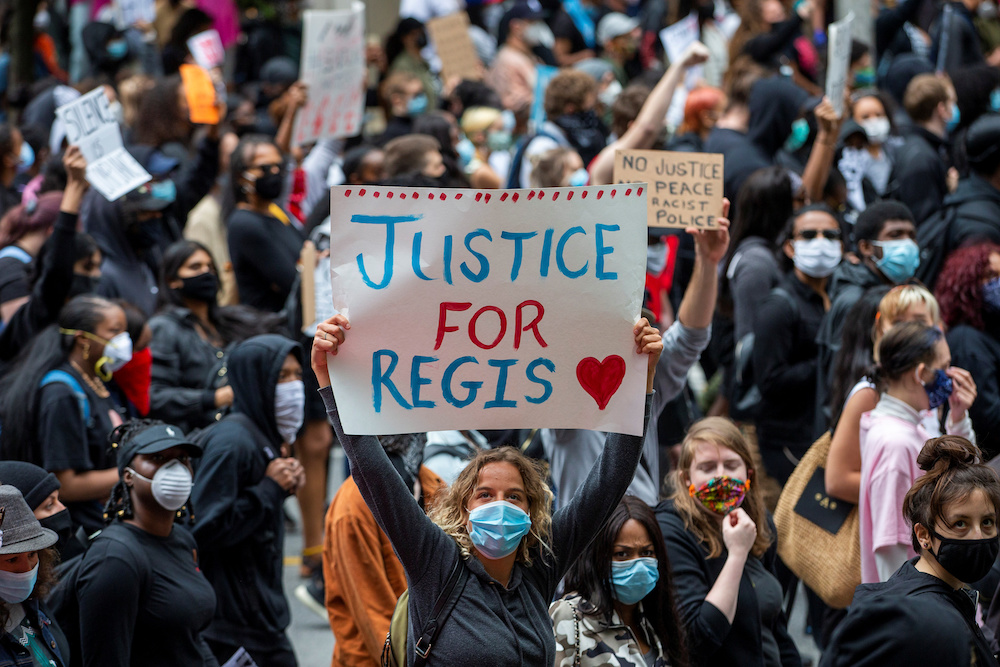
Protesters march to highlight the deaths in the U.S. of Ahmaud Arbery, Breonna Taylor and George Floyd, and of Toronto's Regis Korchinski-Paquet, who died after falling from an apartment building while police officers were present, in Toronto, Ontario, Canada May 30, 2020. (Reuters)
Not everyone was impressed. Jagmeet Singh, the outspoken leader of Canada’s NDP Party, said Trudeau’s government could immediately take actions that “go beyond the pretty words of a prime minister who says that he cares.”
Trudeau’s own cabinet minister, Ahmed Hussen, a Somali Canadian, was more specific: He lamented that black Canadians were disproportionately followed in stores by shop owners fearing theft, while black drivers had every reason to be anxious when they are pulled over by a police officer.
Racism is “a lived reality for black Canadians,” Hussen said, as he urged other Canadians to “step up” and “raise your voices and ensure that real inclusion accompanies the diversity of our country.”
The mood in Canada’s black, indigenous and immigrant communities was perhaps summed up best by Salti, of the Canadian Arab Institute, thus: “Now more than ever, we hope that all our political leaders and elected officials will do more than simply pay lip service, and instead act and invest in strategies that promote an inclusive, integrated and fully respectful society for all Canadians.”