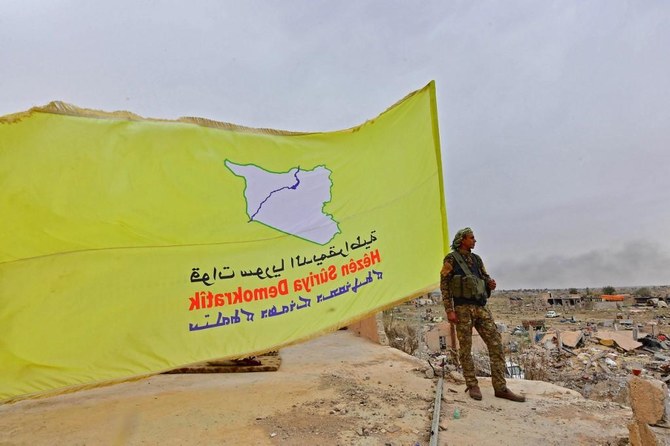
BEIRUT: US-backed Kurdish fighters in Syria announced Friday a fresh campaign to hunt down remnants of the Daesh group near the Iraqi border following a recent uptick in attacks.
The Syrian Democratic Forces, a Kurdish-led paramilitary alliance that has spearheaded the ground fight against Daesh in Syria since 2015, said that the new campaign is being carried out in coordination with the Iraqi army and the US-led coalition.
“This campaign will target ISIS’s hideouts and hotbeds,” it said, using a different acronym for the militant group.
It said operations will focus on the vast east Syria desert near the border with Iraq where Daesh has conducted a spate of attacks in recent months.
Since the loss of its last territory in Syria in March 2019, Daesh attacks have been restricted to the vast desert that stretches from the heavily populated Orontes valley in the west all the way to Iraqi border.
It regularly targets SDF forces and has vowed to seek revenge for the defeat of its so-called “caliphate”.
The SDF, with backing from its coalition allies, launched a campaign to hunt down sleeper cells after it forced Daesh militants out of their last Syrian redoubt in the desert hamlet of Baghouz in March 2019.
A raid in October by US special forces killed Abu Bakr al-Baghdadi, the leader of the militant group which once controlled large swathes of territory in both Iraq and Syria.
Last month, the United Nations accused the Daesh group and others in Syria of exploiting the COVID-19 pandemic to step up violence on civilians, describing the situation as a “ticking time-bomb”.
Across the border in Iraq, Daesh has exploited a coronavirus lockdown, coalition troop withdrawals and simmering political disputes to ramp up attacks.
Iraq declared Daesh defeated in late 2017 but sleeper cells have survived in remote northern and western areas, where security gaps mean the group wages occasional attacks.
They have spiked since early April as militants plant explosives, shoot up police patrols and launch mortar and rocket fire at villages.


![]()

Syria Kurdish-led force launches new anti-Daesh campaign
Short Url
https://arab.news/rjrz4
Syria Kurdish-led force launches new anti-Daesh campaign
- Operations will focus on the vast east Syria desert near the border with Iraq


Latest updates




© 2026 SAUDI RESEARCH & PUBLISHING COMPANY, All Rights Reserved And subject to Terms of Use Agreement.