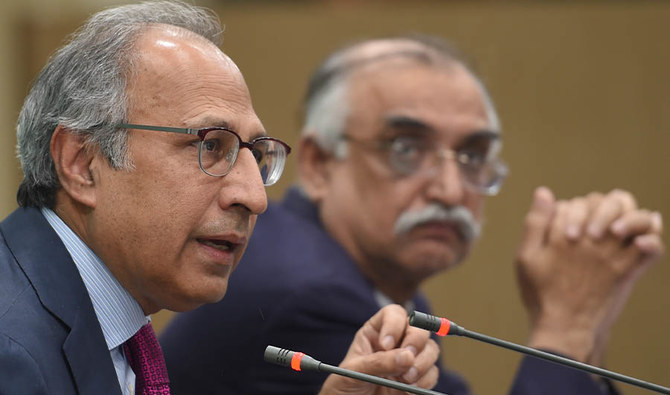
KARACHI: Pakistan is in talks with Saudi Arabia, the United Arab Emirates and China to extend the tenure of their $7.7 billion short term deposits, a move that will ensure long term forex stability of the South Asian nation, Dr. Abdul Hafeez Shaikh, the prime minister’s adviser on finance and revenue, told Arab News in an exclusive interview.
“Last year, when Pakistan was going through the worst balance of payment (BoP) crisis in our history, we were provided financial support by our brotherly countries,” Shaikh said on Monday.
Pakistan’s friendly countries were approached by the government of Prime Minister Imran Khan soon after assuming the office in 2018 as the country’s current account deficit reached $20 billion.
Responding to Pakistan’s call, Saudi Arabia deposited $3 billion while the UAE and China deposited $2 billion and $2.2 billion, respectively. Qatar also contributed by depositing $0.5 billion with Pakistan’s central bank.
“The $7.7 billion secured from the bilateral arrangements provided the much needed balance of payment support to Pakistan,” he added.
“These are short term deposits placed with the central bank in Pakistan at concessional rates,” the PM’s adviser said, adding: “We are in talks with our development partners to move these deposits toward longer tenors.”
Economists say these deposits provided a lifeline to the country’s economy that had higher imports and lower exports.
“The balance of payment support oxygenated the country’s economy that was much need for its survival. The support helped Pakistan not to default on its foreign payment obligations,” Muzzamil Aslam, senior economist, who is familiar with the developments, told Arab News.
Pakistan’s current account deficit (CAD) was $20 billion in 2018 which declined to $13.43 billion during the last fiscal year. Its further decline is also projected for the current fiscal year (2019-20).
“CAD is projected to decline to $4b [or 1.7 percent of the GDP] in the current fiscal year, compared to $20b when the government took office in 2018,” Shaikh said.
The major balance of payment support came from Saudi Arabia which provided $6 billion in financial assistance to Pakistan, with $3 billion in foreign currency support and $3 billion worth of oil on deferred payments. The agreement was signed during the visit of Prime Minister Imran Khan to the Kingdom in October 2018.
Economists say when Pakistan approached the International Monetary Fund (IMF) for the bailout program, the United States had expressed concerns that the money could be used to pay off debts, especially those taken from China.
“After we started getting the IMF assistance, the fund imposed a condition during the first review of the program to roll over these loans instead of paying them back. This was because the US had misgivings that Pakistan will pay the Chinese debt with the IMF money,” Aslam said.
However, the IMF acknowledged in April that “Bilateral creditors have maintained their exposure in line with debt sustainability objectives of the EFF [Extended Fund Facility].”
China maintained their exposure by renewing $2 billion bilateral deposits in March. Saudi Arabia also refinanced $3 billion BoP support loans that matured in November-January, while the UAE rolled over $1 billion BoP support loans in March. The oil facility with Saudi Arabia – worth $3.2 billion – was activated in August 2019 and has also been providing support to the balance of payments, according to the IMF documents.
Instead of frequent rollovers now, the government wants to convert these short term deposits into long tenors. “The IMF is behind this strategy,” Aslam informed. “The conversion will impact the status of these deposits in a way that loan rates will be decided in line with the international benchmark which may be LIBOR+2-3 percent.”
Economists say the conversion of these deposits will positively impact the economy of the country since Pakistan will get some breathing space and an opportunity to improve its overall financial condition. “It will provide long term forex stability. Otherwise, we will be under pressure to pay back $7.7 billion,” Aslam said.


![]()

Pakistan seeks Arab creditors, China to convert $7.7 bn into long term loans — Hafeez Shaikh
Short Url
https://arab.news/ze345
Pakistan seeks Arab creditors, China to convert $7.7 bn into long term loans — Hafeez Shaikh
- Pakistan received $3 billion BoP support from Saudi Arabia, $2 billion from the UAE and $2.2 from China
- Conversion of short term deposit will provide long term financial stability to the country, say experts
Latest updates


Recommended


© 2026 SAUDI RESEARCH & PUBLISHING COMPANY, All Rights Reserved And subject to Terms of Use Agreement.