

Prepare for the worst, Iranians are warned as virus kills 81 in one day

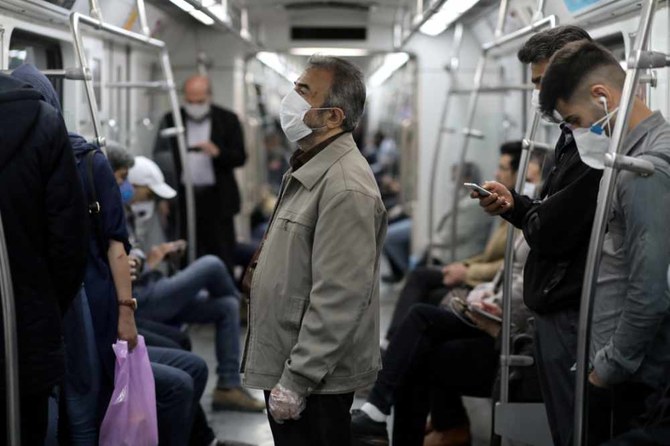
Iranians wear protective face masks as they travel on the metro in Tehran on May 20, 2020. (West Asia News Agency/Ali Khara via REUTERS)
Short Url
Updated 02 June 2020
Follow

Prepare for the worst, Iranians are warned as virus kills 81 in one day

  • New fatalities raise the death toll in Iran to 7,878
  • The Islamic republic has a total of 154,445 infections

JEDDAH: Iranians were warned on Monday to expect a second and more lethal wave of the coronavirus after the regime reported nearly 3,000 new cases and 81 deaths in a single day.

“The outbreak is not over yet and at any moment it may come back stronger than before,” Health Minister Saeed Namaki said.

“If our people fail to respect the health protocols ... we must prepare ourselves for the worst situation.”

Iran reported a total of 154,445 infections on Monday, an increase of 2,979 from the previous day. The 81 new deaths took the total to 7,878.

Analysts both inside and outside the country have voiced skepticism about the official figures, and say the real toll is much higher.

Iran was slow to react to the original outbreak, and is now one of the worst-hit countries in the region. Clerics encouraged pilgrims to visit shrines in Qom and Mashad even when it was clear that they were hotbeds of the coronavirus, as a result of which it spread to Lebanon and Iraq.

Authorities began easing restrictions on movement in April after a drop in deaths, but there was a surge in infections in May and authorities had to reimpose restrictions in the southern provinces of Khuzestan and Baluchistan.

Nevertheless, government employees went back to work and mosques resumed daily prayers on Saturday as part of the relaxation of the lockdown.

Health officials have repeatedly raised the alarm for Khuzestan province on Iran’s southwestern border with Iraq. It remains “red,” the highest level on Iran’s color-coded risk scale, and is the only province where the regime has reimposed a lockdown.

“We pleaded with the people to not hold weddings or funerals but they did not listen,” Namaki said. “If this continues, deaths can reach three digits again.

In Saudi Arabia, health chiefs reported 22 deaths related to the coronavirus disease (COVID-19), raising the total to 525.

The Health Ministry said there were 1,881 new cases of the disease on Monday, bringing the total to 87,142, of which 22,311 are active cases. The ministry said 1,864 patients had recently recovered from COVID-19, taking the total number of recoveries in the Kingdom to 64,306. Saudi Arabia has so far conducted 838,623 tests for the virus.

Worldwide, the virus has infected more than 6.3 million people and killed nearly 375,000.


Tunisian police arrest member of parliament who mocked president

Updated 05 February 2026
Follow

Tunisian police arrest member of parliament who mocked president

  • Ahmed Saidani mocked the president in a Facebook post, describing him as the “supreme commander of sewage and rainwater drainage”

TUNIS: Tunisian police arrested lawmaker Ahmed Saidani on Wednesday, two of his colleagues ​said, in what appeared to be part of an escalating crackdown on critics of President Kais Saied.
Saidani has recently become known for his fierce criticism of Saied. On Tuesday, he mocked the president in a Facebook post, describing him as the “supreme commander of sewage and rainwater drainage,” blasting what he said ‌was the absence ‌of any achievements by Saied.
Saidani ‌was ⁠elected ​as ‌a lawmaker at the end of 2022 in a parliamentary election with very low voter turnout, following Saied’s dissolution of the previous parliament and dismissal of the government in 2021.
Saied has since ruled by decree, moves the opposition has described as a coup.
Most opposition leaders, ⁠some journalists and critics of Saied, have been imprisoned since he ‌seized control of most powers in 2021.
Activists ‍and human rights groups ‍say Saied has cemented his one-man rule and ‍turned Tunisia into an “open-air prison” in an effort to suppress his opponents. Saied denies being a dictator, saying he is enforcing the law and seeking to “cleanse” the country.
Once a supporter ​of Saied’s policies against political opponents, Saidani has become a vocal critic in recent months, accusing ⁠the president of seeking to monopolize all decision-making while avoiding responsibility, leaving others to bear the blame for problems.
Last week, Saidani also mocked the president for “taking up the hobby of taking photos with the poor and destitute,” sarcastically adding that Saied not only has solutions for Tunisia but claims to have global approaches capable of saving humanity.
Under Tunisian law, lawmakers enjoy parliamentary immunity and cannot be arrested for carrying out their ‌duties, although detention is allowed if they are caught committing a crime.