

Turkey’s Kurds demand spending probe, end to military ops in Libya, Syria

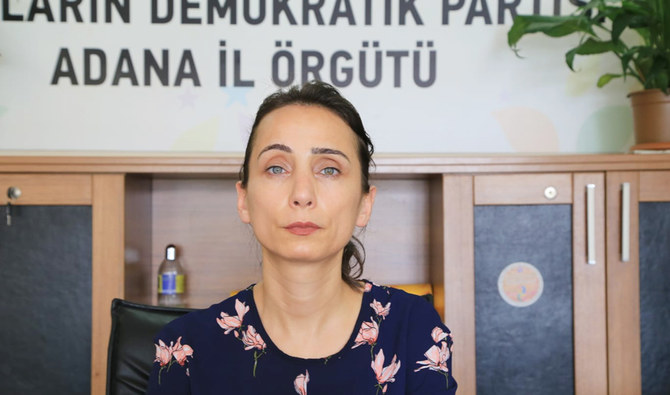
Tulay Hatimogullari. (Photo/Twitter)
Short Url
Updated 02 June 2020
Follow

Turkey’s Kurds demand spending probe, end to military ops in Libya, Syria

  • Hatimogullari criticized the Turkish government for not focusing on the country’s rising debts and jobless rates which had been compounded by the COVID-19 outbreak

JEDDAH: Turkey’s pro-Kurdish Peoples’ Democratic Party (HDP) has called for an “immediate” end to the country’s military spending and armed presence in Libya and Syria.
Party officials on Monday demanded a probe into the full cost of Turkey’s involvement in the Libyan conflict and are urging the government to concentrate its focus on dealing with mounting national debt and unemployment crises at home amid the coronavirus disease (COVID-19) pandemic.
Tulay Hatimogullari, the HDP’s lawmaker from the southern province of Adana, submitted a parliamentary inquiry to Turkey’s Minister of Foreign Affairs Mevlut Cavusoglu questioning the financial impact of Turkey’s military campaign in Libya on the national budget.
She said: “The ongoing war in Libya negatively affects people in Turkey as well. All Turkish citizens have to bear the cost of war policy that is pursued in Libya.
“Instead of spending this money for developing policies related to health, education, child, disabled, women and refugee rights, such expenses for conducting overseas war are actually the result of a conscious choice.”
Hatimogullari criticized the Turkish government for not focusing on the country’s rising debts and jobless rates which had been compounded by the COVID-19 outbreak.
“The presence of the Turkish army in Libya and Syria should be stopped immediately and the government should halt all overseas military expenditures to reallocate them to the immediate needs of its own citizens,” she added.

The lawmaker asked for the total amount of Turkey’s military expenditure in Libya to be revealed including money allocated to the Government of National Accord and local groups collaborating with it.

The HDP has also inquired about the costs of air defense systems, weapons, and ammunition transported to Libya from Turkey, along with the budgetary resources allocated to Syrian mercenaries.

Hatimogullari asked which budget the Turkish government was using “to pay the salaries of about 10,000 Syrian mercenaries who are deployed to Libya?”

Turkey has been accused of sending military supplies and sponsoring Syrian fighters in the war-torn north African country. The mercenaries are reportedly being paid $2,000 a month in cash, although the Turkish government has not made any official statement on the figures.

President Recep Tayyip Erdogan admitted for the first time in February that his government had sent Syrian mercenaries to Libya. “Turkey is there with a training force. There are also people from the Syrian National Army,” he told media in Istanbul.

Turkey-backed factions in Libya have also been accused of recruiting Syrian child soldiers into their ranks.


Israeli attacks on Lebanon kill four, including security officer and child

Updated 7 sec ago
Follow

Israeli attacks on Lebanon kill four, including security officer and child

  • Lebanon’s health ministry says Israeli strike on village of Yanuh in the south killed three people
  • Israeli gunfire also killed one person in the border village of Aita Al-Shaab
BEIRUT: Israeli attacks on Lebanon killed four people on Monday including a Lebanese security forces member and his child, hours after the Israeli army seized a member of Islamist group Jamaa Islamiya.
Israel frequently strikes Lebanon despite a November 2024 ceasefire aimed at ending more than a year of hostilities with militant group Hezbollah.
On Monday, Lebanon’s health ministry said an Israeli strike on the village of Yanuh in the south killed three people.
The Israeli military said the strike targeted Ahmad Ali Salameh, who it alleged was Hezbollah’s head of artillery and had been working to restore the group’s capabilities.
In addition to Salameh, the strike killed a member of Lebanon’s security forces and his three-year-old child, who were passing by, according to Lebanon’s state-run National News Agency (NNA).
The Israeli military said the incident was “under review” after it was made “aware of the claim that uninvolved civilians were killed.”
Later on Monday, the health ministry reported that Israeli gunfire killed one person in the border village of Aita Al-Shaab, with the Israeli military saying it killed a Hezbollah member.
It alleged he was “gathering intelligence on (Israeli) troops and operated to rehabilitate Hezbollah’s terrorist infrastructure in southern Lebanon.”
In addition to recurring attacks, the Israeli army still has troops deployed on five border positions in Lebanon it deems strategic.
Monday’s incidents come hours after the Jamaa Islamiya group, an ally of Palestinian militants Hamas, accused Israel of seizing one of its officials, Atwi Atwi, from his home in the Hasbaya district, south Lebanon, and taking him to an unknown location.
The group, which has claimed responsibility for multiple attacks against Israel during the war with Hezbollah, condemned “the Israeli occupation forces’ infiltration.”
The Israeli military said that it “apprehended a senior terrorist” in the group who was then “transferred for further questioning in Israeli territory.”
Atwi’s capture came hours after Lebanese Prime Minister Nawaf Salam completed a two-day visit to the south, which suffered extensive damage during the conflict with Hezbollah, with thousands displaced.
Salam in a statement condemned Atwi’s “abduction,” calling it a “blatant attack on Lebanese sovereignty, a violation of the ceasefire agreement and “a breach of international law.”
Hezbollah meanwhile called on the state to “take deterrent measures and firm and clear positions, and to act immediately at all political, diplomatic and legal levels, and to work seriously to protect citizens.”
Lebanon accuses Israel of having abducted several other citizens since the start of the hostilities.
Hezbollah lawmaker Hussein Al-Hajj Hassan said last month that Israel was holding “20 Lebanese prisoners,” alleging 10 had been abducted “inside Lebanese territory after the ceasefire.”
Lebanon says Israel must release these detainees and withdraw from the border positions it retains, in addition to halting air strikes on Lebanon.