Lebanon earmarks June 21 to reopen airport if coronavirus decline remains stable

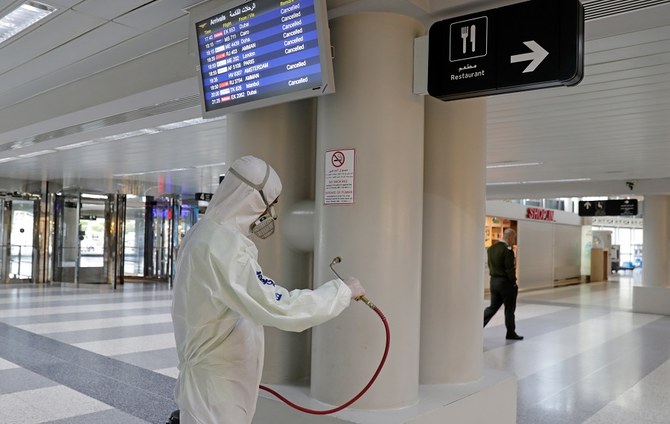
An employee of a private company sprays the interior of the Lebanese capital Beirut's Rafiq Hariri international airport with disinfectant, to limit the spread of the Covid-19 coronavirus, on March 18, 2020. (FIle/AFP)
Short Url
Updated 01 June 2020
Follow

Lebanon earmarks June 21 to reopen airport if coronavirus decline remains stable

  • The capital’s Rafik Hariri International Airport banned all commercial and private flights on March 18

DUBAI: Lebanon plans to reopen its airport to the public on June 21 amid the coronavirus pandemic, according to local media reports citing the Public Works Minister Michel Najjar.
“The airport will not open on June 8 but it is expected [to open] starting June 21,” Najjar said.
The statement was made after the Lebanese Health Minister Hamad Hasan said the reopening of the airport can happen if the country witnesses a two-week stable decline of coronavirus cases.
“As long as the world is suffering from an international pandemic, the airport needs special arrangements regarding its reopening, mainly related to the number of infections that will come through,” he said.
The capital’s Rafik Hariri International Airport banned all commercial and private flights on March 18 to help contain the coronavirus spread in the country.


Syria announces new currency framework, 2-zero redenomination

Updated 29 December 2025
Follow

Syria announces new currency framework, 2-zero redenomination

  • Under the plan, every 100 Syrian pounds will be converted into one unit of the new Syrian Arab Republic’s pound
  • Governor calls move ‘pivotal milestone within a comprehensive strategy’

DAMASCUS: Syria’s Central Bank announced executive instructions on Sunday to introduce a new Syrian currency, launching a monetary reform that includes removing two zeros from the pound and allowing a 90-day period of dual circulation.

The announcement was made during a press conference at the bank’s headquarters in Damascus.

Central Bank Gov. Abdulkader Husrieh said the step was part of a comprehensive institutional strategy to restore confidence and achieve sustainable economic stability.

He said: “The launch of the new currency is not a formal measure, but a pivotal milestone within a comprehensive strategy based on solid institutional foundations.”

Under the plan, every 100 Syrian pounds will be converted into one unit of the new Syrian Arab Republic’s pound. The old and new currencies will circulate together for 90 days, a period which may be extended.

All bank balances will be converted to the new currency at the beginning of next year, while the overall money supply will be maintained without increase or reduction.

An employee at a currency exchange shop stacks Syrian bills at a shop in Damascus. The old currency is expected to be taken out of the market in the next few months. (AFP file photo)

Husrieh said the economic strategy was based on five pillars: monetary stability, a stable and transparent foreign-exchange market, effective and accountable financial institutions, secure digital transformation, and balanced international economic relations.

He said the move required updating financial laws and regulations, improving data systems, keeping pace with global digital developments, and ensuring sustainable financing and training for the financial sector.

The currency exchange will be provided free of charge, with no commissions, fees, or taxes.

All public and private entities must apply the official conversion standard to prices, salaries, wages, and financial obligations. Official exchange-rate bulletins will be issued in both currencies to ensure transparency and prevent speculation.

The governor said the central bank was closely monitoring markets to stabilize the exchange rate and would supply Syrian pounds if demand for foreign currency rises, adding that citizens will feel the impact more clearly after the exchange process is completed.

“Our policy is financial discipline, with no room for inflation,” Husrieh added.

He confirmed that the decree regulating the exchange limits the process to Syrian territory, and said the measures fell within the bank’s 2026-2030 strategy to align with international standards.

The new banknotes, he added, were being printed by leading international companies to prevent counterfeiting.