

From Jeddah to Jerusalem, the faithful return to their mosques

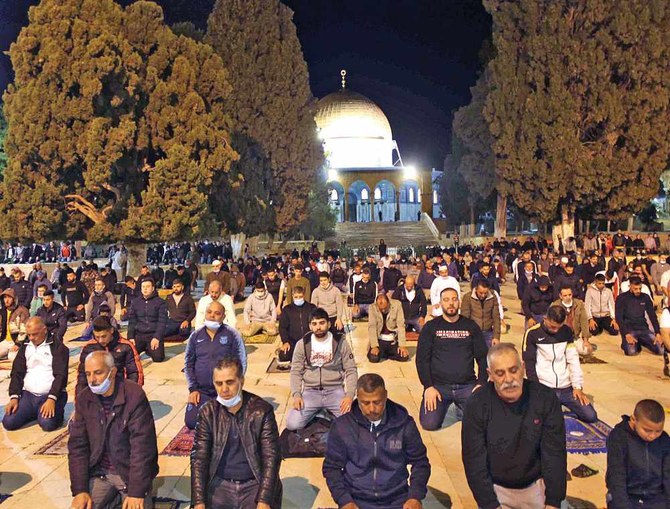
Jerusalem’s Al-Aqsa Mosque compound reopened on Sunday after a more than two-month lockdown aimed at containing the coronavirus crisis. (Supplied)
Short Url
Updated 01 June 2020
Follow

From Jeddah to Jerusalem, the faithful return to their mosques

  • Doors open again after virus lockdown
  • Internal flights resume from Saudi airports

JEDDAH/AMMAN: It began at dawn. As the first light appeared on the horizon and the call to Fajr prayer rang out, Muslims from Riyadh to Madinah and Jeddah to Jerusalem returned to their mosques on Sunday after a two-month break that for many was unbearable.

More than 90,000 mosques throughout Saudi Arabia were deep cleaned and sanitized in preparation for the end of the coronavirus lockdown. Worshippers wore face masks, kept a minimum of two meters apart, brought their own prayer mats and performed the ablution ritual at home.

“My feelings are indescribable. We are so happy. Thank God we are back in His house,” said Abdulrahman, 45, at Al-Rajhi mosque in Riyadh, where worshippers had their temperatures checked before entering.

Television screens inside the mosque displayed written instructions, including the need to maintain a safe distance from others to prevent the spread of COVID-19.

In Jerusalem, at 3:30 a.m. thousands crowded outside three gates assigned to be opened to allow Muslims to enter Al-Aqsa Mosque. Young and old, men and women, many with their phone cameras on, chanted religious songs as they waited to return for the first time since the virus lockdown began.

“Those wishing to pray were checked for their temperature and those without a mask were given one by Waqf staff. All were asked to stay a safe distance from each other when they prayed,” Mazen Sinokrot, a member of the Islamic Waqf, told Arab News.

Wasfi Kailani executive director of the Hashemite Fund for the Restoration of Al-Aqsa Mosque told Arab News that enabling Muslims to pray in large numbers and according to health requirements had gone smoothly.

“People cooperated with the local Muslim authorities and followed the regulations.” The people of Jerusalem had shown a high degree of responsibility, he said.

Israeli police spokesman Miky Rosenfeld told Arab News that extra police units had been  mobilized in the old city of Jerusalem for the reopening of Al-Aqsa. 

“People arrived in the areas scheduled according to health and security guidelines,” he said.

Khaled Abu Arafeh, a former Minister for Jerusalem in the Ismael Haniyeh government in 2006, said people were happy to be able to pray once more at Islam’s third-holiest site.

“It is time to open a new page in cooperation with local institutions and with Jordan to regain all that has been lost over the years,” he told Arab News.

“The Waqf council has done a good job in dealing with the contradictions and pressures that they are under, which is like walking on a knife’s edge as they deal with the occupiers on the one hand and the health situation on the other, while also trying to be responsive to the desires of worshippers.”

Elsewhere in Saudi Arabia, commercial flights took to the air again, office staff returned to work and restaurants resumed serving diners as life began a gradual return to normal after the coronavirus lockdown.

Eleven of the Kingdom’s 28 airports opened on Sunday for the first time since March 21. “The progressive and gradual reopening aims at controlling the crowds inside airports because we want to achieve the highest health efficiency,” civil aviation spokesman Ibrahim bin Abdullah Alrwosa told Arab News.

No one without an e-ticket will be allowed into an airport, face masks must be worn and safe distancing observed, and children under 15 may not travel unaccompanied.


Israel’s ‘deliberate intention of preventing births among Palestinians’ meets ‘legal criteria of Genocide Convention’: Reports

Updated 10 sec ago
Follow

Israel’s ‘deliberate intention of preventing births among Palestinians’ meets ‘legal criteria of Genocide Convention’: Reports

  • Births in Gaza fell by 41% during conflict as maternal deaths, miscarriages surged
  • ‘The destruction of maternal care in Gaza reflects the deliberate infliction of conditions of life calculated to bring about the destruction of the Palestinian people, in whole or in part’

LONDON: Births in Gaza fell by 41 percent due to Israel’s war on the territory, with the conflict resulting in catastrophic numbers of maternal deaths, miscarriages and birth complications, two reports have found.

The data on pregnant women, babies and maternity care in the war-torn Palestinian enclave also revealed a surge in newborn mortality and premature births, The Guardian reported on Wednesday.

Dangerous wartime conditions and Israel’s systematic destruction of Gaza’s health systems were blamed for the alarming statistics.

The two reports were conducted by Physicians for Human Rights, in collaboration with the University of Chicago Law School’s Global Human Rights Clinic and Physicians for Human Rights — Israel.

Researchers highlighted Israel’s “deliberate intention of preventing births among Palestinians, meeting the legal criteria of the Genocide Convention.”

The reports build on earlier findings by PHR’s Israel branch. They place the testimonies of pregnant women and new mothers within the context of health data and field reports, which recorded “2,600 miscarriages, 220 pregnancy-related deaths, 1,460 premature births, over 1,700 underweight newborns, and over 2,500 infants requiring neonatal intensive care” between January and June 2025.

PHRI’s Lama Bakri, a psychologist and project manager, said: “These figures represent a shocking deterioration from pre-war ‘normalcy,’ and are the direct result of war trauma, starvation, displacement and the collapse of maternal healthcare.

“These conditions endanger both mothers and their unborn babies, newborns, and breastfed infants, and will have consequences for generations, permanently altering families.”

She added: “Beyond the numbers, what emerges in this report are the women themselves, their voices, choices and lived realities, confronting impossible dilemmas that statistics alone cannot fully capture.”

Maternal and newborn care in Gaza has been damaged by Israel’s destruction of health infrastructure, as well as fuel shortages, blocked medical supplies, mass displacement and relentless bombardment.

As a result, survival in Gaza’s overcrowded tent encampments has become the sole option for pregnant women and new mothers.

During the first six months of Israel’s war on the territory, more than 6,000 mothers were killed, at an average of two every hour, according to UN Women estimates.

It is also believed that about 150,000 pregnant women and new mothers have been forcibly displaced by the conflict.

In the first months of last year, just 17,000 births were recorded in Gaza, a 41 percent fall compared to the same period in 2022.

The researchers examined Israel’s apparent strategy to undermine Palestinian births, highlighting a targeted strike in December 2023 on the Al-Basma IVF clinic.

The attack on Gaza’s largest fertility center destroyed about 5,000 reproductive specimens and ended a pattern of 70-100 IVF procedures each month.

The strike was deliberately designed to target the reproductive potential of Palestinians, the Independent International Commission of Inquiry later found.

“Reproductive violence constitutes a violation under international law; when carried out systematically and with them intent to destroy, it falls within the definition of genocide of the Genocide Convention,” the reports said.

“The destruction of maternal care in Gaza reflects the deliberate infliction of conditions of life calculated to bring about the destruction of the Palestinian people, in whole or in part.”