



RIYADH: Modern-day Saudi Arabia is home to several archeological treasures, evidence that this part of the world was once the cradle of ancient civilizations.
Several cities that once thrived in this area lay in ruins away from people’s attention and, until a few decades ago, this part of the world was considered to be a vast and uninhabitable desert. However technology has made excavation easier in difficult terrains and changed that perception for good.
The discovery of several ancient sites has put Saudi Arabia on the list of countries that have a rich history and are home to archeological wonders.
An exhibition called “Roads of Arabia: Archaeological Treasures of Saudi Arabia Across the Ages” has been hosted by prominent museums around the world in order to introduce this heritage and legacy to international audiences.
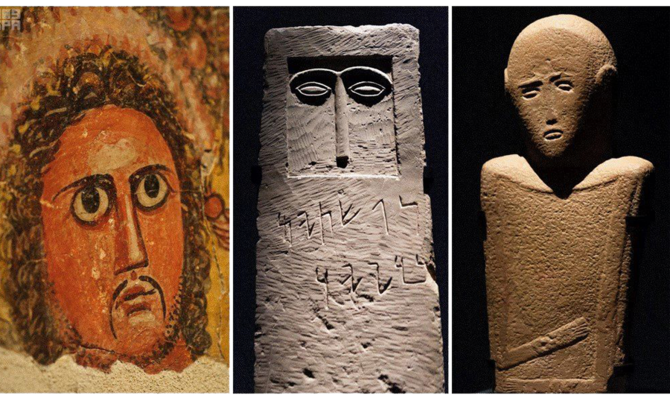
One of the artifacts includes a sandstone statue known as the “Suffering Man.” The masterpiece, dating back 6,000 years, was found near the town of Al-Kahafah, 200 km south of Hail.
It depicts a man with sad sunken eyes, a downturned mouth and his hands extending toward his heart.
“It was discovered during excavations by the archeology department in the Hail region,” said Saudi archaeologist Dr. Saad Al-Rashed. “It dates back to the 4th millennium B.C. and exhibits a mixture of tenderness and serenity. It also reflects funerary expressions.”
He said that transporting the piece was subject to approval from the highest authorities, under the guarantee of international covenants, including insurance and personal accompaniment from the country of origin.
Another famous Saudi artifact is the “Eye-Stele.” It was discovered in Tayma and dates back to the 5th century B.C. It is a memorial tombstone featuring a human face and Aramaic inscriptions citing the name of Taim bin Zaid, a prominent figure of his time.
This important piece, which is well-known among archaeologists around the globe, is the only clear evidence of the existence of cultural contact between Tayma and the northwest and southern Arabian Peninsula, where similar monuments have been found.
Another item is the “Head of a Man.” The bronze statue dates back to the 1st century B.C. and was discovered in Qaryat Al-Faw, 700 km southwest of Riyadh. It shows the face of a man with a Roman hairstyle typical of that period.
The ‘Suffering Man’ was discovered during excavations by the archeology department in Hail region. It dates back to the 4th millennium BC.
Saad Al-Rashed, Saudi archeologist
Two more bronze statues have also been discovered in Qaryat Al-Faw. The first is the statue of Byzantine Emperor Hercules, who is grabbing a club with his right hand and a lion’s skin with his left. The second is of the Egyptian Pharaoh Herbocrath, who is wearing the pharaoh’s double crown.
The masterpieces from Qaryat Al-Faw include a colorful mural of a prominent figure of Kinda Kingdom that dates back to the 1st century B.C. The mural depicts a man with thick hair and a light mustache, grapevines swirling behind him, and two servants. It features a banquet and shows the influence of the Dionysian painting style that was popular in the East during the 1st and the 2nd centuries A.D.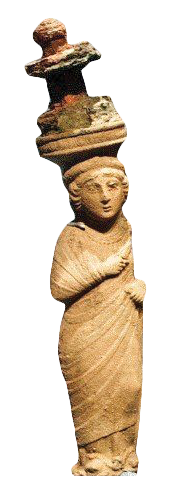
A small statue of “Thaj Girl” was found with Thaj treasures discovered in a burial chamber in Jubail in 1998. These include a gold mask, pearls, bracelets, rings, necklaces, a gold placard inlaid with red carved rubies, and other gold pieces that date back to the Hellenistic era more than 2,000 years ago.
The 46-centimeter statue of the girl dates back to the 1st century A.D. and is made of bitumen, iron and lead. During that era the Arabian Peninsula was linked to the Mediterranean’s major trade routes.
Incense convoys in southern Arabia crossed these routes, some of which passed through Thaj city. This trade may have been the source of wealth that enabled wealthy men to put luxury items into the tomb.
Historical research and archaeological excavations indicate that settlement in the Thaj region dates back to the Stone Ages, and that the region flourished between 332 B.C. and the 1st century A.D.


