

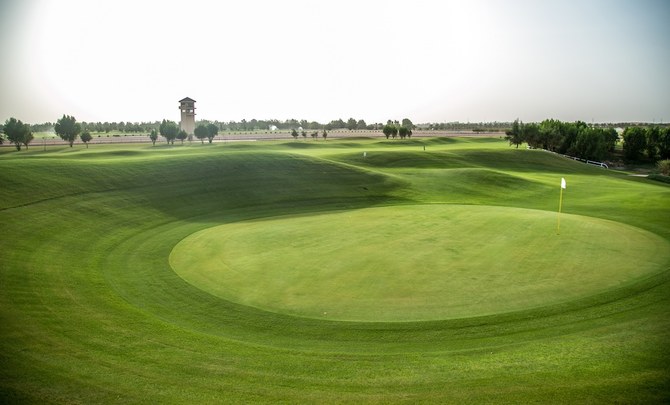
Golf courses in Saudi Arabia to reopen from May 31

Following government guidance, the Saudi Golf Federation (SGF) has confirmed that all of the country’s domestic golf courses will reopen this week, starting from Sunday May 31. (Saudi Golf)
Short Url
Updated 30 May 2020
Follow

Golf courses in Saudi Arabia to reopen from May 31

  • All golf clubs were included in the first phase of the government’s reopening plan
  • There are strict health and safety guidelines and precautionary measures that golf clubs must adhere to

RIYADH: Following government guidance, the Saudi Golf Federation (SGF) has confirmed that all of the country’s domestic golf courses will reopen this week, starting from Sunday May 31.

After more than two months of controlled movement and closures, the Saudi government this week set out a specific timetable to lift current restrictions in three phases. 

All golf clubs were included in the first phase of the government’s plans and have been given official permission to allow their members to return.


However, there are strict health and safety guidelines and precautionary measures that golf clubs must adhere to, if continued play is to be permitted. As part of these new measures, golfers must pre-book their round in advance, and wear masks upon arrival. Temperature checks will also be conducted on arrival for all members and anyone showing signs of illness will be asked to leave the course.

Commenting on the measures put in place to ensure golf’s safe return in Saudi Arabia, Majed Al-Sorour, CEO of the Saudi Golf Federation, said: “It is great news that we are now in a position to reintroduce the game we all love across the Kingdom, in line with the latest government regulations. As one of the sports which can be played safely during this period, we urge everyone to be respectful of the phased approach taken by the Saudi Golf Federation.”

Al-Sorour added: “We will continuously monitor the situation both in the Kingdom, and across the world and we have not ruled out the reintroduction of further restrictions if the guidelines are not followed correctly. It is therefore imperative that both golf clubs and members take the necessary steps and adhere to guidelines, if facilities are to remain open in the weeks ahead.”

Additional restrictions designed to prevent the spread of COVID-19 include the use of physical distancing, with members keeping at least two meters apart from each other at all times.

Golf carts will only be permitted to be used by one golfer and concierge services will also be closed, meaning players will need to carry their bags to and from their own vehicles.

To prevent overcrowding on all courses, tee times have been extended to 14-minute intervals, with a maximum of three players per slot. This gap will not be altered for one or two balls.

Restaurants and cafeterias will remain closed for seating, with takeaway orders possible via the on-course cart or telephone order. For payments, only contactless or card payments will be accepted. Shower and locker facilities will also remain closed.

Player-specific restrictions have also been put in place ahead of next week to prevent the spread of COVID-19. When playing from bunkers, golfers will be asked to make their very best efforts to smooth the sand using their club or their feet, rather than use a rake. Pick and place rules apply for bad lies. It will be forbidden for players to touch or handle the flagstick.

Putts will need to be completed with the flagstick in, with players removing their own balls from the hole. Following the play of a hole, players should not enter the next teeing area until all members of the group in front have played their tee shots and left the tee box. Only one golfer should be on the tee at any given time. 

Ahead of next week’s return to golf, courses up and down the Kingdom have been hard at work to ensure conditions are pristine for the return of members. Despite restrictions resulting in a shortage of labor, agronomy teams have continued to work hard ensuring both the greens and fairways remain in superb shape, with their efforts being recognised by Al Sorour:

“Thankfully, all of our clubs have had the experience and skills to remain calm and continue their preparations unheeded, without knowing exactly when golf would be able to safely return. We will continue to remain in regular dialogue with the government, updating golf facilities and players on changes to regulations and procedures as restrictions across the Kingdom continue to lift. Given the continuous change in restrictions, there may be a requirement for the Saudi Golf Federation to update and reissue guidelines at regular intervals to reflect government and global advice.”

For further information on how to golf safely, please visit: www.golfsaudi.com


New innings as women’s cricket set to take off in Saudi Arabia 

Updated 5 sec ago
Follow

New innings as women’s cricket set to take off in Saudi Arabia 

  • A landmark partnership has been announced between the Saudi Arabian Cricket Federation and FairBreak, under which, it is proposed that a new professional women’s cricket tournament, the Women’s World T20 Challenge, will take place in Saudi Arabia

In my column of May 4, 2022, I highlighted a new women’s cricket tournament which took place in Dubai that month. It was entitled the SDG FairBreak Invitational 2022 Tournament and was sanctioned by the International Cricket Council. Six teams consisting of 90 players from 35 countries competed across 19 matches. The tournament, organized by Cricket Hong Kong, was scheduled to be held there, but the location had to be moved because of COVID-19 restrictions. 

The players were a mixture of those from ICC full member and associate member countries. There was no auction of the players. Instead, an organizing committee invited players and then allocated them to one of six teams. This ensured that a balance between players from full and associate member countries was achieved. Over 25 countries were represented. Nine of the 11 full member national cricket boards were delighted to allow their players to take part. Only India and Afghanistan, for different reasons, did not allow their players to participate. 

A vital ingredient of the tournament was the opportunity it provided for members of Associate countries to play against and alongside some of the world’s best female cricketers. It also enabled players from full member countries to gain an understanding of the challenges faced by associate players, as well as appreciate their skill sets. A second tournament took place in Hong Kong in 2023, and the event looked to be established in the global cricket calendar. A third tournament was planned for the US, but was delayed and then postponed, partly because of a clash with the ICC Men’s T20 World Cup. 

Internal changes were also underway in FairBreak, which was founded in 2013 by former Australian women’s cricket captain Lisa Sthalekar and her manager, Shaun Martyn. They sought to champion the cause of gender equality in cricket at a time when women’s cricket was still underdeveloped. Indeed, cricket’s leading administrators did not endorse their concept of a Women’s International Cricket League. Their initiative survived through one-off events and tours, until the first invitational tournament in 2022.

In January 2024, Martyn stood down and Ramasamy Venkatesh, who had been involved since 2019, became managing director in September 2025. He is the co-founder and managing director of Gencor Pacific, a multinational healthcare company. Somehow, he finds time to stand as an ICC Development Panel umpire. He also found time to speak to me this week about the landmark partnership which has been announced between the Saudi Arabian Cricket Federation and FairBreak. Under this, it is proposed that a new professional women’s cricket tournament, the Women’s World T20 Challenge, will take place in Saudi Arabia in 2026 and for the following four years. 

The Gulf had been identified as a potential region by FairBreak. In early April this year, the opportunity arose to open discussions with representatives of the SACF. These advanced well during the ensuing months. The outcome is the promise of the Kingdom stepping onto the global stage of women’s cricket, hand in hand with an organization which has gender equality on a global scale at its core, using cricket as the vehicle. 

Various approvals, including ICC sanction, will now be sought, after which an operational phase will begin. Venkatesh told me that this tournament will take place in one stadium, in one city in Saudi Arabia. The identity of the city has yet to be revealed as are the proposed dates. Cricket’s international calendar is already crowded. In 2026, the women’s T20 World Cup will be held in England and Wales in June, after which The Hundred will take place in August. Later in the year the Australian Women’s Big Bash will be played. This leaves September/October as the most promising window of opportunity. 

At this stage, the format of the tournament is proposed to follow that of the FairBreak Invitational, with invited players allocated to the six teams, which have a balance of full member and associate country players. Maintaining this balance is dear to Venkatesh’s heart. He told me that in the inaugural tournament, associate nation players were reluctant to talk with those from full member nations. Previously, they had only seen them on television or, perhaps, as spectators at matches. They were in awe, but the ice had to be broken. It was the full member players who achieved that. Friendships have been continued and nurtured on social media to the point where the more experienced players help build the self-confidence of the associates if they at a low ebb with their performances. 

It is also proposed to retain four salary bands. Players in Band A will earn $20,000, those in Band B, $15,000, Band C, $10,000 and Band D, $5,000. At this point, FairBreak will continue to own the six teams, with an option to partner with a corporate sponsor. Venkatesh emphasized that sponsorship is a vital way in which player remuneration can be increased, so that FairBreak’s core purpose of achieving equal pay can be pursued. 

In the 2022 event in Dubai, one of the sponsors was the “Barmy Army.” What started out as a loose-knit group of supporters of the English cricket team has developed into a major sports brand which organizes tours and is involved in charity work. It is known for its noisy behavior, based on chants, songs, anthems, and its undying support for the English team irrespective of its performances. The Australian media coined the sobriquet in 1994/5 on yet another unsuccessful England tour of Australia. It will be interesting to see if the army’s sponsorship will reach into Saudi Arabia. 

It is too early to know if the Board of Control for Cricket in India will allow Indian players to take part. Their participation would be a major boost for the tournament and for the associate players. Women’s cricket in Saudi Arabia has been extremely low-key activity, focusing mainly on tape ball and soft ball. However, the national team will play in the GCC Women’s T20I Championship in Oman between Dec. 12-19, 2025. They will play against the UAE, Oman, Kuwait, Qatar, and Bahrain. Their development is now moving out of the low-key zone, with next year’s Women’s World T20 Challenge on home soil primed to provide further stimulus to their ambitions. 

Following the signing of the partnership with FairBreak, the SCAF President Prince Saud Bin Mishal Al-Saud said that “by bringing a global women’s tournament to Saudi Arabia, we are not only elevating the sport, but also opening new pathways for talent development, private sector participation and international development — fully aligned with our vision for the future of cricket and the ambitions of Vision 2030.” There can be little doubt that he is right. The Kingdom’s long-awaited entry into cricket’s global landscape has come about in a way that may have wrong-footed observers. Cleverly, it is tapping into the most changing part of that landscape, while addressing the domestic policy of women’s empowerment.