

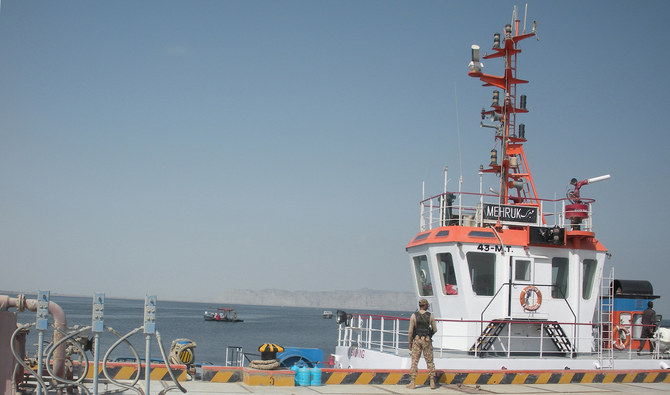

KARACHI: Pakistan’s Gwadar deep-sea port witnessed the beginning of a new era of transit trade as the first bulk cargo ship for landlocked Afghanistan docked at the facility on Thursday, said officials while talking to Arab News on Saturday.
“MV Manet is the first bulk cargo vessel that arrived at the deep-sea port on May 28, 2020, carrying a big consignment of wheat and urea fertilizer for Afghanistan under the Afghan Transit Trade [ATT],” Naseer Khan Kashani, Chairman of the Gwadar Port Authority (GPA), confirmed.
The Gwadar deep-sea port lies at the heart of the multibillion-dollar China-Pakistan Economic Corridor (CPEC), a major component of Beijing’s Belt and Road Initiative (BRI) that envisions infrastructure development and investments in nearly 70 countries around the world.
The port is situated near the international oil trading hub and shipping routes at the mouth of the Arabian Gulf, outside the Strait of Hormuz.
Islamabad decided to allow bulk cargo import of wheat, sugar and fertilizers under the ATT at the Gwadar port in April 2020. The shipments would then be carried forward to Kabul in sealable trucks.
Packaging of the 16,000 megaton urea is also supposed to be done at the deep-sea port.
“For the first time, bagging will be done locally and not on any foreign port. Urea will be bagged in Gwadar and shipped on trucks to Afghanistan, generating some good employment opportunities for locals. Instructions have already been given to allocate all labor jobs to the local population,” Abdul Razak Dawood, adviser to Prime Minister on Commerce, said in a Twitter post on Friday.
First bulk-cargo ship “MV Manet” carrying wheat n urea of Afghan Transit trade reached Gwadar this week-a dream come true for local economy as it will stimulate host of business activity... #cpec #CPECMakingProgress pic.twitter.com/Imi9T4fbt2
— Asim Saleem Bajwa (@AsimSBajwa) May 30, 2020
The Gwadar port has been operational since March 2018, and it was opened for the ATT in October 2019. The first ship carrying containers for Afghan transit trade docked at the port on January 14 this year.
“This is the third ATT consignment as the first two were containerized cargoes and this one is bulk cargo shipment,” said the GPA chief.
“Authorities have taken necessary preventive measures against COVID-19 beforehand to ensure smooth business activities at the port,” he added.
Local businessmen also hailed the development, saying their decades-old dream had turned into reality.
“Our elders waited for this moment since the 1970s. They dreamt of the day Gwadar port would be connected with the Central Asian states. Now their vision has come true,” Mir Naveed Baloch, group leader at the Gwadar Chamber of Commerce and Industry, told Arab News.
Excited about the development, Baloch hoped it would create more employment opportunities for locals. “A ship can employee at least 500 people directly or indirectly,” he continued.
“This is a welcome step,” Zubair Motiwala, chairman of the Pakistan-Afghanistan Joint Chambers of Commerce and Industry, said. “Owing to the 100 percent inspection of the cargo, however, it is delaying the delivery to the neighboring country which should not happen.”
As the expansion of Gwadar port takes place through Chinese investment, the authorities are gearing up for transshipment that is expected to spur with the start of industrial activities in free zones.
“The port is being developed at the cost of about $600 million, and a chunk of that investment is also going into the pipeline. Additional three berths will be constructed here in the coming two years,” the GPA chief, Kashani, told Arab News.
“The rules have been notified for transshipment that is likely to commence in about six months,” he said, adding: “The transshipment activity will pick up as other businesses gain pace in the free zones. Nine industries are already being set up in the Gwadar free zone.”
The Gwadar deep-sea port is CPEC’s starting point. It is also considered to be the cheapest route for imports and exports to and from China and the Central Asian countries.
The port provides a much shorter and inexpensive route to ship oil and gas from the Middle East and minerals from Africa to these destinations.


