

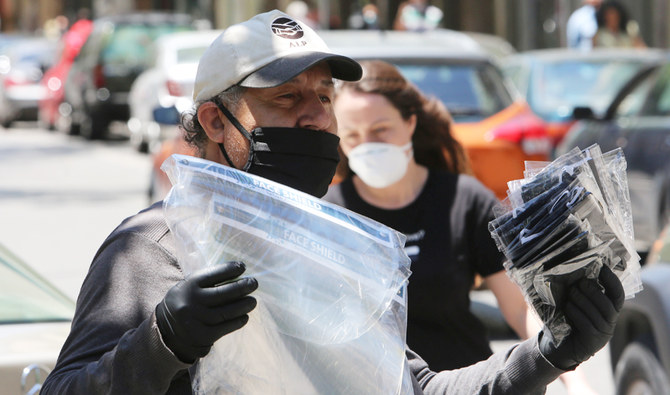

BEIRUT: Lebanese security forces on Friday began handing out fines to enforce the wearing of face masks, as the country recorded four new coronavirus cases to bring its tally to 1,172.
The fine is LBP50,000 ($33), a steep sum amid the country’s ongoing economic crisis and the financial hardships that the Lebanese have endured for months because of it.
People are wearing surgical masks or improvised face coverings to avoid the fines when out and about and security forces have organized patrols to ensure compliance with the face mask decision, especially among worshippers heading to mosques.
Lebanon’s interior minister said that, as of May 8, places of worship could reopen to the general public provided that worshippers performed ablutions in homes, brought their own prayer mats, wore face masks and gloves, and checked their temperature before entering mosques.
Health Minister Hamad Hassan said 76,000 PCR tests had been conducted to date, and the government is waiting to reopen the airport to commercial flights pending the assessment of the COVID-19 response committee.
“The decline in the number of cases in Lebanon is not due to the decline or non-development of the virus, but in Lebanon things are still under control and the health sector is still able to receive and treat the infected cases so far,” Dr. Firas Al-Abyad, director of the Hariri Governmental University Hospital, told Arab News. “The number of patients on ventilators in the Hariri Governmental University Hospital, which is allocated by the state to receive COVID-19 cases in Lebanon, can be counted on one hand.”
Al-Abyad said that the total number of cases constituted 0.2 percent of the country’s population and residents, and that this figure was due to the “rapid measures” taken by the government and the “rapid traceability” of people infected with coronavirus and contact tracing. “The decline in the number of cases depends on people’s commitment to wearing face masks and social distancing,” he added.
FASTFACT
People are wearing surgical masks or improvised face coverings to avoid the fines when out and about and security forces have organized patrols to ensure compliance with the face mask decision, especially among worshippers heading to mosques.
Dr. Al-Abyad said the committee evaluating the path of the virus and future steps to take in response, including the airport’s reopening, depended on the study of the evacuation experience that took place in three stages, the resulting infections and whether this number was acceptable.
“The problem in Lebanon is that a large number of people depend on travel to complete their work and there are many expatriates and students abroad. We have to wait for the decision of the International Air Transport Association allowing passengers to be seated next to each other in an aircraft. We have to look at it in two ways: Health and public safety, and economic and social impact. The decision is up to the council of ministers,” he said.
The UN said that the pandemic had hit the country at a time of instability, leading to an increase in domestic violence and the gender gap in employment and unpaid work.
“Since the outbreak of the pandemic women are reporting lay-offs, and income and wage reductions at higher numbers to men, which could result in a prolonged dip in women’s engagement in the paid economy,” Rachel Dore-Weeks, head of UN Women Lebanon, said. “Lebanon has been witnessing an increase in cases of domestic violence since the outbreak of the COVID-19 pandemic.”
The UN, she added, was working to provide “unconditional cash” to women and men laid off as a result of the pandemic, and basic assistance and urgent protection services. It was also working to provide advice to government partners on how social protection and economic stimulus measures could be devised to equally affect women and men.
Asma Kurdahi, head of UNFPA Lebanon, said: “With movement being restricted and many confined to their homes, women and girls find themselves at risk of gender-based violence and harmful practices on a daily basis. We must continue to work towards ensuring protection measures are in place to reach those most at risk.”


