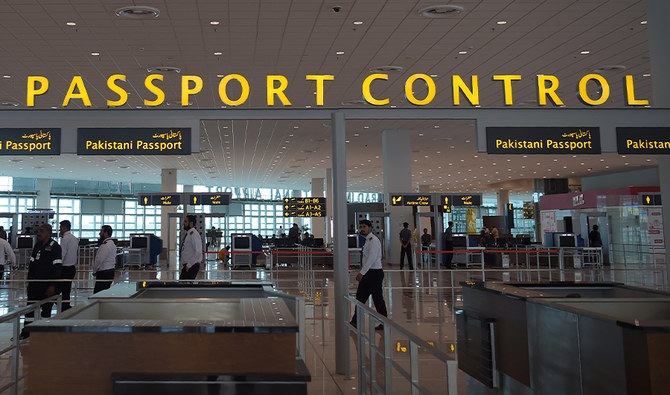
ISLAMABAD: Pakistan on Saturday resumed outbound international flight operations after having its airspace closed for commercial flights for over two months.
PIA flight, PK701, departed the Islamabad International Airport for Manchester at 9:36 am, confirmed Abdullah Hafiz Khan, an airlines spokesperson, while talking to Arab News.
The outbound commercial flight operations resumed after the Civil Aviation Authority (PCAA) issued a statement on Friday, saying: “Both national and foreign airlines shall be allowed to operate from all international airports of Pakistan with exception of Gwadar and Turbat.”
As the pandemic is not over, PCAA said airlines operating the flights will have to follow the standard operating procedures of their destination countries.
“SOPs for outbound international flights have already been issued according to which airlines will be required to follow the SOPs of the destination country. Additionally, disinfection of aircraft will be ensured and no congestion at airports shall be allowed,” the statement read.
International travel was suspended on March 21, as a measure to contain the spread of coronavirus.
Also on Friday, the PCAA said domestic flight volume would be increased, starting from June 1, to up to 45 percent of pre-pandemic operations from the current 20 percent, amid growing business and public demand for air travel.
Domestic flights resumed at five airports on May 16, when the country started to reboot economic activity and ease coronavirus restrictions on businesses.
The five airports are Jinnah International Airport in Karachi, Allama Iqbal International Airport in Lahore, Islamabad International Airport (IIAP), Quetta International Airport, and Bacha Khan International Airport in Peshawar.


Pakistan resumes outbound international flights after two months
https://arab.news/ndpps
Pakistan resumes outbound international flights after two months

- International travel was suspended on March 21, as a measure to contain the spread of coronavirus
- Airlines operating international flights will have to follow the SOPs of their destination countries

Arif Habib-led group plans to buy remaining 25 percent stakes in Pakistan International Airlines
- Consortium bought 75 percent stake in Pakistan International Airlines in December 2025 for $482 million
- Group will have to pay government $161 million by April 2027 for 25 percent stakes, says Arif Habib Ltd. CEO
ISLAMABAD: The Pakistani consortium led by Arif Habib Ltd. which bought a 75 percent stake in the Pakistan International Airlines (PIA) plans to secure full control of the airline, a senior official of the firm confirmed on Sunday.
In December 2025, the consortium headed by Arif Habib Group secured a 75 percent stake in the PIA for Rs135 billion ($482 million) after several rounds of bidding, valuing the airline at Rs180 billion ($643 million). Pakistan had previously attempted to reform the debt-ridden airline, which had accumulated more than $2.8 billion in financial losses over the years.
Arif Habib Ltd. CEO Shahid Habib told Arab News that since the PIA’s privatization documents were signed in January, the group will formally take over the airline at the end of April. He said as per the by-laws, the group will have to notify the government whether it intends to buy the remaining 25 percent stake in the airline or “leave it with the government.”
“At present, their [Arif Habib-led group’s] stated position is that they intend to acquire the 25 percent from the government,” Habib said.
He said once the group conveys its decision to buy the remaining 25 percent stakes in the airline, it will have 12 months to complete the payment.
“This means that from April to the following April [in 2027], they must pay the Government of Pakistan Rs45 billion [$161 million] more for the additional stake,” Habib said.
Habib said beyond ownership, the group intends to improve service for customers. This would include strengthening overall safety and security standards, enhancing staff performance and upgrading the airline’s ticketing system.
He said the group intends to increase the frequency of flights on commercially viable routes.
“For example, routes that currently operate only two flights every two weeks could be expanded to as many as six flights per week,” Habib said.
“This would significantly improve passenger convenience and availability.”
Habib said currently, PIA has 18 operational aircraft, adding that some of them require capital expenditure (CAPEX) for upgrades and improvements. He said six to seven aircraft could be made operational with additional CAPEX.
“The medium-term goal is to expand the fleet from 18 to 38 aircraft over the coming years,” Habib said.
“While the exact timeline has not been specified, the intention is to achieve this within a defined multi-year framework.”
Habib shared leasing brand new aircraft would require time, adding that current delivery slots that are being offered for them are for 2030, 2031 and 2032.
He said that as an interim solution, relatively newer aircraft — around eight to ten years old — can be acquired for the airline.
“If orders are placed now, Boeing or comparable models, as well as Airbus aircraft in the seven-to-ten-year range, could be secured to stabilize and expand short-term operations,” he said.
Once considered among Asia’s leading airlines, PIA struggled with chronic mismanagement, political interference, overstaffing, mounting debt and operational issues that led to a 2020 ban on flights to the European Union, UK and the US after a pilot licensing scandal.
The EU and the UK lifted the bans, providing fresh momentum to the carrier.



