

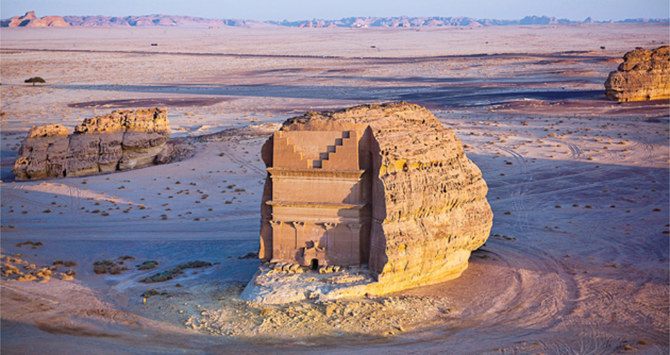

RIYADH: The Royal Commission for AlUla (RCU) recently participated in the Hospitality Tomorrow virtual conference, on a panel titled “Arts and Culture: Inspiring a future of tourism development in ancient landscapes.”
The panel included former director general of UNESCO Irina Bokova; Jean-François Charnier, scientific director at Agence Française pour le Développement d’AlUla; Neville Wakefield, creator and artistic director at Desert X; and Callum Lee, expert in cultural and creative industries from BOP Consulting.
The audience learned about RCU’s goal to contribute towards Saudi Vision 2030 by creating 38,000 jobs, contributing SR120 billion ($31.96 billion) to the Kingdom’s GDP, and hosting 2 million visitors every year while protecting and preserving AlUla’s history and cultural heritage.
Abdulrahman Alsuhaibani, Saudi archaeologist and RCU’s director of museums and exhibitions, who conducted research into AlUla’s ancient civilizations as part of his doctorate at the Sorbonne University in France, said: “For me, AlUla means the past, the present, and the future. It is an exceptional place. The human presence in AlUla began more than 200,000 years ago and continues until our time.”
He added: “This has left a diversity and richness in the archaeological remains, and also in the community today. There is a huge story that we are going to share with the world, but the most important thing is how we can preserve and protect it.”
RCU’s Arts and Culture Programming Director Nora Aldabal said: “It’s really important to us to establish AlUla as a cultural hub for creativity and artistic exchange. We’ve developed multiple arts workshops, including with Desert X: We had the artists work not only on the exhibition itself but also within the community. So, the community was really part of this experience.”
Desert X curator Wakefield echoed this, saying that their mission with Desert X was about cross-cultural dialogue. “Indeed, one of the joys of working in AlUla was making the community part of the artistic experience. We had so much involvement because everyone had a point of entry. Everyone has a sense of what the desert is and how art can reflect it. So, the art became a prism showing different aspects of the AlUla community.”
Meanwhile, the General Authority of Civil Aviation announced the resumption of domestic flights on Monday, stressing that social-distancing measures will be observed. “Sitting in the middle seat will be prohibited as a precaution to reduce the spread of the coronavirus,” Flynas airline said.


