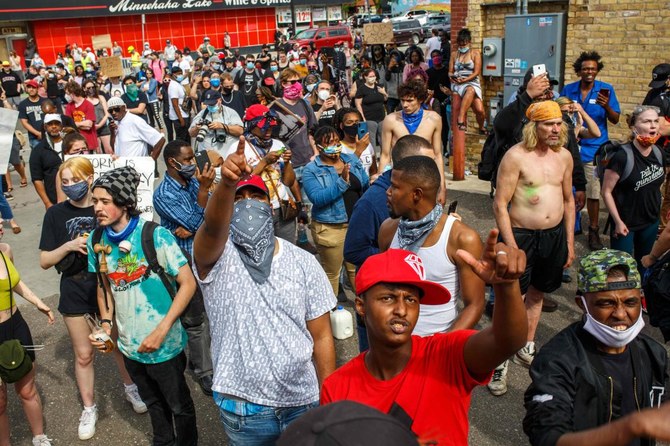
MINNEAPOLIS: Demonstrators clashed with police, looted stores and set fires as a man was fatally shot during a second night of protests in the US city of Minneapolis Wednesday over the killing of a black man by a police officer.
Police fired tear gas and formed a human barricade to keep protesters from climbing a fence surrounding the Third Precinct, where the officers accused of killing George Floyd worked before they were fired on Tuesday.
They pushed protesters back as the crowd grew, a day after firing rubber bullets and more tear gas on thousands of demonstrators angered by the latest death of an African-American at the hands of US law enforcement.
Minnesota state Governor Tim Walz urged people to leave the area around the precinct where several fires were burning, warning of the “extremely dangerous situation” in a tweet late Wednesday.
Outrage has grown across the country at Floyd’s death on Monday, fueled in part by bystander cellphone video which shows him, handcuffed and in the custody of four white police officers, on the ground while one presses his knee into the victim’s neck.
President Donald Trump in a tweet called Floyd’s death “sad and tragic,” and all four officers have been fired, as prosecutors said they had called in the FBI to help investigate the case.
Minneapolis police chief Medaria Arradondo cautioned protesters Wednesday to remain peaceful.
But by 10:00 p.m. (0300 GMT Thursday) an auto parts store across from the precinct had been set alight and a nearby Target was being looted, according to US media.
Police continued to hold the crowds back from scaling a fence into the precinct’s parking lot, where their cruisers contain guns.
As the violence escalated, with more businesses looted, a man was shot near the protests and later died, police said. A person has been arrested.
Protesters remained peaceful at two other locations in the city.
At the place where Floyd was first taken into custody, people chanted and carried placards and sent out bouquets were set out as tributes to Floyd.
Calls for justice came from around the country.
“I would like those officers to be charged with murder, because that’s exactly what they did,” Bridgett Floyd, the victim’s sister, said on NBC television.
“They murdered my brother.... They should be in jail for murder.”
Protesters marched on downtown Los Angeles and briefly blocked the 101 Freeway.
Some demonstrators smashed the windows of two police highway patrol cruisers, clambering on the hood of one of the vehicles. One of the protesters was injured when they fell off the vehicle as it sped away.
Minneapolis mayor Jacob Frey said he could not understand why the officer who held his knee to Floyd’s neck on a Minneapolis street until the 46-year-old restaurant worker went limp has not been arrested.
“Why is the man who killed George Floyd not in jail? If you had done it, or I had done it, we would be behind bars right now,” Frey said.
The case was seen as the latest example of police brutality against African Americans, which gave rise six years ago to the Black Lives Matter movement.
Floyd had been detained on a minor charge of allegedly using a counterfeit $20 bill to make a purchase at a convenience store.
In the video, policemen hold him to the ground while one presses his knee to Floyd’s neck.
“Your knee in my neck. I can’t breathe.... Mama. Mama,” Floyd pleaded.
He grew silent and motionless, unable to move even as the officers told him to “get up and get in the car.”
He was taken to hospital where he was later declared dead.
Democratic presidential candidate Joe Biden said the FBI needs to thoroughly investigate the case.
“It’s a tragic reminder that this was not an isolated incident, but part of an engrained systemic cycle of injustice that still exists in this country,” Biden said.
“We have to ensure that the Floyd family receive the justice they are entitled to.”
Democratic Senator Kamala Harris called the policeman’s using his knee on Floyd’s neck “torture.”
“This is not new, it has been going on a long time... what our communities have known for generations, which is discriminatory implementation and enforcement of the laws,” she said.
“He was begging to be able to breathe,” she said. “It was a public execution.”
The protests evoked memories of riots in Ferguson, Missouri in 2014 after a policeman shot dead an African American man suspected of robbery, and the case of New Yorker Eric Garner, who was detained by police for illegally selling cigarettes and filmed being held in an illegal chokehold that led to his death.
“How many more of these senseless excessive-force killings from the people who are supposed to protect us can we take in America?” said civil rights attorney Ben Crump, who was retained by Floyd’s family
Crump pointed out that the arrest involved a minor, non-violent crime, and there was no sign, as police initially claimed, that Floyd resisted arrest.
“There is no reason to apply this excessive fatal force,” Crump said.
“That has to be the tipping point. Everybody deserves justice ... We can’t have two justice systems, one for blacks and one for whites.”


![]()

Angry US protests for second night over police killing of black man
Short Url
https://arab.news/cae5b
Angry US protests for second night over police killing of black man
- Outrage has grown across the country at George Floyd’s death on Monday,
- ‘I would like those officers to be charged with murder, because that’s exactly what they did’


Latest updates


© 2026 SAUDI RESEARCH & PUBLISHING COMPANY, All Rights Reserved And subject to Terms of Use Agreement.