


DUBAI: It’s up for grabs now.
If you recognize these words, then you probably know one of the most dramatic moments in football history.
On May 26, 1989, Arsenal went to Anfield needing to beat reigning champions Liverpool by two goals to win their first league title in 18 years. Everyone thought it was an impossible mission.
Arsenal, having led the 1988-89 First Division league table comfortably at the turn of the year, had slipped, allowing Liverpool to overtake them by three points by the time the match had been rescheduled for the delayed final day of a turbulent season. This was a Liverpool team, and a city, recovering from the Hillsborough tragedy which would eventually claim the lives of 96 of their fans.
Liverpool had pulled off one miracle after another to get themselves into that position at the same time Arsenal seemingly decided to shoot themselves in the foot.
Only days before the showdown, Liverpool, then on the same number of points as Arsenal and with an exact goal difference, faced West Ham at Anfield in another match rearranged in the wake of the tragedy.
A storming 5-1 win gave Liverpool a three point lead and superior goal difference of four over Arsenal. The title was all but theirs.
But it was a deceptive, if still hugely significant, lead for Liverpool. Arsenal needed to win by two goals, not four, to swing the situation around.
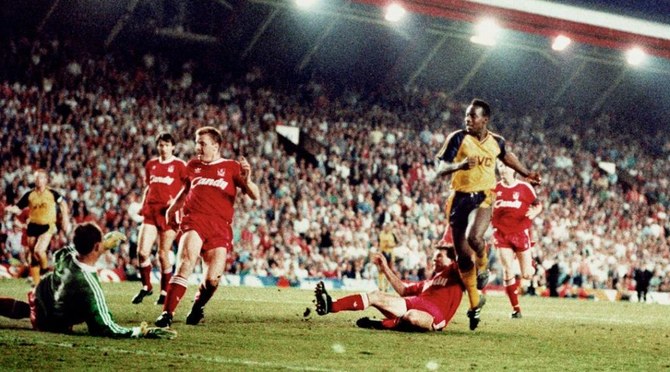
The match is now football folklore. Alan Smith scored a 52-minute header to ramp up the nerves at Anfield, but against a visibly tiring home team, Arsenal still needed a winner.
It came, astonishingly, in the 92nd minute.
“It’s up for grabs now,” commentator Brian Moore famously said as Michael Thomas broke away from the Liverpool defence to tap the ball past Bruce Grobbelaar.
It was Arsenal, not Liverpool, that had pulled off the biggest and final miracle of the season.
League titles rarely deliver such stunning finales. And the nature of this particular match meant it had a winner-takes-all cup final feel that the guardians of today’s Premier League can only dream of. It was in effect a second-leg of a cup tie and Thomas’s winner ensured that the two clubs finished on the same number of points and with identical goal differences of +37. Arsenal were crowned champions on account of having scored more goals. That goal was, in effect, an away goal that settled a whole season.
Have football fans enjoyed greater, better matches? Sure.
But greater moments?
Not even the greatest cup finals of all time can claim bigger stakes being won and lost in such fashion.
The world’s oldest competition, the FA Cup, has seen some memorable stories since its first edition in 1871-72, and Arsenal themselves delivered the greatest end to a final ever.
In 1979, the Gunners led Manchester United 2-0 as a seemingly average final entered its dying moments. But two goals by Gordon McQueen and Sammy McIlroy in the dying embers of the match stunned Wembley and set up a scarcely believable extra time. Except that from the kick-off Arsenal immediately went up the other end and scored through Alan Sunderland to win what would become known as the “Five-minute Cup Final”.
But just ask any Arsenal fan which moment remains the most dramatic in the club’s history.
Manchester United’s 1999 Champions League triumph makes a strong claim for the most dramatic conclusion to a match ever. But, while the two-goal injury time turnaround was close to miraculous, Ole Gunnar Solskjaer’s winning goal lacks Thomas’s defeat-to-victory aspect.
At the risk of sounding like a killjoy, Alex Ferguson’s men had already saved themselves with Teddy Sheringham’s equaliser and would have had a chance to claim victory in extra-time, a luxury Arsenal did not have in that 92nd minute at Anfield.
And then there is the 2005 Champions League final in Istanbul. Liverpool’s still incomprehensible triumph over a vastly superior AC Milan team ticks off all the boxes for drama. it boasted some of the best players on the planet at the top of their game. In Hernan Crespo’s third goal for Milan, one of the competition’s finest ever goals. There was a seemingly unassailable 3-0 half-time lead for the favourites. But then a comeback for the ages as a Steven Gerrard-inspired Liverpool equalized the match within 15 minutes of the restart. This was followed by an unbearably tense extra time, and finally a penalty shootout which saw Jerzy Dudek, seemingly in his last moments as Liverpool goalkeeper, redeemed himself to win the cup for the Reds.
Few can argue the Miracle of Istanbul is not a superior match to the 1989 showdown in almost every aspect. But although penalty shootouts are naturally won or lost with the last kick of the game, they inherently lack the element of utter surprise that Thomas’s goal provided.
The closest comparison to Thomas’s historic moment is without doubt Sergio Aguero’s title-winning goal for Manchester City against QPR in the dying seconds of the 2011-12 Premier League campaign. Like Manchester United’s Champions League win in 1999, the two injury-time goals rightfully lend the comeback legendary status. And, like Thomas’s win, it had the winner takes all away-goal factor; there was no safety net of extra-time here for City.
But despite the moment’s extraordinary drama, it still marginally loses out to the events at Anfield. For a start, it was not a face-off between the top two teams. Roberto Mancini’s team were also firm favourites to win against a team fighting for relegation. The match was at the Etihad Stadium in front of City’s own fans and the decisive goals finally arrived against an exhausted 10-man QPR. This is a match City were expected to walk and blowing it would have been the real miracle.
The 1994-95 Premier League season also provided one of the more recent dramatic finishes; it even had a last minute goal, and at Anfield as well. But the fact that it came against eventual champions Blackburn, who could afford to lose 2-1 to Liverpool while challengers Manchester United wasted one chance after another at West Ham to only draw, means it cannot quite be compared to Arsenal’s heroics at Anfield.
In Spain, Atletico Madrid went to the Nou Camp on the final day of the 2013-14 La Liga season needing a draw against the Barcelona of Leo Messi, Andres Iniesta and Xavi to claim a shock title win, but when Alexis Sanchez gave the home team the lead, it looked like Atletico’s dream was over. But a 49th minute equaliser from Diego Godin gave them a priceless point that would see them crowned champions.
A head-to-head final day clash between the two top teams had been won by the underdog, just like in 1989. But this was an underdog needing only a draw, and there were no comparable last-minute heroics or drama.
Perhaps closest was the conclusion of Portugal’s 2012-13 Primeira Liga race. On May 11, 2013, Benfica travelled to the Estádio do Dragão to play fierce rivals Porto, with a two-point lead over their opponents. As the match entered its final seconds locked at 1-1, Porto broke away to score an astonishing winner and break their opponents’ hearts. All over the pitch, there were tears of joy and despair as Porto leapfrogged their opponents in the standings at the death. It was one of the most dramatic matches the Portuguese top division has ever witnessed.
However, this was only a de-facto finale; watching those dramatic scenes now, it is often forgotten that there was, in fact, one round of matches left. Both teams would win their last games, with that late winner proving ultimately decisive, though not quite with the finality of Thomas’s strike.
But what about matches of sheer importance? Surely many World Cup moments are bigger and more dramatic than a First Division title win. But which?
The 1970 World Cup semi-final between West Germany and Italy is often dubbed the “Game of the Century”, and for good reason. In an unforgettable back and forth battle with many incredible moments, Italy would prevail 4-3 after extra time. But the fabled match does not have a last-minute goal, and ultimately the winners went on to lose the final.
In that final they played a Brazil team considered the greatest football team of all time. Pele, Jairzinho, Tostao, Rivellino and Carlos Alberto put on a masterclass that day, eventually destroying their exhausted opponents 4-1. For many, it remains the greatest football match ever played.
But it was, especially in those final minutes, literally a walk in the park for Brazil.
The 1982 World Cup saw two truly stunning matches within days of each. Italy got revenge for 1970 with Paolo Rossi’s hat-trick in a 3-2 second-round group win over Brazil; and then West Germany’s semi-final penalty shootout win over France after a controversial 3-3 draw.
Both were matches of extraordinary tension and quality; but without a magic moment to rival Thomas’s silver bullet.
In his era-defining book “Fever Pitch,” Arsenal fan and author Nick Hornby tried and, and his own words, failed, to describe the drama of that finale at Anfield. No metaphor or event, footballing or otherwise, could quite convey its sheer joy and improbability.
“Childbirth must be extraordinarily moving, but it doesn’t have that crucial surprise element.” he said, adding: “What else is there that can possibly provide the suddenness?”
And the answer is nothing.
Sorry, Sergio. Sorry, Manchester City. But football's most dramatic moment is not up for grabs.


