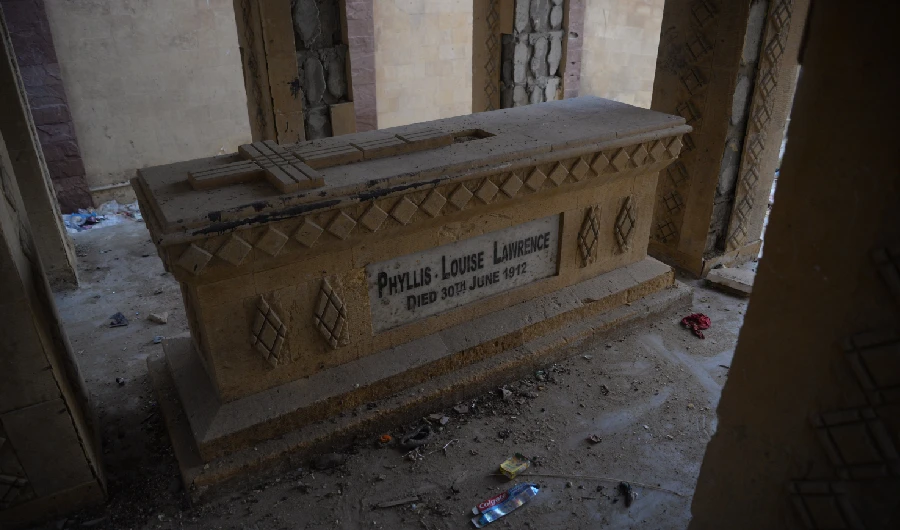
In grave neglect, Karachi forgets its long-departed benefactress

The grave of Phyllis Louise Lawrence, wife of Sir Henry Lawrence, former collector of Karachi, is seen at Gora Qabristan in Karachi on May 18, 2020 (AN Photo by S.A. Babar)
Short Url
Updated 25 May 2020
Follow

In grave neglect, Karachi forgets its long-departed benefactress

  • Phyllis Louise Lawrence (1868-1912) was a philanthropist committed to bringing health care to Sindhi women
  • Gora Qabristan went into disarray after the independence of Pakistan in 1947, when British funding had ceased

KARACHI: Once a darling of Karachi, Phyllis Louise Lawrence was forever immortalized in a mausoleum built by her grieving husband in Gora Qabristan. Touched by time and lost to the city’s memory, her white marble mausoleum is now completely forgotten under piles of garbage and dirt.

During her life, Lady Phyllis, as she was affectionately called, advocated for education and health of Sindhi women. The Cowasjee School of Midwifery at the Lady Dufferin Hospital in Karachi is a continuation of the Phyllis Louise Lawrence Institute, which was established in 1912 and named after her.
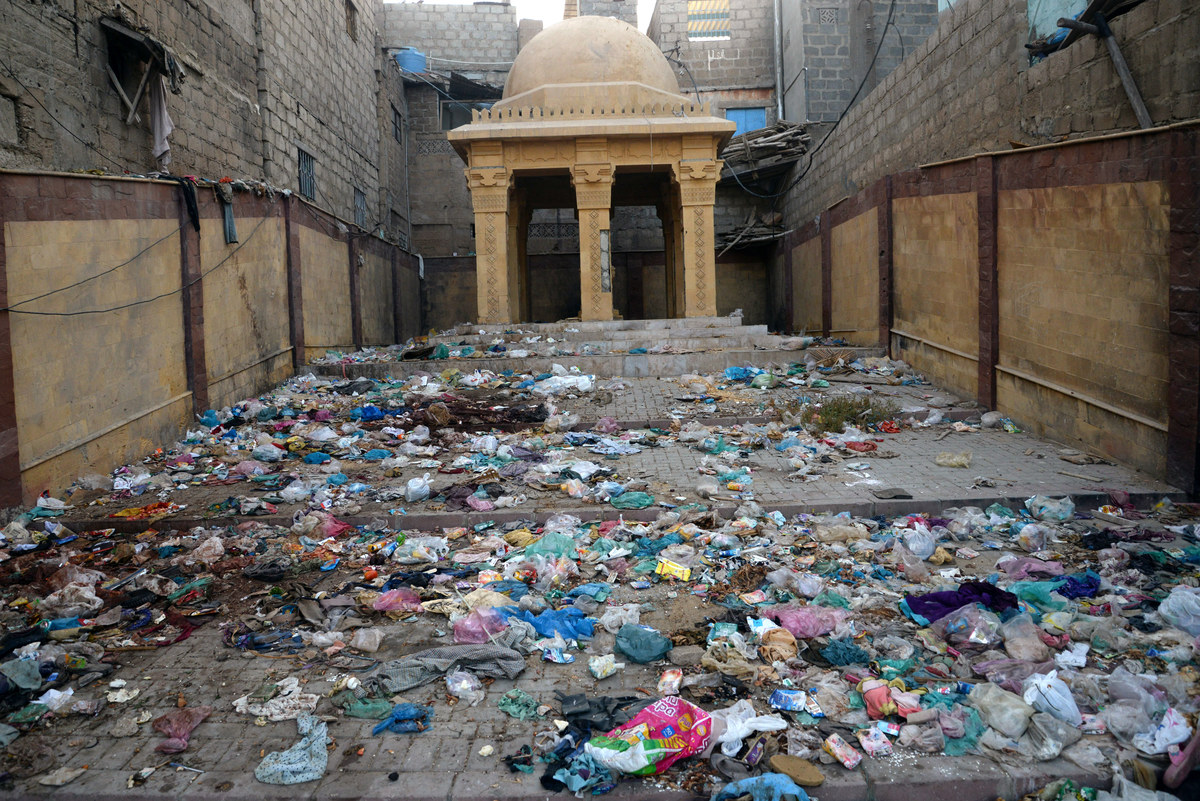


The mausoleum of Lady Phillis is hidden amid litter at the Gora Qabristan cemetery in Karachi on May 18, 2020. (AN Photo by S.A. Babar)

“She brought medical help to the common people of Sindh and was particularly committed to Sindhi women,” Darryl Abraham Thomas, a Karachi-based researcher, told Arab News. “She knew from personal experience as how many suffered in childbirth from the lack of adequately trained help, and worked to improve the level of midwifery and maternal care.”

She also loved horse racing, which ultimately led her to her doom, when on June 30, 1912, Lady Phyllis decided to go on a carriage ride by herself.

“She got the carriage to a good speed but unfortunately, her long flowing hair became entangled in the spokes of the carriage wheel and she was pulled off the carriage and dragged for a long time before the horses came to a stop,” Thomas said.
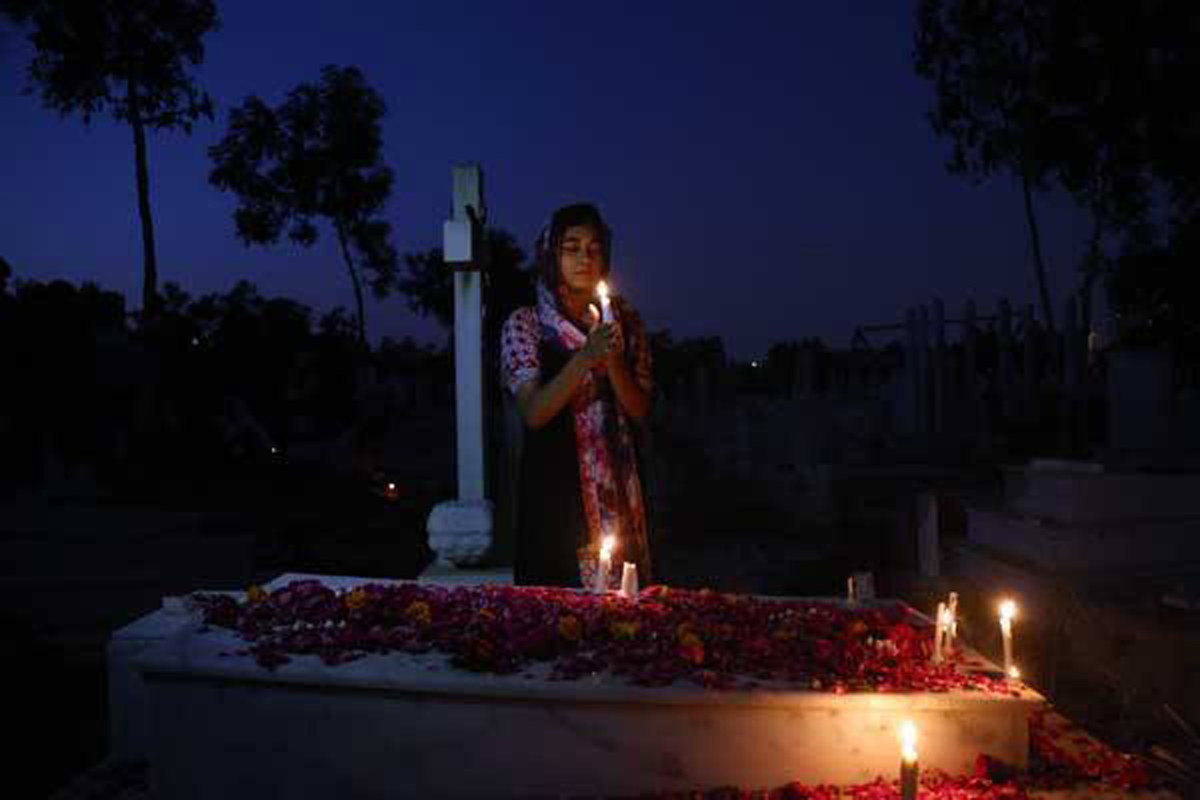


A woman offers prayers at the grave of her relative in Gora Qabristan, Karachi on April 28, 2020. (AN Photo by S.A Babar )

Devastated by her untimely death, Lady Phyllis’s husband, Sir Henry Staveley Lawrence, a British civil servant and colonial administrator in Karachi, built a marble tomb for her final resting place.

“It seems that her spirit was restless after her death and would call out to her husband on certain nights and her ghost was also reportedly spotted,” Thomas said.

Lady Phyllis’s mausoleum in the historical British-era graveyard is a dome supported by six pillars. Partly renovated in 2007, the ivory-white marble of her tomb was replaced with yellow stone. But amid heaps of garbage, it no longer bears much resemblance to the Mughal-style mausoleum it used to be.
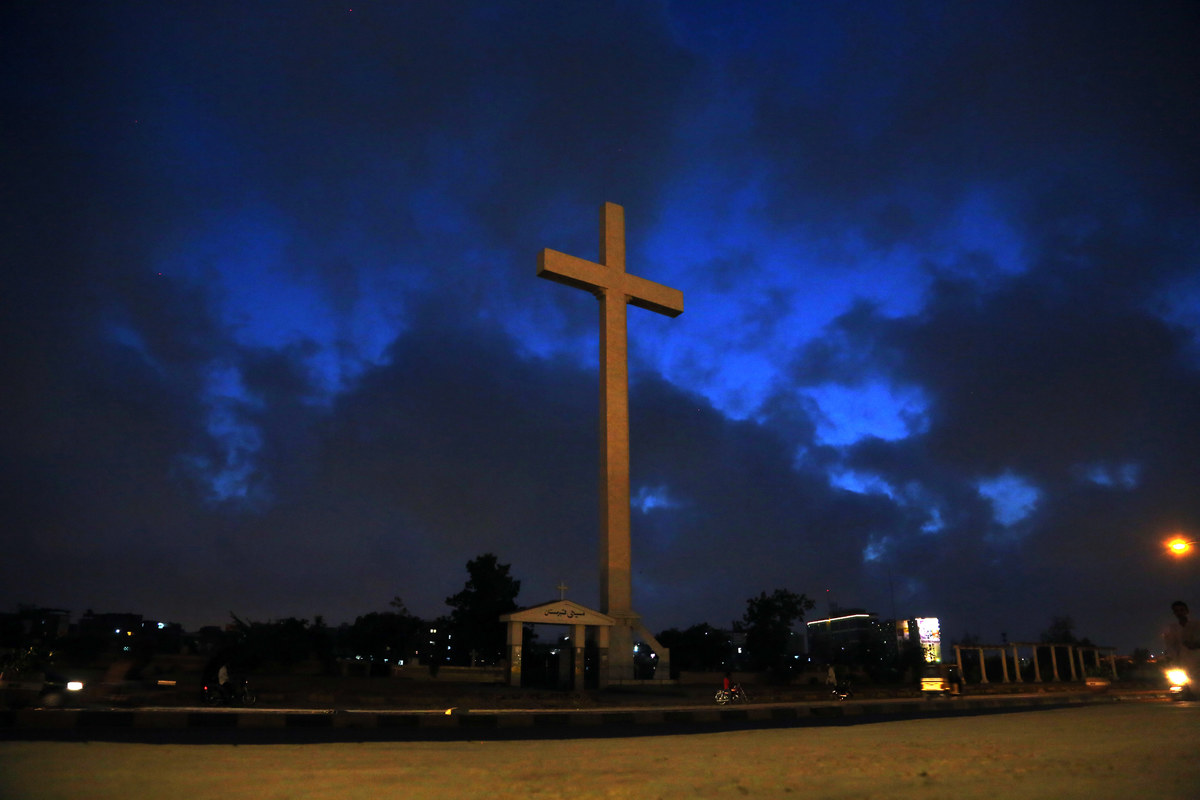


The Karachi Christian Cemetery, popularly known as Gora Qabristan, is one of the city's oldest graveyards where the British and polish officers and members of their families would be buried: May 18, 2020 (AN Photo by S.A. Babar)

The glory of the old Christian cemetery, which name translates to “white man’s graveyard,” was over in 1947, when after the partition of India and creation of Pakistan, British funds to maintain it had ceased and everything went into disarray.

“Until World War II, the cemetery was in an open desert as there were no buildings between Napier Barracks and Drigh Road Cantonment. This whole area was quite clean and tidy and had trees around,” Thomas said.

There appears to be little interest in the fate the old memorial park. Consecrated in 1845, it now seems to be left to its own devices.

Sewage water has washed away some of the old graves. Crucifixes and sculptures have been broken, lead plaques that bore epitaphs have been looted.

“A lot of damage had been done in the past due to neglect and apathetic attitude,” Thomas said, but added that the British Council had committed itself to restoration work, especially on the grave of Lady Phyllis.

Citing coronavirus lockdown, the British Deputy High Commission in Karachi was unavailable for comment.
IMF board to meet tomorrow to consider $1.2 billion disbursement for Pakistan

Updated 11 sec ago
Follow

IMF board to meet tomorrow to consider $1.2 billion disbursement for Pakistan

  • Pakistan, IMF reached a Staff-Level Agreement for second review of $7 billion loan program 
  • Economists view disbursement crucial for cash-strapped Pakistan as it tackles economic crisis

ISLAMABAD: The International Monetary Fund’s (IMF) Executive Board will meet tomorrow, Monday, to consider and approve a $1.2 billion disbursement for Pakistan, according to the global lender’s official schedule. 

The meeting takes place nearly two months after the Fund reached a Staff-Level Agreement (SLA) with Pakistan for the second review of its $7 billion Extended Fund Facility (EFF) and the first review of its $1.4 billion Resilience and Sustainability Facility (RSF). 

The SLA followed a mission led by IMF’s Iva Petrova, who held discussions with Pakistani authorities during a Sept. 24–Oct. 8 visit to Karachi, Islamabad and Washington, DC.

“The International Monetary Fund’s (IMF) Executive Board will convene on Dec. 8 to consider Pakistan’s request for a $1.2 billion disbursement under the Extended Fund Facility (EFF) and the Resilience and Sustainability Facility (RSF), according to the Fund’s updated schedule,” the state-run Pakistan TV reported on Sunday.

Economists view IMF’s bailout packages as crucial for cash-strapped Pakistan, which has relied heavily on financing from bilateral partners such as Saudi Arabia, China and the United Arab Emirates, as well as multilateral lenders including the IMF, World Bank, Asian Development Bank and Islamic Development Bank. 

The South Asian country has been grappling with a prolonged macroeconomic crisis that has drained its financial resources and triggered a balance of payments crisis. Islamabad, however, has recorded some financial gains since 2022, which include recording a surplus in its current account and bringing inflation down considerably. 

Speaking to Arab News last month, Pakistan’s former finance adviser Khaqan Najeeb said the $1.2 billion disbursement will further stabilize Pakistan’s near-term external position and unlock additional official inflows. 

“Continued engagement also reinforces macro stability, as reflected in recent improvements in inflation, the current account, and reserve buffers,” Najeeb said. 

Pakistan came close to sovereign default in mid-2023, when foreign exchange reserves fell below three weeks of import cover, inflation surged to a record 38 percent in May, and the country struggled to secure external financing after delays in its IMF program. Fuel shortages, import restrictions, and a rapidly depreciating rupee added to the pressure, while ratings agencies downgraded Pakistan’s debt and warned of heightened default risk.

The crisis eased only after Pakistan reached a last-minute Stand-By Arrangement with the IMF in June 2023, unlocking emergency support and preventing an immediate default.