

Face masks and ‘prayer shifts’ as Italy’s Muslims return to mosque

1 / 3
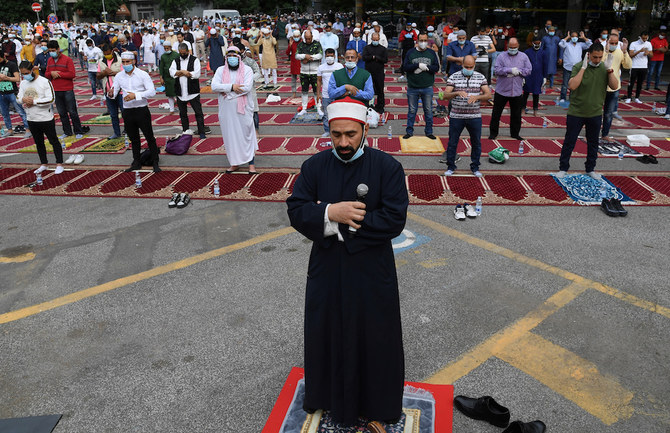
Muslim men pray on the first day of Eid Al-Fitr, as Italy eases some of the lockdown measures put in place during the coronavirus disease (COVID-19) outbreak, in Rome on Sunday. (Reuters)
2 / 3
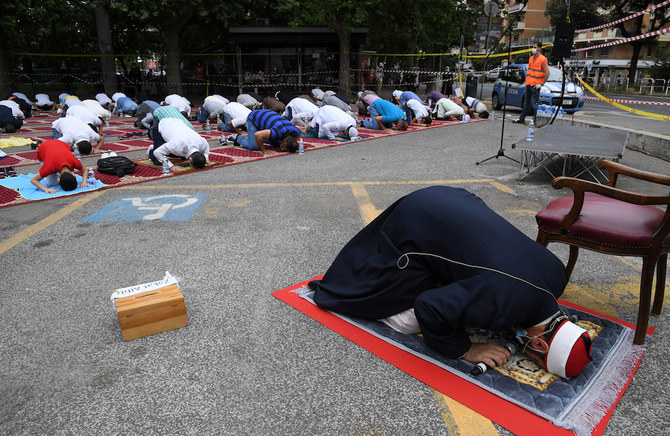
Muslim men pray on the first day of Eid Al-Fitr, as Italy eases some of the lockdown measures put in place during the coronavirus disease (COVID-19) outbreak, in Rome on Sunday. (Reuters)
3 / 3
Muslim men pray on the first day of Eid Al-Fitr, as Italy eases some of the lockdown measures put in place during the coronavirus disease (COVID-19) outbreak, in Rome on Sunday. (Reuters)
Short Url
Updated 24 May 2020
Follow

Face masks and ‘prayer shifts’ as Italy’s Muslims return to mosque

  • Worshippers at Milan’s Via Meda Mosque are required to wear masks
  • ‘Prayer shifts’ have been introduced to avoid overcrowding

ROME: Mosques in Italy are beginning to reopen their doors for the first time in months, implementing government measures to contain the spread of coronavirus.
Worshippers at Milan’s Via Meda Mosque are required to wear masks and there are ‘prayer shifts’ to avoid overcrowding.

“It is for our safety, for our good, so we must do as required,” one worshipper named Saleh told Arab News. “This way we reduce risks for us and our families. At least we are back here to pray together. It’s a really good thing. I have been waiting long for this moment. Now we hope the pandemic will finish soon and that we can all go back to our lives, to our habits and customs without fear.”
Italy went into lockdown on March 9, with mosques closing that same date, and restrictions were eased earlier this month as the country embarked on a phased return to normality.
The capacity of the Via Meda Mosque has decreased from 250 to just 70, and it has been decided that Muslims will pray in shifts until the pandemic ends.
Posters in Italian and Arabic at the mosque’s entrance and on its walls urge everyone to wear masks and socks.
Prayer mats are sanitized between shifts so that the next person can use them safely. Shoes are placed on racks outside the room in a well-spaced fashion to avoid a crush. Handshakes and hugs are forbidden, so people greet each other by putting their right hand on the heart.
Imam Yaha Pallavicini used his sermon to thank Allah for the health of the whole community, and prayed that the last days of Ramadan could be lived “in a safe way so that physical and spiritual health of all the faithful, throughout Italy, may be preserved.”
In Vicenza, which is around 50 kilometres from Venice, WhatsApp was used to ensure that social distancing could be maintained and that only those who could fit in the place of worship would attend.
In Biella, an industrial city in the northwestern Piedmont region, authorities allowed the call to prayer to be transmitted on loudspeakers every Friday during Ramadan.
But most of Italy’s mosques remain closed until after the end of Ramadan following an appeal from the Union of Islamic Communities in Italy.
“We might not guarantee that the social distancing rules would be respected,” Imam Abdullah Tchina told Arab News, saying that a big turnout would be expected in the final part of the holy month.
May 18, which was the date set for the reopening of mosques, coincided with this important period of Ramadan and discouraged many imams to hold prayers, especially in smaller places of worship. “We have thus been able to balance the need for physical health with the spiritual one,” Yusuf Abd al-Hakim Carrara, from the national Italian Muslim association Coreis, told Arab News.
But the Grand Mosque in Rome, the largest in Europe, is “indefinitely closed” according to a note on its main gate.

Abdellah Redouane, secretary-general of the mosque’s Islamic Cultural Centre, invited Rome’s Muslims to keep complying with state rules about the containment of COVID-19 and to avoid gatherings. “Eid Al-Fitr can be naturally celebrated at home with families,” he said.


Ukraine accuses Hungary, Slovakia of ‘blackmail’ over threats to cut electricity

Updated 3 sec ago
Follow

Ukraine accuses Hungary, Slovakia of ‘blackmail’ over threats to cut electricity

KYIV: Ukraine’s Foreign Ministry condemned what it described as “ultimatums and blackmail” by the governments of Hungary and Slovakia on Saturday, after they threatened to stop electricity supplies to ​Ukraine unless Kyiv restarts flows of Russian oil.
Shipments of Russian oil to Hungary and Slovakia have been cut off since January 27, when Kyiv says a Russian drone strike hit pipeline equipment in Western Ukraine. Slovakia and Hungary say Ukraine is to blame for the prolonged outage.
Slovakia’s Prime Minister Robert Fico said on Saturday that he would cut off emergency electricity supplies to Ukraine within two days unless Kyiv resumes Russian oil transit to Slovakia over Ukraine’s ‌territory. Hungary’s Viktor ‌Orban made a similar threat days earlier.
The issue ​has ‌become ⁠one of ​the ⁠angriest disputes yet between Ukraine and two neighbors that are members of the EU and NATO but whose leaders have bucked the largely pro-Ukrainian consensus in Europe to cultivate warm ties with Moscow.
Slovakia and Hungary are the only two EU countries that still rely on significant amounts of Russian oil shipped via the Soviet-era Druzhba pipeline over Ukraine.
“Ukraine rejects and condemns the ultimatums and blackmail by the ⁠governments of Hungary and the Slovak Republic regarding energy supplies ‌between our countries,” the Ukrainian Foreign Ministry said ‌in a statement. “Ultimatums should be sent to the Kremlin, ​and certainly not to Kyiv.”

HUNGARY, ‌SLOVAKIA ARE KEY FOR UKRAINE’S ELECTRICITY IMPORTS
Between them, Hungary and Slovakia ‌have been providing around half of European emergency electricity exports to Ukraine, which Kyiv increasingly relies on as Russian attacks have damaged its grid.
“If oil supplies to Slovakia are not resumed on Monday, I will ask SEPS, the state-owned joint-stock company, to stop emergency electricity ‌supplies to Ukraine,” Fico said in a post on X.
Kyiv said that such actions were “provocative, irresponsible, and threaten the energy ⁠security of ⁠the entire region.”
Throughout the war that began with the full-scale Russian invasion whose fourth anniversary falls on Tuesday, Ukraine has allowed its territory to be used for Russian energy exports to Europe, which have been sharply curtailed but not halted.
Ukraine has proposed alternative transit routes to ship oil to Europe while emergency pipeline repair works are under way.
In a letter seen by Reuters, the Ukrainian mission to the EU proposed shipments through Ukraine’s oil transportation system or a maritime route, potentially including the Odesa-Brody pipeline linking Ukraine’s main Black Sea port to the EU.
Since October last year, Russia has intensified its drone and ​missile attacks on the Ukrainian ​energy system, knocking out electricity and heat and plunging millions of Ukrainians into long blackouts during bitterly cold winter temperatures.