Cher tweets joy as Pakistan agrees to free lonely elephant ‘Kaavan’

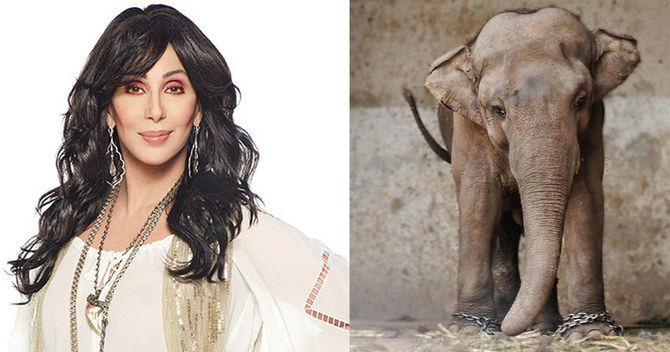
US music icon Cher took to twitter to express her gratitude for Pakistani govt upon releasing of lone elephant "Kavaan" in Pakistani zoo. (Photo courtesy: social media)
Short Url
Updated 27 November 2020
Follow

Cher tweets joy as Pakistan agrees to free lonely elephant ‘Kaavan’

  • The star has for years spoken out about Kaavan’s plight
  • Without a better habitat, the elephant’s future was bleak, experts say

ISLAMABAD: Music icon Cher marked “ONE OF THE GREATEST MOMENTS OF MY LIFE” Thursday after a Pakistani court ordered freedom for a lonely elephant named Kaavan, who had become the subject of a high-profile rights campaign backed by the US singer.

“WE HAVE JUST HEARD FROM PAKISTAN HIGH COURT KAAVAN IS FREE,” Cher tweeted, adding a string of emojis and saying she felt “SICK.”

“THIS IS ONE OF THE GREATEST MOMENTS OF MY LIFE,” the effusive singer continued.
The Islamabad High Court has ordered wildlife officials to consult with Sri Lanka to find Kaavan a “suitable sanctuary” within 30 days, tweeted the Friends of Islamabad Zoo, which described itself as a group of citizens concerned about animal welfare at the zoo.

Outrage over treatment of Kaavan, an Asian elephant originally from Sri Lanka, went global several years ago with a petition garnering over 200,000 signatures after it emerged he was being chained at the Islamabad Zoo in Pakistan’s leafy capital.

Zoo officials later said this was no longer the case, and that he just needed a new mate after his previous partner died in 2012.

But experts have told AFP previously that without a better habitat his future was bleak, even if a long-promised new mate finally arrives.

His behavior — including signs of distress such as bobbing his head repeatedly — demonstrates “a kind of mental illness,” Safwan Shahab Ahmad of the Pakistan Wildlife Foundation told AFP in 2016.

Activists said he had insufficient shelter from Islamabad’s searing summer temperatures, which can rise to above 40 degrees Celsius (100 Fahrenheit).
Asian elephants can roam thousands of kilometers through deep tropical and subtropical forests, according to the World Wildlife Fund.

In contrast, Kaavan’s 90 by 140 meter (100 by 150 yard) pen had almost no foliage, and only limited shade was provided.

Arriving as a one-year-old in 1985 from Sri Lanka, Kaavan was temporarily held in chains in 2002 because zookeepers were concerned about increasingly violent tendencies, but he was freed later that year after an outcry.

His mate Saheli, who arrived also from Sri Lanka in 1990, died in 2012, and in 2015 it emerged that Kaavan was regularly being chained once more — for several hours a day.
Scores of people signed a petition sent to zoo authorities and Pakistan’s then-Prime Minister Nawaz Sharif in protest.

A second petition circulated in 2016 and backed by over 200,000 animal-lovers from across the globe demanded Kaavan’s release to a sanctuary.

Cher, who for years has spoken out about Kaavan’s plight, tweeted her thanks to the Pakistani government, adding “it’s so emotional for us that I have to sit Down.”


Islamabad dismisses claims about paying up to 8 percent interest on foreign loans as ‘misleading’

Updated 22 February 2026
Follow

Islamabad dismisses claims about paying up to 8 percent interest on foreign loans as ‘misleading’

  • Pakistan has long relied on external loans to help bridge persistent gaps in public finances and foreign exchange reserves
  • Pakistan’s total external debt, liabilities stand at $138 billion at an overall average cost of around 4 percent, ministry says

KARACHI: Pakistan’s finance ministry on Sunday dismissed as “misleading” claims that the country is paying up to 8 percent interest on external loans, saying the overall average cost of external public debt is approximately 4 percent.

Pakistan has long relied on external loans to help bridge persistent gaps in public finances and foreign exchange reserves, driven largely by a narrow tax base, chronic trade deficits, rising debt-servicing costs and repeated balance-of-payments pressures.

Over the decades, successive governments have turned to multilateral and bilateral lenders, including the International Monetary Fund, the World Bank and the Asian Development Bank, to support budgetary needs and shore up foreign exchange reserves.

The finance ministry on Sunday issued a clarification in response to a “recent press commentary” regarding the country’s external debt position and associated interest payments, and said the figures required contextual explanation to ensure accurate understanding of Pakistan’s external debt profile.

“Pakistan’s total external debt and liabilities currently stand at $138 billion. This figure, however, encompasses a broad range of obligations, including public and publicly guaranteed debt, debt of Public Sector Enterprises (both guaranteed and non-guaranteed), bank borrowings, private-sector external debt, and intercompany liabilities to direct investors. It is therefore important to distinguish this aggregate figure from External Public (Government) Debt, which amounts to approximately $92 billion,” it said.

“Of the total External Public Debt, nearly 75 percent comprises concessional and long-term financing obtained from multilateral institutions (excluding the IMF) and bilateral development partners. Only about 7 percent of this debt consists of commercial loans, while another 7 percent relates to long-term Eurobonds. In light of this composition, the claim that Pakistan is paying interest on external loans ‘up to 8 percent’ is misleading.

The overall average cost of External Public Debt is approximately 4 percent, reflecting the predominantly concessional nature of the borrowing portfolio.”

With respect to interest payments, public external debt interest outflows increased from $1.99 billion in Fiscal Year (FY) 2022 to $3.59 billion in FY2025, representing an increase of 80.4 percent, not 84 percent as reported. In absolute terms, interest payments rose by $1.60 billion over this period, not $1.67 billion, it said.

According to the State Bank of Pakistan’s records, Pakistan’s total debt servicing payments to specific creditors during the period under reference were as follows: the IMF received $1.50 billion, of which $580 million constituted interest; Naya Pakistan Certificates payments totaled $1.56 billion, including $94 million in interest; the Asian Development Bank received $1.54 billion, including $615 million in interest; the World Bank received $1.25 billion, including $419 million in interest; and external commercial loans amounted to nearly $3 billion, of which $327 million represented interest payments.

“While interest payments have increased in absolute terms, this rise cannot be attributed solely to an expansion in the debt stock,” the ministry said. “Although the overall debt stock has increased slightly since FY2022, the additional inflows have primarily originated from concessional multilateral sources and the IMF’s Extended Fund Facility (EFF) under the ongoing IMF-supported program.”

Pakistan secured a $7 billion IMF bailout in Sept. 2024 as part of Prime Minister Shehbaz Sharif’s efforts to stabilize the South Asian economy that narrowly averted a default in 2023. The government has since been making efforts to boost trade and bring in foreign investment to consolidate recovery.

“It is also important to note that the increase in interest payments reflects prevailing global interest rate dynamics. In response to the inflation surge of 2021–22, the US Federal Reserve raised the federal funds rate from 0.75-1.00 percent in May 2022 to 5.25–5.50 percent by July 2023. Although rates have since moderated to around 3.75 percent, they remain significantly higher than 2022 levels,” the finance ministry said.

“The government remains committed to prudent debt management, transparency, and the continued strengthening of Pakistan’s macroeconomic stability,” it added.