

Pakistani woman legislator becomes first politician to die from coronavirus

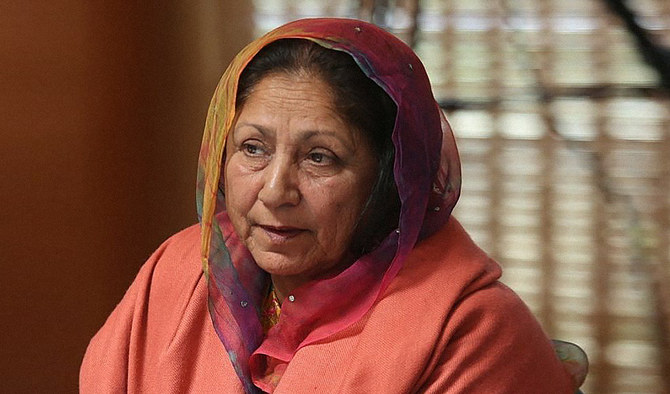
Undated file photo of Shaheen Raza, the legislator from Punjab Assembly and member of the ruling party Pakistan Tehreek-e-Insaf. Raza died of COVID-19 on 20 May, 2020. (Photo courtesy: social media)
Short Url
Updated 20 May 2020
Follow

Pakistani woman legislator becomes first politician to die from coronavirus

  • Raza was elected to the Punjab Assembly on a special seat in 2018
  • Was brought to a hospital in Lahore on May 17 after her condition deteriorated

LAHORE: Shaheen Raza, a woman legislator from Punjab’s provincial assembly, became the first Pakistani politician to die from coronavirus on Wednesday, officials told Arab News.

Raza, 60, was elected to a special seat reserved for women in 2018 and represented the ruling Pakistan Tehreek-e-Insaf (PTI) party.

“Shaheen Raza, a PTI female MPA (Member of the Provincial Assembly), has died. She is the first member of the assembly who lost her life fighting the pandemic disease,” Abdul Qahar Rashed, spokesperson for the Punjab Assembly (PA) told Arab News.

The PA has a total strength of 371 members; 297 of whom are directly elected, with 66 seats reserved for women and eight allocated for non-Muslim citizens. 

After being diagnosed with coronavirus symptoms, Raza was admitted to a hospital in Gujranwala, 73.4 km away from Lahore, capital of the populous Punjab province, where she hailed from.

However, after her condition deteriorated last week, she was moved to the Mayo Hospital in Lahore on May 17, where she lost her life.

“Shaheena Raza was admitted to Mayo Hospital, Lahore on May 17, 2020, and was on the ventilator since then and died today (Wednesday),” Dr. Tahir Khalil, Medical Superintendent of the hospital, confirmed to Arab News.

Expressing his sorrow over her untimely demise, Punjab Chief Minister, Usman Buzdar, said Raza was a “great asset to the party.”

“It is very sad news that we have lost our colleague, Shaheen Raza. She was a great asset of the party,” a statement released by his media office said.

As of Wednesday, 1,932 people had tested positive for COVID-19 in the past 24 hours, bringing the total number of infections to 45,898 across the country, according to data shared by the National Command and Control Center.

Out of the total count, 16,685 cases were registered from the Punjab province alone.


Rating firm S&P says it won’t rush Iran war downgrades, sees risks for countries like Pakistan

Updated 12 March 2026
Follow

Rating firm S&P says it won’t rush Iran war downgrades, sees risks for countries like Pakistan

  • Agency says it is monitoring indebted energy importers as higher oil prices strain finances
  • Gulf economies seen better placed to weather shock, though Bahrain flagged as vulnerable

LONDON: S&P Global ‌said it would not make any knee-jerk sovereign rating cuts following the outbreak of war in the ​Middle East, but warned on Thursday that soaring oil and gas prices were putting a number of already cash-strapped countries at risk.

The firm’s top analysts said in a webinar that the conflict, which has involved US and Israeli strikes ‌against Iran and Iranian ‌strikes against Israel, ​US ‌bases ⁠and Gulf ​states, ⁠was now moving from a low- to moderate-risk scenario.

Most Gulf countries had enough fiscal buffers, however, to weather the crisis for a while, with more lowly rated Bahrain the only clear exception.

Qatar’s banking sector could ⁠also struggle if there were significant ‌deposit outflows in ‌reaction to the conflict, although there ​was no evidence ‌of such strains at the moment, they ‌said.

“We don’t want to jump the gun and just say things are bad,” S&P’s head global sovereign analyst, Roberto Sifon-Arevalo, said.

The longer the crisis ‌was prolonged, though, “the more difficult it is going to be,” he ⁠added.

Sifon-Arevalo ⁠said Asia was the second-most exposed region, due to many of its countries being significant Gulf oil and gas importers.

India, Thailand and Indonesia have relatively lower reserves of oil, while the region also had already heavily indebted countries such as Pakistan, Bangladesh and Sri Lanka whose finances would be further hurt by rising energy prices.

“We ​are closely monitoring ​these (countries) to see how the credit stories evolve,” Sifon-Arevalo said.