

UAE calls for Libya cease-fire, return to political process

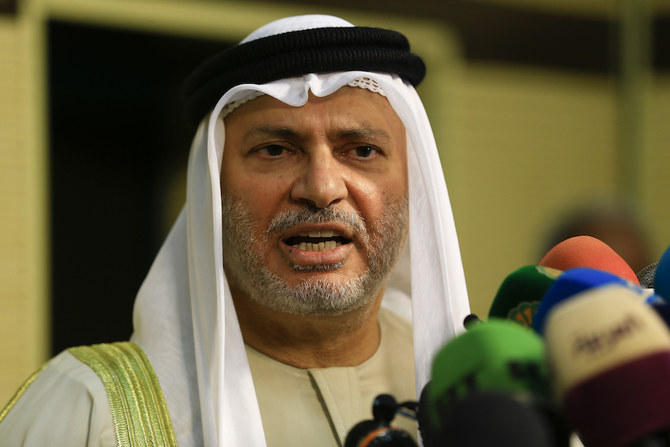
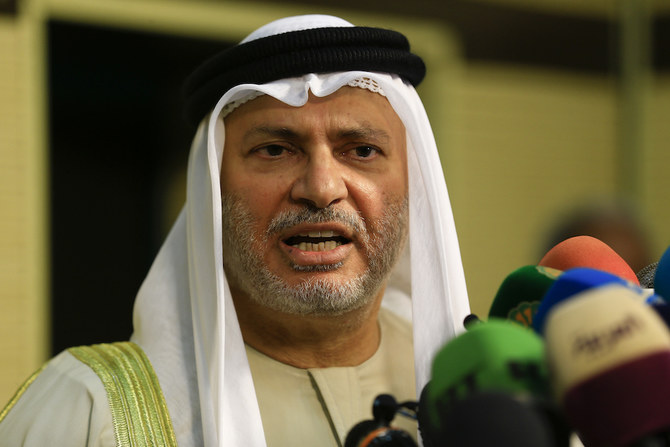
Minister of State for Foreign Affairs Anwar Gargash said Libyans will not have the chance to create a stable or prosperous country until combatants aim higher than tactical territorial gains. (File/AFP)
Short Url
Updated 19 May 2020
Follow

UAE calls for Libya cease-fire, return to political process

  • Gargash said the UAE’s position on the Libyan crisis has been firm and clear

DUBAI: The only acceptable path forward in the Libya conflict involves “an immediate, comprehensive cease-fire and a return to the political process,” a senior Emirati minister said on Tuesday.
“The UAE’s position on the Libyan crisis has been firm and clear and shared by the majority of the international community,” Minister of State for Foreign Affairs Anwar Gargash said on Twitter.

“The only acceptable path forward involves an immediate, comprehensive cease-fire and return to the political process.”
Libya has been in turmoil since a civil war toppled and later killed Muammar Qaddafi in 2011.

The is split between rival administrations in the east and the west.
Gargash added: “Libyans will not have the chance to create a stable or prosperous country until combatants aim higher than tactical territorial gains.”


Iran envoy: Saudi Arabia a pivotal partner, relations ‘fortified’

Updated 5 sec ago
Follow

Iran envoy: Saudi Arabia a pivotal partner, relations ‘fortified’

  • ‘Our contacts continue at all levels,’ Ambassador Alireza Enayati tells Asharq Al-Awsat
  • Alireza Enayati: Iran and the Kingdom are keen on the security and stability of the region

RIYADH: A senior Iranian official said that relations with Saudi Arabia are “fortified” and cannot be undermined, highlighting both nations’ shared commitment to regional security and stability. 

Alireza Enayati, Iran’s ambassador to Saudi Arabia, said in an exclusive interview with Asharq Al-Awsat that both countries are committed to preventing escalation and avoiding actions that could destabilize the region. 

He added that contacts and coordination between the two countries are taking place at various levels, including visits, meetings and private discussions.

Enayati said: “We must recognize the sensitivity of the current situation amid repeated threats facing the region and the risk of sliding into unprecedented escalation.

“In Iran, we believe that regional stability serves the interests of all countries in the region, and we have repeatedly sensed this affirmation during our meetings and encounters with Saudi officials.”

A senior Saudi official had told Asharq Al-Awsat on Saturday that reports circulated by some media outlets about a change in the Kingdom’s position regarding escalation in the region were inaccurate.

The source said that Saudi Arabia supports efforts aimed at reaching a peaceful solution to all disputed issues between the US and Iran through dialogue and diplomatic means, stressing the Kingdom’s rejection of the use of its airspace or territory for any military actions against Iran.

Enayati pointed to the existence of “ongoing contacts and exchanges between the two countries at various levels, including visits and meetings — some of which are public, while others are held away from the media.”

The Iranian diplomat said that Tehran “considers Saudi Arabia a pivotal and influential state in the region,” adding that cooperation between the two countries on issues of mutual interest “contributes to strengthening the region’s security and stability.”

He said: “Iran and the Kingdom are keen on the security and stability of the region, and emphasize the need to avoid escalation and steer clear of anything that could disturb regional calm.” 

Consultations are taking place between the two sides “stemming from a strategic conviction that has crystallized for both parties and serves their interests as well as those of the region as a whole,” Enayati added.

“The Kingdom views Iran as a reliable partner, while Iran regards Saudi Arabia as an important and effective state in the region, and their cooperation on issues of mutual interest helps consolidate regional security and stability.”

The ambassador said: “These relations are fortified and cannot be undermined, thanks to the leadership of both countries and their understanding of the inevitability of these relations, ensuring their continuity and growth, and the reflection of their positive effects on all.”

Enayati recalled the Saudi position in support of Tehran during its recent war with Israel, saying: “Iran welcomed the Saudi position supporting it during the war imposed on it, as Saudi Arabia strongly condemned the Israeli aggression against Iran, and we received a phone call that morning from the Saudi foreign minister. This stance was not surprising from our Saudi brothers, who stood by us during that phase.”

He added: “Second, any harm to Iran affects the security of the entire region, and this was clearly reflected in constructive positions, including that of the Kingdom. Third, the attack on Iran comes within a series of Israeli attacks that have targeted countries across the region, and no state is immune from these aggressions.”

Regarding talk of a negotiating framework taking shape between Iran and the US, Enayati said that Iran “entered the negotiations in 2015 and 2025 with full seriousness, but the US withdrew from them and dealt with them in a contradictory manner.”

He added: “If the US is serious about an equal dialogue without preconditions, Iran welcomes that, and Iranian officials have repeatedly affirmed this position.

“We recently heard statements indicating that the two sides are working to establish a framework for negotiations; however, negotiations cannot begin with predetermined outcomes. Rather, their results must emerge from the negotiating process itself, not be imposed on it in advance.”

Crown Prince Mohammed bin Salman, during a phone call he received from Iranian President Masoud Pezeshkian last week, highlighted the Kingdom’s support for any efforts aimed at resolving disputes through dialogue in a manner that enhances regional security and stability.

During the call, the Saudi crown prince stressed Riyadh’s position on respecting Iran’s sovereignty and the Kingdom’s refusal to allow the use of its airspace or territory for any military actions against Iran, or for attacks by any party, regardless of their direction.

Pezeshkian expressed his gratitude to Saudi Arabia for its respect of Iran’s sovereignty and territorial integrity, and his appreciation for the crown prince’s efforts and initiatives to achieve regional security and stability.