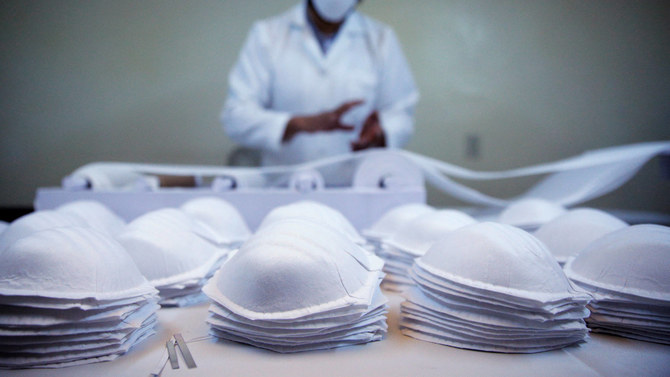
LONDON: An Abu Dhabi factory that usually produces plane parts is now being used to make masks in the latest example of a major manufacturer changing tack in response to the COVID-19 pandemic.
Mubadala unit Strata Manufacturing and Honeywell will produce as many as 30 million masks annually, the pair said in a statement on Tueday.
“We will be able to deliver critical support to frontline health care workers and members of the wider community,” said Mubadala CEO Khaldoon Khalifa Al-Mubarak. “This new manufacturing capability will help address the critical demand for N95 respirators, and bolster the resilience of UAE’s personal protective (PPE) equipment supply chains.”
Global manufacturing giants are re-purposing their assembly lines to meet a global shortage of PPE equipment needed to slow the spread of the COVID-19 virus and protect front line health care workers.
At the same time, the interruption of global supply chains from automotive manufacturing to plane making has exposed the fragility of globalized supply chains and led to a rethink of the manufacturing process.
The new N95 respirator manufacturing line based at the Al Ain Strata factory will be the first of its kind in the GCC region, Mubadala said.
Currently, the UAE imports all N95 respirators from abroad. The new facility will meet the national requirements of the country while also fulfilling export orders.
Strata was established in 2009 with production starting a year later and supplying plane makers including Boeing and Airbus.

Abu Dhabi’s Mubadala starts making masks in plane parts factory
https://arab.news/93tr3
Abu Dhabi’s Mubadala starts making masks in plane parts factory
- Mubadala CEO: This new manufacturing capability will help address the critical demand for N95 respirators and bolster the resilience of the UAE’s PPE supply chains
- Manufacturing giants worldwide are re-purposing their assembly lines to meet a global shortage of PPE equipment needed to slow the spread of COVID-19
Emerging markets driving global growth despite rising risks: Saudi finance minister
RIYADH: Emerging markets now account for a growing share of global output and are driving the bulk of world economic expansion, Saudi Arabia’s finance minister said, even as those economies grapple with rising debt and mounting geopolitical risks.
Speaking at the opening of the annual AlUla Conference for Emerging Market Economies on Feb. 8, Mohammed Al-Jadaan said the role of emerging and developing nations in the global economy has more than doubled since 2000, underscoring a structural shift in growth away from advanced economies.
The meeting comes as policymakers in developing markets try to keep growth on track while controlling inflation, managing capital flows and repairing public finances after years of heavy borrowing. Saudi Arabia has positioned the forum as a platform to coordinate policy responses and strengthen the voice of emerging economies in global financial discussions.
“This conference takes place at a moment of profound transition in the global economy. Emerging markets and developing economies now account for nearly 60 percent of the global gross domestic product in purchasing power terms and 70 percent of global growth,” Al-Jadaan said.
He added: “Today, the 10 emerging economies and the G20 alone account for more than half of the world’s growth. Yet, emerging markets face a more complex and fragmented environment, elevated debt levels, slower trade growth and increasing exposure to geopolitical shocks.”
According to Al-Jadaan, more than half of low-income nations face the risk of debt distress, while global trade growth has slowed to around half its pre-pandemic pace.
Launched in 2025, the conference this year brings together economic decision-makers, finance ministers, central bank governors, leaders of international financial institutions, and a select group of experts and specialists from around the world.
Al-Jadaan said credible fiscal frameworks and disciplined debt management are essential for long-term growth, pointing to Saudi Arabia’s own reform experience.
“Macroeconomic stability is not the enemy of growth; it is actually the foundation. Credible fiscal framework, clear medium-term anchors, and disciplined debt management create the space for investment and reform, especially in volatile global conditions,” he said.
The minister stressed that policy credibility depends on execution rather than plans, adding that structural reforms succeed only when institutions are able to deliver.
The importance of multilateral cooperation is rising as the global system becomes more divided, he said, calling for stronger international financial safety nets for developing economies.
“International cooperation matters more, not less, in a fragmented world. Strong multilateral institutions, effective surveillance and adequate global financial safety nets are essential, particularly for emerging and developing economies,” Al-Jadaan said.
Kristalina Georgieva, managing director of the International Monetary Fund, said emerging markets are growing faster than advanced economies but remain vulnerable to future shocks.
“Growth still lags pre-pandemic levels, and this is doubly concerning as we will surely experience more shocks, but face them with depleted fiscal buffers in many places, with high spending pressures practically everywhere, and rising debt levels in many countries,” she said.
Georgieva outlined two policy priorities emerging economies should embrace to sustain growth.
“First priority, unleash private sector-led growth by cutting red tape, deepening financial markets, strengthening institutions and improving governance,” she said.
Georgieva added: “Second priority is stepping up integration. In a world of shifting alliances and trade partners, there are new opportunities for cooperation at the regional and cross-regional levels.”
Lan Fo’an, China’s finance minister, said the world has entered a period of turbulence marked by unilateralism and geopolitical conflict.
“A cold wave of deglobalization is sweeping across the globe, and the world once again stands at a crucial crossroads,” he said, adding that the global economy expanded 3.3 percent in 2025, below the pre-pandemic average of 3.7 percent.
He called for reforms to global economic governance and greater attention to the needs of developing countries.
“We should improve the global economic governance system through reforms. We should add dialogue over confrontation. We should practice multilateralism to ensure that our countries, regardless of their size or wealth, can participate, make decisions and benefit on an equal footing.”
According to Fo’an, China has joined hands with the Global South to advance cooperation in food security, development financing and climate change.


