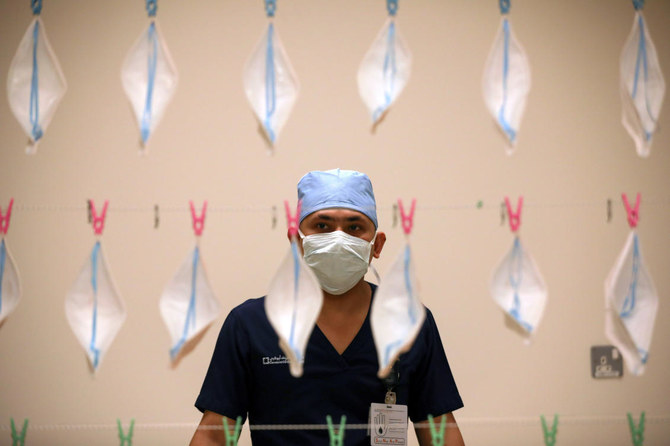
ABU DHABI: Dozens of N95 protective face masks hang on a line in a room of an Abu Dhabi hospital to be decontaminated so they can be used again by medical staff should there be a shortage due to the new coronavirus pandemic.
Cleveland Clinic Abu Dhabi this month started sterilizing N95 masks with ultraviolet light, a method used by other hospitals to extend the wearability beyond single use.
“We want to make sure we can give N95 masks to all of our caregivers,” Sterile Processing Manager Jason Unger said. “We are getting up to just over 200 masks a day which greatly increases our supply and will help us in case we have any supply chain problems.”
The hospital has treated over 100 patients with COVID-19, the disease caused by the new coronavirus, and is currently testing over 800 people a day for the virus. All medical staff treating infected or potentially infected patients wear N95 masks, which fit extremely closely and filter airborne particles.
They are considered essential for protecting health care professionals and are in short supply in many places.
The UAE, which has ramped up testing, has the second highest infection count among the six Gulf Arab states at more than 8,000 with over 50 deaths.
Cleveland Clinic Abu Dhabi said it began stockpiling personal protective equipment in the early days of the outbreak in the United Arab Emirates, which began in late January, and currently has a sufficient supply. But demand has soared globally.
It has not been able to stockpile produce for the hospital kitchen however, such as strawberries, asparagus and herbs due to the impact on global supply chains. Like other Gulf states, the UAE relies heavily on food imports.
“We have had a lot of challenges, but challenges are minimal,” Raghuprasad Pillai, who works in the kitchen, said.


![]()

Face masks to strawberries: Abu Dhabi hospital keeps tabs on resources
Face masks to strawberries: Abu Dhabi hospital keeps tabs on resources
- Cleveland Clinic Abu Dhabi this month started sterilizing N95 masks with ultraviolet light
- All medical staff treating infected or potentially infected patients wear N95 masks
Latest updates


© 2026 SAUDI RESEARCH & PUBLISHING COMPANY, All Rights Reserved And subject to Terms of Use Agreement.