

Al-Aqsa to remain closed until after Eid Al-Fitr

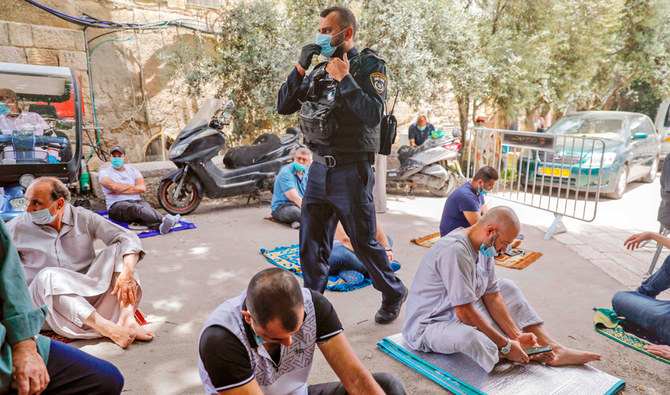
An Israeli soldier walks among Palestinian worshippers as they pray outside the closed Al-Aqsa Mosque compound in Jerusalem. (AFP)
Short Url
Updated 19 May 2020
Follow

Al-Aqsa to remain closed until after Eid Al-Fitr

  • Officials fear they will not be able to control those coming in if the mosque reopens and that the influx will prevent physical distancing, which is a vital measure in the fight against the spread of the virus

AMMAN: Al-Aqsa Mosque is to stay closed until after Eid-Al-Fitr celebrations, following a decision from the Islamic Waqf Council on Monday to keep the holy site shut in order to save lives amid the coronavirus outbreak.

Council member Mahdi Abdelhadi said all issues related to the opening of the mosque had been discussed, but the authority upheld a previous decision to keep it closed. There is an exception for waqf staff, who have continued to pray at Islam’s third holiest mosque.

“Mosques in Makkah, Madinah, Al-Azhar, Amman and other mosques have also been closed for the same reason, which is the protection of the health of worshippers,” he told Arab News.

The council called on the Jordanian waqf department to do what was needed in terms of health precautions to prepare the mosques and other facilities within the Haram Al-Sharif site to be open when lockdown conditions allowed.

Wasfi Kailani, who is director of the Royal Hashemite Fund for the Restoration of Al-Aqsa, told Arab News that waqf authorities had no tools to regulate worshippers if they were to return.

FASTFACT

Officials fear they will not be able to control those coming in if Al-Aqsa Mosque reopens and that the influx will prevent physical distancing, which is a vital measure in the fight against the spread of the virus.

Officials fear they will not be able to control those coming in if the mosque reopens and that the influx will prevent physical distancing, which is a vital measure in the fight against the spread of the virus.

The prolonged closure means that worshippers will not be able to go to Al-Aqsa Mosque on Wednesday night for the important occasion of Laylatul Qadr, which commemorates the night that Allah first revealed the Holy Qur'an to Prophet Muhammad (peace be upon him) through the Angel Gabriel.

The council’s decision to keep the mosque shut coincides with fresh attempts by Jews to restart their unapproved visits to the mosque.

Yehuda Etzion and Arnon Segal have been petitioning for Jews to access the site, denied since the lockdown started. They have argued that preventing Jews from going to the site while Muslims are allowed is unconstitutional.

Waqf sources told Arab News that if there was any change or if the Israeli police allowed Jews in from the Moghrabi Gate, which is under the control of Israeli police, then Muslim worshippers would also go.

Jews and other visitors regularly make unapproved trips to the mosque with police protection.


Tunisian police arrest member of parliament who mocked president

Updated 5 sec ago
Follow

Tunisian police arrest member of parliament who mocked president

  • Ahmed Saidani mocked the president in a Facebook post, describing him as the “supreme commander of sewage and rainwater drainage”

TUNIS: Tunisian police arrested lawmaker Ahmed Saidani on Wednesday, two of his colleagues ​said, in what appeared to be part of an escalating crackdown on critics of President Kais Saied.
Saidani has recently become known for his fierce criticism of Saied. On Tuesday, he mocked the president in a Facebook post, describing him as the “supreme commander of sewage and rainwater drainage,” blasting what he said ‌was the absence ‌of any achievements by Saied.
Saidani ‌was ⁠elected ​as ‌a lawmaker at the end of 2022 in a parliamentary election with very low voter turnout, following Saied’s dissolution of the previous parliament and dismissal of the government in 2021.
Saied has since ruled by decree, moves the opposition has described as a coup.
Most opposition leaders, ⁠some journalists and critics of Saied, have been imprisoned since he ‌seized control of most powers in 2021.
Activists ‍and human rights groups ‍say Saied has cemented his one-man rule and ‍turned Tunisia into an “open-air prison” in an effort to suppress his opponents. Saied denies being a dictator, saying he is enforcing the law and seeking to “cleanse” the country.
Once a supporter ​of Saied’s policies against political opponents, Saidani has become a vocal critic in recent months, accusing ⁠the president of seeking to monopolize all decision-making while avoiding responsibility, leaving others to bear the blame for problems.
Last week, Saidani also mocked the president for “taking up the hobby of taking photos with the poor and destitute,” sarcastically adding that Saied not only has solutions for Tunisia but claims to have global approaches capable of saving humanity.
Under Tunisian law, lawmakers enjoy parliamentary immunity and cannot be arrested for carrying out their ‌duties, although detention is allowed if they are caught committing a crime.