

Fighting rages in Yemen’s Abyan province

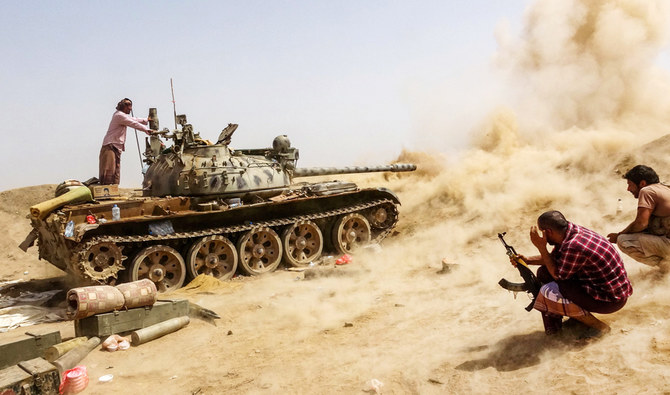
A tank belonging to forces loyal to Yemen's Southern Transitional Council (STC) separatists fires while on the frontline of clashes with pro-government forces for control of Zinjibar, the capital of the southern Abyan province, on its eastern outskirts in the Sheikh Salim area, on May 15, 2020. (AFP)
Short Url
Updated 18 May 2020
Follow

Fighting rages in Yemen’s Abyan province

  • Internationally recognized government seeking to expel the separatist Southern Transitional Council

AL-MUKALLA: Fighting raged on Sunday for the seventh consecutive day between government forces and separatists on the outskirts of the city of Zinjibar, the capital of the southern province of Abyan, residents and local military commanders said.

Government troops launched an offensive on May 11 aimed at expelling the separatist Southern Transitional Council (STC) from southern provinces including the port city
of Aden. “Fighting has been raging since early Sunday as our forces cut a road between Jaar and Zinjibar,” a local military commander, who wished to remain anonymous, told Arab News by telephone. He said that more than 20 soldiers on both sides had been killed and dozens injured since early last week.
On Saturday Yemeni government commanders admitted that separatist forces had captured Brig. Saif Al-Qufaish, the commander of Brigade 115 in Abyan, and a number of his associates after besieging their position in Abyan’s Sheikh Salem region.
“Our forces are in their positions and what happened on Saturday happens in every war,” Maj. Gen. Sanad Al-Rahwah, the commander of the government’s 1st Presidential Protection Brigade, told official media, commenting on the capture of Al-Qufaish. “If they captured a commander, we would respond by capturing or killing one or 10 of theirs.”
Over the last couple of days, residents in Zinjibar and Shouqra have reported hearing explosions from battlefields as government forces intensified the shelling of separatists on the outskirts of Zinjibar in an attempt to make headway. Government military commanders admit that separatists have resisted their offensive
and that it could take longer to break through and reach Zinjibar and Aden.

FASTFACTS

• 20 soldiers on both sides have been killed.

• Six Houthi militants killed in Taiz.

There is mounting local and international pressure on the STC to back down and revoke its controversial self-rule declaration that triggered the violence. However, the council’s leaders are defiant and are demanding that government forces stop their offensive and surrender.
Yemen’s Information Minister Muammar Al-Iryani said that the STC self-rule declaration in Aden had hampered the government’s efforts to pay public servants and fight the spread of coronavirus.
At least six Houthis were killed on Saturday in clashes with government troops in the southern city of Taiz.
Col. Abdul Basit Al-Baher, a Yemeni army spokesperson in Taiz, said that Houthis shelled the densely populated city with canons, tanks and heavy machine guns before attacking government troops on the western edges of the city. Two government troops were killed and three injured in the clashes that ended on Saturday afternoon when loyalists repelled the Houthi attack.

COVID-19 cases
Local health authorities in the southeastern province of Hadramout on Sunday reported four new coronavirus cases in the coastal areas of the province, including two deaths, bringing the total number of confirmed cases in government-controlled areas to 126. Health authorities also recorded three recoveries, bringing the total number of recovered cases to four.


Israeli Druze leader says Syrian community ‘besieged’ months after clashes

Updated 12 sec ago
Follow

Israeli Druze leader says Syrian community ‘besieged’ months after clashes

  • “They aren’t allowed to bring in any humanitarian aid, including the aid we’re trying to deliver,” Sheikh Mowafaq Tarif told AFP
  • Clashes erupted last July in southern Syria between Druze fighters and Sunni Bedouin tribes

JULIS, Israel: Seven months after deadly clashes between Syria’s Druze minority and government-backed forces, the spiritual leader of Druze in neighboring Israel said members of the community across the border remained in peril.
“They’re still besieged — completely encircled. They aren’t allowed to bring in any humanitarian aid, including the aid we’re trying to deliver,” Sheikh Mowafaq Tarif told AFP in an interview this week.
The cleric spoke in Julis, a quiet Druze village in northern Israel, where the community has set up an “emergency room” to coordinate aid efforts for Druze in Syria.
Israeli and Druze flags hang on the walls of the room, alongside posters in Hebrew and Arabic calling for an end to the killing of Syrian Druze.
The Druze are followers of an esoteric religion that split from Shiite Islam centuries ago. Its adherents are spread across parts of Syria, Israel, Lebanon and the Israeli-occupied Golan Heights.
Clashes erupted last July in southern Syria between Druze fighters and Sunni Bedouin tribes.
The Syrian authorities said their forces intervened to stop the clashes, but witnesses and monitors accused them of siding with the Bedouin.
Israel bombed Syria during the violence, saying it was acting to defend the minority group.
The Syrian Observatory for Human Rights said the fighting left more than 2,000 people dead, including 789 Druze civilians who were “summarily executed by defense and interior ministry personnel.”
The UN Office for the Coordination of Humanitarian Affairs estimated that some 187,000 people were displaced by the violence.
- ‘Why not let them return?’ -

“There are still more than 120,000 people displaced from their homes,” Sheikh Tarif said.
“Thirty?eight villages have been captured, and residents aren’t allowed to return. There are more than 300 captives, including children and women.”
AFP was unable to verify those claims.
Although a ceasefire was reached in July, access to Sweida remains difficult.
Residents accuse the government of imposing a blockade on the province, which Damascus denies. Several aid convoys have entered since then.
“Why not let them return to their villages? We’re in the depths of winter and that is a mountainous area. It’s very cold,” Tarif said.
With Syria’s government and Kurdish-led forces agreeing last month to integrate Kurdish fighters and civil institutions into state structures, Sweida is the last major area outside Damascus’s control.
Tarif said the community did not need government security forces in the region.
“The Druze have forces capable of defending themselves and maintaining order,” he said, referring to Syrian government forces as jihadists and “Islamic State members.”
Many in Syria remain wary of Sharaa, given that the jihadist group he once led started out as an Al-Qaeda affiliate and many of its former members are in his government.
Israel’s leaders have repeatedly referenced Sharaa’s jihadist past in calling for the West not to legitimize him.
Nevertheless, Israel and Syria, which have no official diplomatic ties, have held several rounds of direct talks in recent months.
Following negotiations in January, and under US pressure, both sides agreed to set up an intelligence?sharing mechanism as they moved toward a security agreement.
One issue under discussion is the possibility of Syrian Druze working in Israel.
Sheikh Tarif confirmed “that is something we have heard” and added that he wished any Syrian could come to work as a daily laborer “because the (economic) situation in Syria is very difficult.”
He also called for Druze across the Middle East to be able to visit their religious sites in neighboring countries, “just as our Christian and Muslim brothers visit their holy places” in states with which they may not have diplomatic relations.
“The Druze also deserve to access and pray at our holy sites in Syria and Lebanon and for them to come visit our holy places” in Israel, he said.