

Ireland will start easing lockdown from Monday: PM

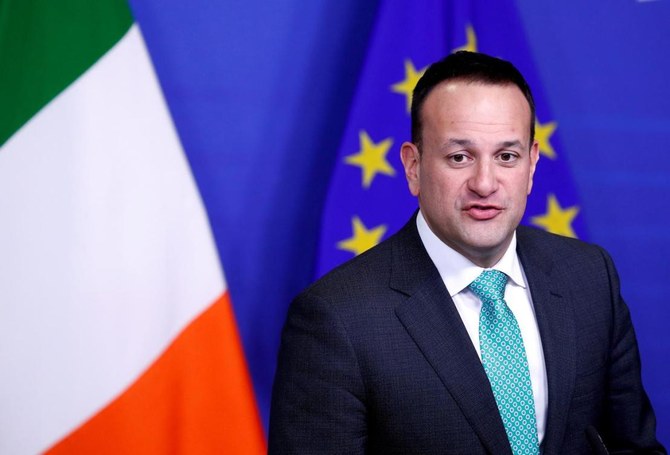
Irish Prime Minister Leo Varadkar (Taoiseach) speaks during a news conference in Brussels, Belgium, February 6, 2019. (Reuters)
Short Url
Updated 15 May 2020
Follow

Ireland will start easing lockdown from Monday: PM

  • Prime Minister Leo Varadkar: I can confirm that it is safe to proceed with phase one of our plan to ease the COVID-19 restrictions from Monday
  • Ireland will also introduce a legally binding 14-day quarantine period for travelers arriving in the country

DUBLIN: Ireland will begin to lift its coronavirus lockdown in the coming days, Prime Minister Leo Varadkar said Friday, starting a staggered easing of restrictions set to stretch until August.
“I can confirm that it is safe to proceed with phase one of our plan to ease the COVID-19 restrictions from Monday,” he said.

Ireland will also introduce a legally binding 14-day quarantine period for travelers arriving in the country, Prime Minister Leo Varadkar said.
The Irish cabinet agreed to make it mandatory for arrivals to fill out forms outlining where they will quarantine. “We’re going to examine means by which it can be enforced thereafter,” Varadkar said.
Travelers from Northern Ireland will be exempt.


Blair pressured UK officials over case against soldiers implicated in death of Iraqi

Former British Prime Minister Tony Blair. (File/AFP)
Updated 30 December 2025
Follow

Blair pressured UK officials over case against soldiers implicated in death of Iraqi

  • Newly released files suggest ex-PM took steps to ensure cases were not heard in civilian court
  • Baha Mousa died in British custody in 2003 after numerous assaults by soldiers over 36 hours

LONDON: Former UK Prime Minister Tony Blair pressured officials not to let British soldiers be tried in civil courts on charges related to the death of an Iraqi man in 2003, The Guardian reported on Tuesday.

Baha Mousa died in British Army custody in Basra during the Iraq War, having been repeatedly assaulted by soldiers over a 36-hour period.

Newly released files show that in 2005 Antony Phillipson, Blair’s private secretary for foreign affairs, had written to the prime minister saying the soldiers involved would be court-martialed, but “if the (attorney general) felt that the case were better dealt with in a civil court he could direct accordingly.”

The memo sent to Blair was included in a series of files released to the National Archives in London this week. At the top of the memo, he wrote: “It must not (happen)!”

In other released files, Phillipson told Blair that the attorney general and Ministry of Defence could give details on changes to the law they were proposing at the time so as to avoid claims that British soldiers could not operate in a war zone for fear of prosecution. 

In response, Blair said: “We have, in effect, to be in a position where (the) ICC (International Criminal Court) is not involved and neither is CPS (Crown Prosecution Service). That is essential. This has been woefully handled by the MoD.”

In 2005, Cpl Donald Payne was court-martialed, jailed for a year and dismissed from the army for his role in mistreating prisoners in custody, one of whom had been Mousa.

Payne repeatedly assaulted, restrained and hooded detainees, including as part of what he called “the choir,” a process by which he would kick and punch prisoners at intervals so that they made noise he called “music.”

He became the first British soldier convicted of war crimes, admitting to inhumanely treating civilians in violation of the 2001 International Criminal Court Act.