Turkey seeks global funding help to gird against lira shock

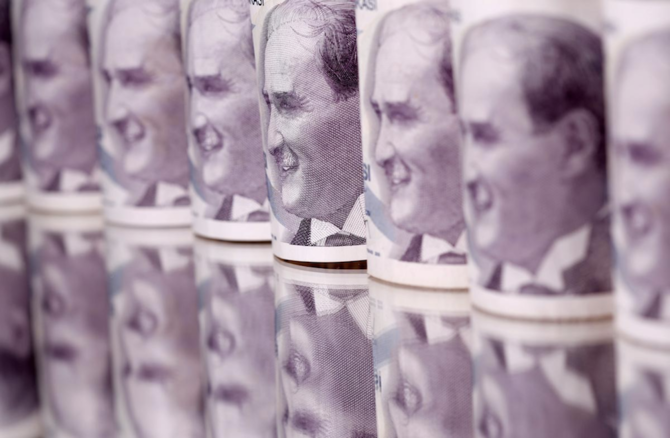
Treasury and central bank officials have held bilateral talks in recent days with counterparts from Japan and the UK on setting up currency swap lines. (Reuters/File Photo)
Short Url
Updated 14 May 2020
Follow

Turkey seeks global funding help to gird against lira shock

  • Cevdet Yilmaz, the ruling AK Party's deputy chairman for foreign affairs, confirmed on Thursday that Turkey was seeking swap agreements

ANKARA: Turkey's government has appealed to foreign allies in an urgent search for funding, three senior Turkish officials said, as it prepares defences against what analysts fear could be a second currency crisis in as many years.

Treasury and central bank officials have held bilateral talks in recent days with counterparts from Japan and the UK on setting up currency swap lines, and with China on expanding existing facilities, the officials said.

Cevdet Yilmaz, the ruling AK Party's deputy chairman for foreign affairs, confirmed on Thursday that Turkey was seeking swap agreements.

"We are having negotiations with different central banks for swap opportunities," he told a panel discussion, adding: "It is not only the U.S., there are also other countries."

He did not give further details.

The push comes after the lira hit a historic low last week, limiting Ankara's capacity to address concerns over its depleted foreign reserves and hefty debt obligations.

One of the officials told Reuters Turkey was feeling confident after the talks. But it was unclear how close it may be to securing any deals as the coronavirus pandemic stretches governments and central banks like never before.

Turkey's Treasury ministry, Japan's finance ministry and the Bank of England declined to comment. The People's Bank of China did not respond to a faxed request for comment.

If Turkey cannot secure tens of billions of dollars worth of funding, analysts say it risks a currency spiral https://tmsnrt.rs/2L5ks0o similar to 2018, when the lira briefly shed half its value in a crisis that shook emerging markets.

The government has said its forex buffer is adequate. This week, President Tayyip Erdogan blamed the lira's fall on "those who think they can destroy our economy, put shackles on our feet, corner us by using financial institutions abroad".

The diplomatic effort comes as the coronavirus pandemic is expected to trigger a recession.

It suggests Turkey is looking beyond its preferred source of funding, the U.S. Federal Reserve, and may have to consider tougher decisions on interest rates or options it has dismissed, such as IMF assistance or capital controls, investors say.

The two other officials said Turkey reached out to Japanese representatives about possible funding, with one adding that talks need to be speeded up if a swap line is to be secured.

The Turkish central bank's net foreign currency reserves tmsnrt.rs/3bOJYmo have dropped to $26 billion from $40 billion this year. Bankers say that was largely due to state lenders selling some $30 billion in FX markets to support the lira, which has nonetheless fallen 15% this year.

The country’s 12-month foreign debt obligations are $168 billion, with about half due by August, while disappearing tourism income has inflated its monthly current account deficit to nearly $5 billion.

“I don’t really see how Turkey can navigate this period, especially considering their external vulnerabilities,” said Shamaila Khan, director of emerging markets debt at AllianceBernstein in New York.

Turkey has underestimated its risks “unfortunately for months now” said Khan, who was among hundreds of investors on a conference call with Finance Minister Berat Albayrak last week.

On the call, Albayrak said reserves are adequate and he was optimistic about negotiating new funding with fellow G20 nations and trade partners, according to participants and a brief ministry summary.

He singled out countries with whom Turkey has large trade deficits and promised an update to existing swap lines, one investor said. Turkey has currency swap facilities worth $1.7 billion with China and $5 billion with Qatar.

The Fed extended dollar swap lines to several countries in March but it appears unlikely to add Turkey despite Ankara’s appeal to Washington, based on comments from current and former officials. The U.S. central bank declined to comment.

A Japanese government official said Tokyo has no plan for now beyond monitoring the lira, but added the Group of Seven (G7) countries or the International Monetary Fund would rescue Turkey “if it morphs into a real crisis.”


Deal with Iran ‘Unimaginable,’ Pompeo tells WGS in Dubai

Updated 4 sec ago
Follow

Deal with Iran ‘Unimaginable,’ Pompeo tells WGS in Dubai

  • UAE’s Gargash says he would like to see direct US negotiations with Tehran

DUBAI: Former US secretary of State, Mike Pompeo, told the World Government Summit in Dubai on Monday that he believed a deal between Iran and the United States was “unimaginable” under the current Ayatollah regime believing US strikes on the nation were still a possibility despite the apparent deescalation of the last few days.

“It's unimaginable that there could be a deal. To me, we've had a deal with Iranians multiple times,” he told a panel in Dubai on Tuesday.

“They have cheated and lied and avoided compliance with every deal they've signed.”

Pompeo was central to the US decision to leave the Joint Comprehensive Plan of Action (JCPOA) nuclear deal when he served as secretary during Donald Trumps first term. According to the US department of Justice, the Islamic Republic subsequently placed a $1 million bounty on his head.

Trump has in previous days said the US was seeking to srike a deal with Iran whilst simultanously ordering a large scale militray build up in the region. Pompeo said that he believed the US president could use military strikes – or at least the threat of them – to increase leverage on the regime to give up its enrichment and missiles fully, although he remained cynical of anything being achieved without regime change. 

“To think that there's a long-term solution that actually provides stability and peace to this region while the Ayatollah was still in power, is something I pray for, but find unimaginable,” Pompeo said.

On Syria, Pompeo expressed cautious optimism that the interim president Ahmed Hussein al-Sharaa will succeed in rebuilding his country with a lasting peace.

Al-Sharaa has previously said he was focused on consolidating power, rebuilding state institutions, integrating military factions, and restoring Syria's international relations, including with the United States, Russia, and regional powers.

Pompeo said he maintained a level of mistrust in the Syrian president – most notably due to his involvement with Al-Qaeda - but added that he hoped Al-Sharaa would do well.

 “I have known of Mr. Sharaa for a long time, when I was a CIA director… we had a $10m bounty on his head. He was an Al Qaeda terrorist,” he said.

“It is important for the region to get stability in Syria and so I am rooting for him…. I hope we all do our part to help him be more successful at bringing a very fractured nation back together so that.”

He said he hoped the up to seven million people who had fled the country as refugees could one day return to their homes.

“But it is a very difficult task for anyone and someone with the history that he has, I think it makes it even more complicated for him to be successful. But he’s the leader today and we all should hope that he is able to pull off what It is he has stated his intentions are.”

Pompeo was joined on stage by former UAE Minister of State for Foreign Affairs, Anwar Gargash, who was more hopeful of a diplomatic solution to the Iranian crisis; saying the region stood firm against escalation and further prolonged military conflict.

Gargash believed that it was in the best interest of Iran to strike a deal with the US that would open the pathway to it resolving its multitude of crises.

“I think that the region has gone through various various calamitous confrontations. I don't think we need another one,” he told the summit.

“I would like to see direct Iranian American negotiations leading to understandings so that we don't have these issues every other day.”

Speaking more broadly on regional security, Gargash said resolving the Palestinian issue was still of utmost importance if the middle east was to secure a prosperous future. He said that the UAE was commiitted to seeing through the Trumps plan but ruled out rumours that the emirates was poised to take over governance of the territory.

“We have to work with the Palestinians. We have to work with the Egyptians, the Israelis, the Jordanians, and of course, American leadership is key, really, for achieving a sort of, I won't say, sustainable solution at this time, but moving on with with the part two of President Trump's plan,” he said.

On the international stage, Gargash said he bvelived the health of the China-US relationship was the biggest hinderence to peace – warning that if not managed properly it would likely lead to increasing comflict around the world. He said it was paramount that the two countries maintained a mature relationship based on competition.