

Turkish lira plunges as finance minister fails to reassure market on Fed support

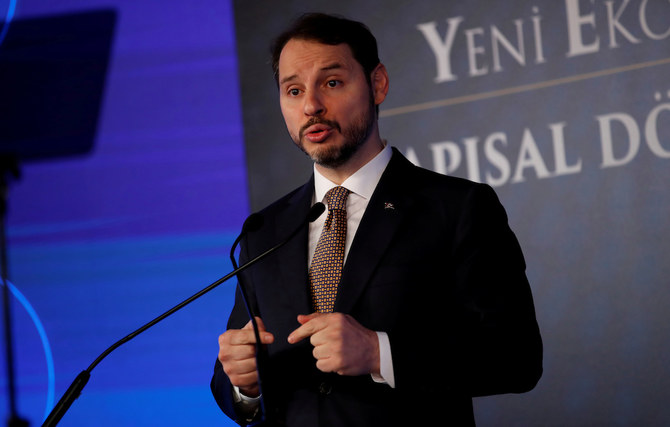
Berat Albayrak said the central bank’s foreign exchange reserves were more than adequate. (Reuters)
Short Url
Updated 07 May 2020
Follow

Turkish lira plunges as finance minister fails to reassure market on Fed support

  • Turkish economy has been hammered by a currency crisis which pushed the lira down to a record low of 7.25 to the dollar on Thursday
  • The shutdown of the tourism industry because of the COVID-19 pandemic has been a further blow to the Turkish economy

LONDON: The Turkish lira tumbled on Thursday despite efforts by the finance minister to defend the country’s fiscal policy.

Berat Albayrak said the central bank’s foreign exchange reserves were more than adequate even as the currency continued to fall during his address.
The son-in-law of President Tayyip Erdogan has been in the spotlight as the economy has been hammered by a currency crisis which pushed the lira down to a record low of 7.25 to the dollar on Thursday.
The president has ruled out seeking help from the International Monetary Fund.
The lira has now lost more than 18 percent against the greenback since the start of 2020 and has been in retreat for six days on the trot.
Earlier Reuters reported that a Fed policymaker — asked on Wednesday about extending swap facilities to Turkey and others in need — said the Fed already has lines with countries that have a relationship of “mutual trust” with the US, and the highest credit standards.
Richmond Fed President Thomas Barkin said the facilities were meant to stabilize markets and not provide funding as such.
Nikolay Markov, senior economist at Pictet Asset Management, told the newswire it was “just a matter of time” before the lira’s weakness and low reserves lead to a crisis in which Turkish firms or banks are unable to meet some debt obligations.
“There is no immediate risk of a full-fledged financial crisis but the risk has increased recently,” he said.
The shutdown of the tourism industry because of the COVID-19 pandemic has been a further blow to the Turkish economy, sapping the country of foreign currency and putting thousands of people out of work as the country nears what would normally be the busy high season.


Oman targets clean energy, EVs in China talks

Updated 5 sec ago
Follow

Oman targets clean energy, EVs in China talks

JEDDAH: Oman is intensifying efforts to attract investment into its industrial sector and advance toward high-value, technology-led activities through an official visit to China.
The delegation was headed by Saleh Said Masan, undersecretary for commerce and industry at the Ministry of Commerce, Industry and Investment Promotion, who visited a number of major Chinese manufacturing facilities, according to the Oman News Agency.
Industrial development is a central pillar of Oman Vision 2040 and the Industrial Strategy 2040, which target a tripling of manufacturing output, the attraction of approximately 40 billion Omani rials ($104 billion) in investment, and the expansion of advanced and green industries.
“These visits fall within ongoing efforts to strengthen investment in the industrial sector, in line with Oman’s strategy to develop integrated industrial clusters and shift toward high value-added industries driven by innovation and advanced technologies,” ONA reported.
As part of the visit, the delegation toured global solar energy firm JA Solar, where discussions with senior management focused on the latest smart solar cell and panel manufacturing technologies.
Both sides reviewed progress on the establishment of JA Solar’s facility in the Sohar Freezone, following a previously signed memorandum of understanding with the ministry to develop an integrated solar cell and module plant with an estimated investment of $564 million.
Officials confirmed that construction is proceeding according to plan, underscoring Oman’s goal of positioning itself as a regional hub for clean energy technologies and supporting its net-zero emissions target by 2050.
The delegation also visited the headquarters of BAIC Motor Corp., where recent advancements in electric and smart vehicles, along with next-generation transportation systems, were presented.
During the visit, Masan highlighted the incentives and support mechanisms offered by Oman to attract investment in the electromechanical and transport industries, reaffirming the ministry’s commitment to facilitating high-quality industrial projects.
“This direction aims to establish joint ventures in automotive assembly and manufacturing, helping diversify the industrial base and create specialized employment opportunities for Omani professionals in engineering and digital technologies, in line with Industrial Strategy 2040 objectives,” ONA stated.
Concluding the visit, the undersecretary said the engagements reflect the ministry’s focus on a qualitative shift toward capital-intensive and technology-driven industries.
He added that integrating renewable energy projects with JA Solar and localizing vehicle technologies with BAIC would enhance manufacturing’s contribution to gross domestic product and strengthen the competitiveness of national products under the Made in Oman brand.
Masan emphasized the ministry’s commitment to fostering an attractive investment climate that encourages foreign direct investment and supports the integration of small and medium-sized enterprises into the global supply chains of leading international companies.