

UN chief calls on Lebanon to disarm Hezbollah

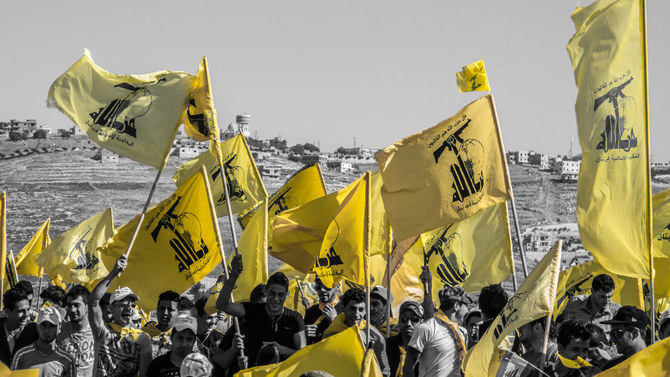
Hezbollah supporters celebrating in Lebanon. (Shutterstock photo)
Short Url
Updated 14 May 2020
Follow

UN chief calls on Lebanon to disarm Hezbollah

  • Lebanese leaders rap Nasrallah for his stance over Assad regime

BEIRUT:  Lebanon on Wednesday entered talks with the International Monetary Fund, amid calls to disarm Hezbollah. 

A report in the Jerusalem Post on Tuesday quoted UN Secretary-General Antonio Guterres as saying that the Lebanese government and the army should take all possible steps to prevent Hezbollah and other armed groups from acquiring weapons. 

He added that Hezbollah’s continued involvement in Syria “carries the risk of entangling Lebanon in regional conflicts and undermining the stability of Lebanon and the region.” 

Guterres also expressed concern over Israel’s use of Lebanese airspace to attack targets in Syria. 

Lebanon’s Supreme Defense Council, which is headed by President Michel Aoun, on Wednesday met to review measures to contain the spread of the coronavirus disease (COVID-19), and steps to control smuggling through illegal crossings on the border with Syria. 

Within an hour of the meeting, Hezbollah Secretary-General Hassan Nasrallah gave a televised speech in which he called on the Lebanese government and army to work with the Syrian regime to halt the cross-border smuggling. 

Commenting on the possible deployment of UN forces along the border, Nasrallah said that this would be “an achievement of one of the objectives of the Lebanese-Israeli war of July 2006, which is something we can never accept as it has nothing to do with the economy.” 

He called on the Lebanese government to restore ties with the Syrian regime. 

Following the speech, Lebanese MP Fadi Karam said: “It is not only a matter of some illegal border points, but there are highways open to assist the economy of the Syrian regime.” 

In a message posted on Twitter, former minister May Chidiac wrote: “Nasrallah is eager to take advantage of the financial collapse and poverty of the Lebanese, and is going on with his plan to make us submit to the Iranian alliance.” 

Former MP Mustafa Allouch, a member of the Future Movement, said: “It is true that Lebanon needs Syria economically but Lebanon does not need the Syrian regime, nor the Wilayat Al-Faqih in it. All they have contributed is destruction and devastation.” 

Former MP Fares Souaid said: “Nasrallah lives in his own world. Lebanese relations are not only limited to Syria and Iraq as he claimed, but many other Arab countries.” 


Algeria parliament to vote on law declaring French colonization ‘state crime’

Updated 3 sec ago
Follow

Algeria parliament to vote on law declaring French colonization ‘state crime’

ALGERIA: Algeria’s parliament is set to vote on Wednesday on a law declaring France’s colonization of the country a “state crime,” and demanding an apology and reparations.
The vote comes as the two countries are embroiled in a major diplomatic crisis, and analysts say that while Algeria’s move is largely symbolic, it could still be politically significant.
The bill states that France holds “legal responsibility for its colonial past in Algeria and the tragedies it caused,” according to a draft seen by AFP.
The proposed law “is a sovereign act,” parliament speaker Brahim Boughali was quoted by the APS state news agency as saying.
It represents “a clear message, both internally and externally, that Algeria’s national memory is neither erasable nor negotiable,” he added.
France’s colonization of Algeria from 1830 until 1962 remains a sore spot in relations between the two countries.
French rule over Algeria was marked by mass killings and large-scale deportations, all the way to the bloody war of independence from 1954-1962.
Algeria says the war killed 1.5 million people, while French historians put the death toll lower at 500,000 in total, 400,000 of them Algerian.
French President Emmanuel Macron has previously acknowledged the colonization of Algeria as a “crime against humanity,” but has stopped short of offering an apology.
Asked last week about the vote, French foreign ministry spokesman Pascal Confavreux said he would not comment on “political debates taking place in foreign countries.”
Hosni Kitouni, a researcher in colonial history at the University of Exeter in the UK, said that “legally, this law has no international scope and therefore is not binding for France.”
But “its political and symbolic significance is important: it marks a rupture in the relationship with France in terms of memory,” he said.