From haircuts to face masks, Thai tourism workers turn to new skills

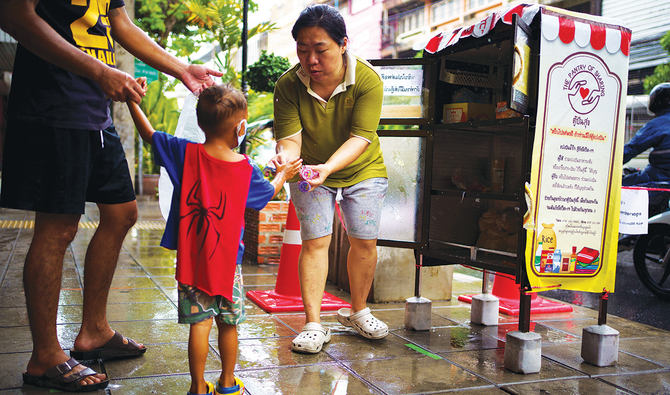
A boy and his father receive free food at a pantry run by a community charity in Bangkok amid growing hardship in the capital. (Reuters)
Short Url
Updated 13 May 2020
Follow

From haircuts to face masks, Thai tourism workers turn to new skills

  • Coronavirus travel restrictions decimate key industry, forcing thousands to search out other sources of income

BANGKOK: As Thailand’s tourist economy suffers a near-total shutdown from travel restrictions due to the global coronavirus pandemic, employees in the industry have been forced to improvise to make ends meet.

Air purser Kosit Rattanasopon, 37, has traded in his cabin crew uniform for a delivery driver’s jacket, stylishly ferrying food deliveries around the capital Bangkok on his Ducati motorbike since the Thai airline he works for grounded all flights.

Kosit makes about 1,000 baht ($31.13) per day, just enough to support his father and sister, who also cook boxed meals to sell online.

“I know things will not be the same again for at least another year, so I will have to keep doing this,” he said.

Tourism accounted for 11 percent of Thailand’s gross domestic product last year, and border closures and travel restrictions to prevent its spread are expected to decimate the industry for months to come.

Those who have new jobs are among the fortunate. About 4 million Thais work in the tourism sector, and most face a year or more of lost income until a vaccine or new coronavirus treatment allows travel to return to previous levels.

Another grounded airline worker, stewardess Thawanan Thawornphatworakul, has turned her living room into a hair salon. She averages two to three clients per day and charges 150 baht per cut. Thawanan, 36, said her income is nowhere near her airline salary, but it helps.

“The income here helps with some expenses and pays the bills,” she said.

Scuba diving instructor Sermsak Posayajinda, 47, has also found a new income source, making jars of chili paste from his mother’s recipes and selling them online.

“At first it was only a hobby during COVID-19 period, but the results have been very good, so this will become a business for us in the long term,” Sermsak said.

The closure of hotels and exhibition centers also disrupted the business of Asaree Jarugosol, 36, who rents out chairs and builds stages for hotels and caterers around Bangkok.

Asaree decided to retain all her staff by transforming her warehouse into a factory that makes 2,500 reusable face masks per day, first for local hospitals and now for exporting overseas as worldwide demand surges.

“At first we only have one sewing machine operated by one staff, but now we have about 40 people working a proper production line,” she said.

“We will continue to produce face masks even when our old business returns.”


Free trade negotiations between GCC, India mark new phase of partnership, says sec-gen

Updated 24 February 2026
Follow

Free trade negotiations between GCC, India mark new phase of partnership, says sec-gen

RIYADH: The Gulf Cooperation Council’s secretary-general affirmed that the negotiations for a free trade agreement between the GCC and India, and the signing of the joint statement, represents a new phase of strategic partnership.

Jasem Mohamed Al-Budaiwi said that this contributes to enhancing close cooperation and strengthening economic and trade ties, according to the Saudi Press Agency.

This came during the signing ceremony of the joint statement on launching the free trade agreement negotiations between the Al-Budaiwi and India’s Minister of Commerce and Industry, Piyush Goyal, which took place in New Delhi, on Tuesday.

During the signing ceremony, Al-Budaiwi said that the Terms of Reference, signed on Feb. 5, provide a comprehensive and clear framework for these negotiations. The two nations agreed to discuss enhancing cooperation in vital strategic areas, including trade in goods, customs procedures, and services.

Additionally, the framework covers Sanitary and Phytosanitary measures, intellectual property rights, cooperation on Micro, Small, and Medium Enterprises, along with other topics of mutual interest. This reflects the comprehensive nature of the agreement and its ability to keep pace with the future economy.

Al-Budaiwi expressed hope that these negotiations would lead to a comprehensive and ambitious free trade agreement that works to remove customs and non-customs barriers, enhance the flow of quality investments in both directions, and achieve further liberalization in trade and investment cooperation between the GCC and India for mutual benefit. 

This would provide a stimulating economic environment and an investment climate that opens broad horizons for the business sector, supports supply chains, and accelerates the pace of economic growth in line with the ambitious developmental visions of the GCC states. 

The top official affirmed the full readiness of the General Secretariat to host the first round of negotiations at its headquarters in Riyadh during the second half of this year.

The two sides held a meeting during which they reviewed the existing cooperation relations between the GCC and India and discussed ways to develop and elevate them to broader horizons, serving mutual interests and enhancing opportunities for strategic partnership between the two sides, particularly in the economic, investment, and trade fields.

They praised the role undertaken by the negotiating teams from both sides, appreciating the efforts contributing to reaching a comprehensive agreement that enhances economic integration and supports the smooth flow of trade between the two nations.