



LONDON: Qatar-owned Al Jazeera has come under fire for a podcast that glorifies Qassem Soleimani, the Iranian general killed in a US airstrike earlier this year.
The head of Iran’s Quds Force was the mastermind of Tehran’s inflammatory policies across the region. He helped fund and train terrorist groups in Lebanon, Yemen, Syria and Iraq and was himself sanctioned by the US and Europe.
However, a 27 minute Al Jazeera Arabic podcast published last week, paints a very different picture.
An actor playing the commander offers a sweeping justification of his and Iran’s role in the region.
The unusual format allows the Soleimani character a free rein to explain why he supported groups like Hamas and Hezbollah and helped Bashar Assad massacre his own people in Syria.
Egyptian media analyst Abdellatif El-Menawy said the podcast sounded like it had been produced by an Iranian propaganda channel rather than a news network that claims to adhere to professional rules.
“Documenting the lives of important personalities is one of the roles that the media should play, but it is important that the coverage is objective and does not adopt a particular direction,” El-Menawy said.
“When I listened to the Soleimani episode, I found unambiguous propaganda material.
“Those who listen to this podcast will find it has presented Soleimani as a national hero and a popular hero — the protector of Islam and the liberator of Jerusalem.
“This is propaganda par excellence, produced only by a biased media that adopts this approach. This is not strange for Al Jazeera.”
Entitled “Soleimani … Iran’s Spearhead,” the podcast is part of the “Rumooz” or “Symbols” series available on iTunes and other hosting platforms.
The podcast starts with the Soleimani character speaking with Russian President Vladimir Putin about the situation in Syria, where Iran and Russia have fought in support of Bashar Assad.
“Participating in the Syrian conflict has been one of my many achievements, along with convincing the Russian President Vladimir Putin in 2015 to militarily intervene for the benefit of us and our ally,” the Soleimani character says with pride.
“I am Qassem Soleimani, a soldier who has dedicated his life to serve the religion of Islam and the Islamic Revolution, its pride and dignity,” he continues.
The character describes himself as “a soldier engaged in jihad” before bragging that he is a “name feared by the biggest devil (the US), and the Zionist enemy (Israel).
He talks about his upbringing and the 1979 revolution in Iran, and describes its leader, Ayatollah Ruhollah Khomeini, as “an honest scholar” and that the uprising “shook the world, and revived Islam.”
The character then moves on to his own military prowess in the Iran-Iraq War and how he became leader of the Quds Force, the overseas arm of Iran’s Islamic Revolutionary Guard Corps “that is on a mission to liberate Jerusalem.”
The only counterpoint to the Soleimani character’s claims comes almost 20 minutes into the podcast when a woman’s voice appears as a moderator and asks if his force “aims to expand Iranian influence in the Arab and Gulf region through your agents.”
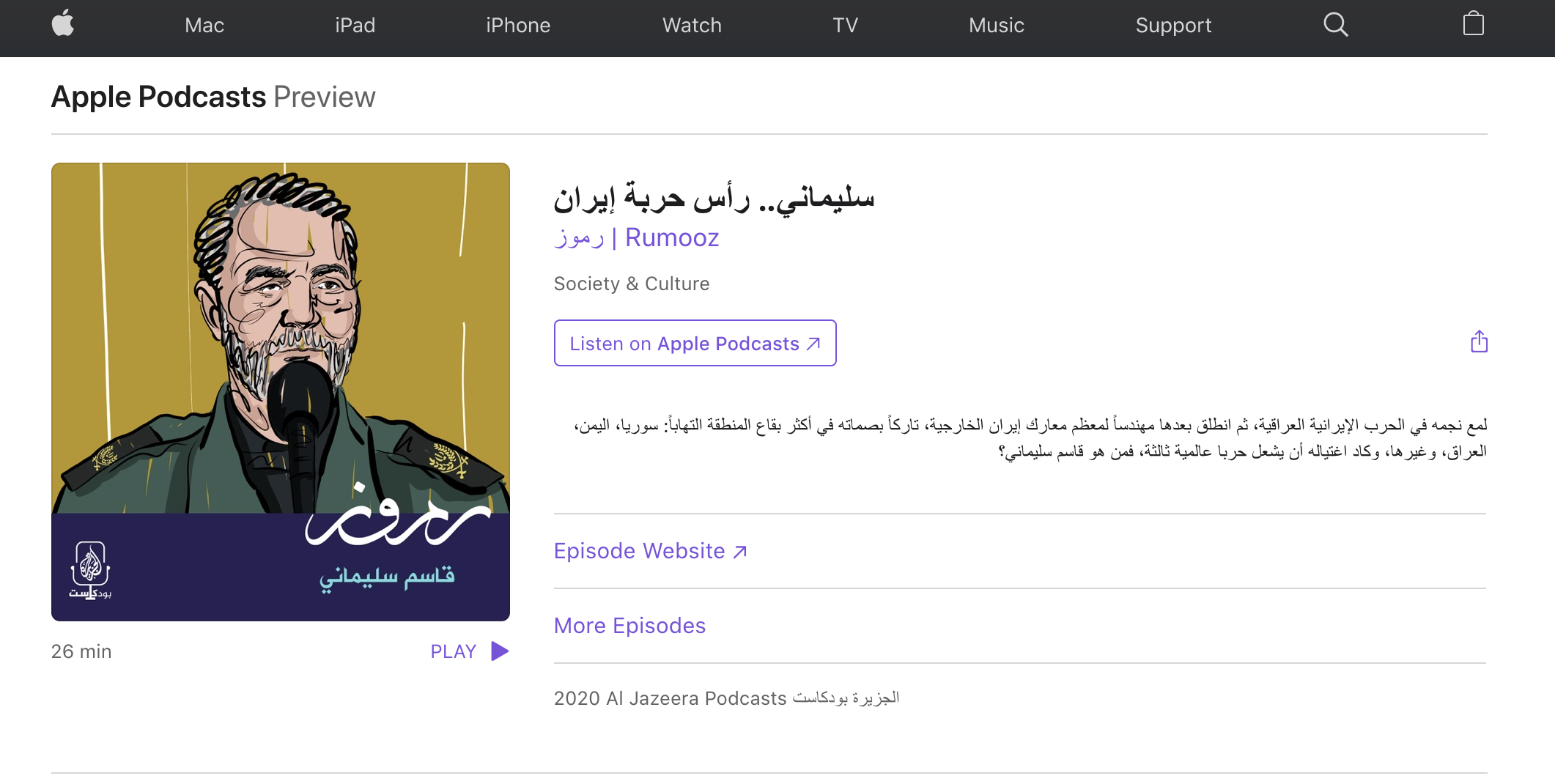
The podcast available on iTunes.
The Soleimani character is allowed a full and unquestioned response, saying: “This force has been established to serve resistance movements against the Zionist entity, and will always support them.”
He then reels off the terrorist-designated groups that his Quds Force supports in the region; Hezbollah, Hamas and Islamic Jihad, before describing them as “brothers to us, not agents, in the project to destroy the Zionist entity.”
The narrator then asks Soleimani about his part in the Syrian war and support for the Assad regime.
“How can you sleep at night without listening to the voices of the victims?” she asks.
The response, written by Al Jazeera’s editors, could not have been scripted better by the commander himself.
“We are fully aware of how things developed in Syria and how things spiraled out of control,” the character replies. “We are aware there were reasonable and legitimate demands in some Syrian cities, but in the same time, we are aware of the size of the conspiracy Syria is facing the US and the Zionist entity.
“The intent was to destroy Syria … a citadel of resistance in the region.”
The character continues to say Iran has been a “source of stability in Syria.”
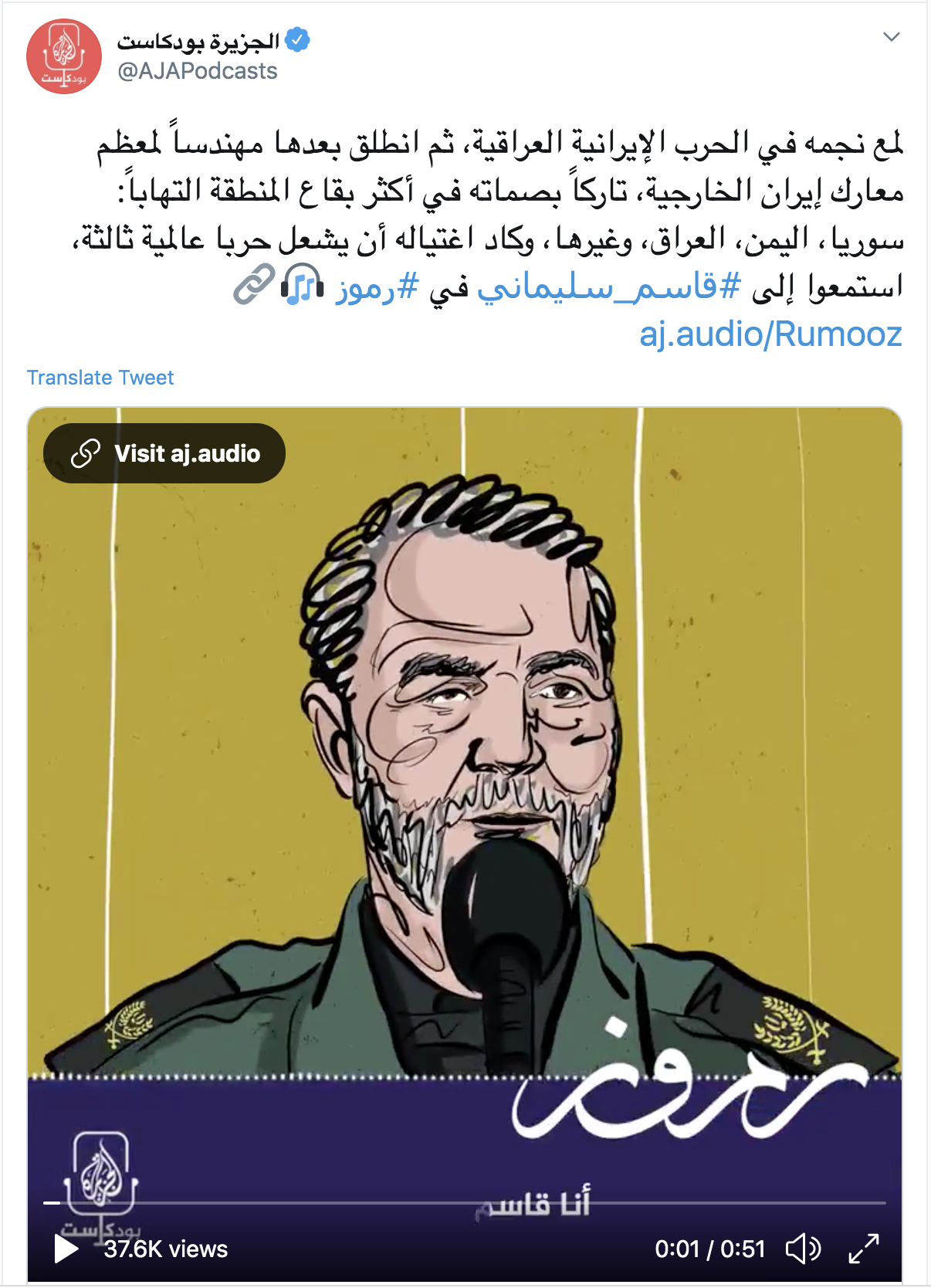
A tweet promoting the Qassem Soleimani podcast, which was later deleted.
Al Jazeera did not respond to Arab News's request for a comment on Monday. A tweet posted on Al Jazeera Arabic's podcast account promoting the episode was deleted Monday evening.
Soleimani was killed on Jan. 3 at Baghdad Airport, when his vehicle was struck by a missile fired by a US drone. The commander had just landed after a short flight from Damascus after spending time in Beirut with the Hezbollah leader Hassan Nasrallah.
Abu Mahdi Al-Muhandis, a senior figure in Iraq’s Hashed Al-Shaabi paramilitary force, was also killed in the attack.
The American action followed attacks on US bases in Iraq and marked a peak in tensions between the two countries. In the days that followed, Iran’s air defence systems shot down a Ukrainian passenger plane killing 176 people.
In the aftermath of Soleimani’s death, Al Jazeera Arabic was accused of ignoring his actions that had killed thousands in places like Syria, Yemen and Iraq. Instead the network focussed on his popularity in Iran.
Qatar has moved closer to Tehran since Saudi Arabia, the UAE, Bahrain and other Arab countries launched a boycott of the country primarily over its links to terror groups.


