

EU plots travel restart, saying ‘Europe needs a break’

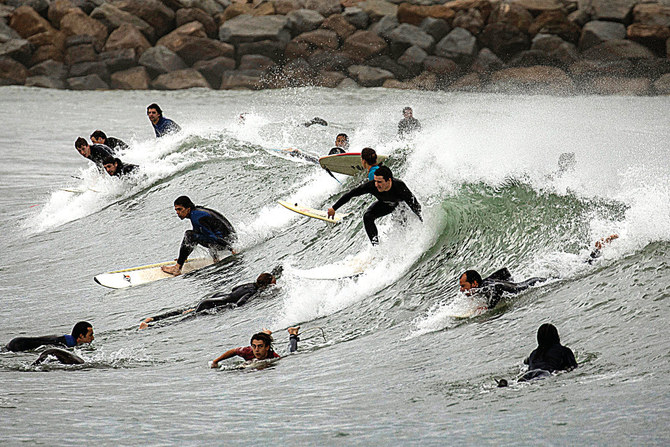
People surf in Barcelona, Spain, which reopened beaches for sporting activities after lockdown measures imposed due to coronavirus, were relaxed. (● Tourism, travel, hospitality business hit the hardest by virus. ● EU to unveil plan on Wednesday for gradual reopening. ● Brussels eyes state guarantees for canceled travel.AP)
Short Url
Updated 10 May 2020
Follow

EU plots travel restart, saying ‘Europe needs a break’

  • Continent’s flailing tourism sector, worth as much as ten percent of economic output, at heart of plans to kickstart revival

BRUSSELS: EU states should guarantee vouchers for travel canceled during the coronavirus pandemic and start lifting internal border restrictions in a bid to salvage some of the summer tourism season, the bloc’s executive will say next week.

Tourism, which under normal circumstances contributes almost a tenth of the EU’s economic output, is among the sectors hardest hit by the global outbreak that has grounded nearly all domestic and international travel.

Germany and other member states have urged a suspension of EU rules that force cash-drained airlines and the hospitality industry to offer full refunds for canceled flights and trips instead of vouchers for future travel.

In response, the European Commission will tell member states to guarantee vouchers to make them more attractive to customers, according to a strategy document seen by Reuters ahead of official publication due on Wednesday.

“To provide incentives for passengers and travelers to accept vouchers instead of reimbursement, vouchers should be protected against insolvency of the issuer and remain refundable by the end of their validity if not redeemed,” the draft document said.

“Insolvency protection needs to be assured at the national level and secured vouchers need to be accessible to all passengers and travelers,” it added.

The EU executive will also tell the bloc’s 27 member countries to gradually lift internal border restrictions and restart some travel to help the ailing tourism sector.

Tourism normally brings in some €150 billion every season from June through to August, with some 360 million international arrivals, according to the commission.

HIGHLIGHTS

  • Tourism, travel, hospitality business hit the hardest by virus.
  • EU to unveil plan on Wednesday for gradual reopening.
  • Brussels eyes state guarantees for canceled travel.

But Europe’s external borders are now bound to be shut for any non-essential travel until at least mid-June, an emergency measure to limit the spread of the virus.

“Our tourism industry is in grave trouble,” the commission is due to say, warning that 6.4 million jobs could be lost in the sector that has reported falls in revenue ranging from up to 50 percent for hotels and restaurants, to around 90 percent for cruises and airlines.

The pandemic set the EU on a path toward its worst-ever economic downturn and bitterly tested unity between member states fighting over medical equipment, export bans on drugs, chaotic border curbs and money to salvage their single market.

Titled “Europe needs a break” the commission’s tourism strategy will call for targeted restrictions to replace a general ban on travel and seek a gradual lifting of internal border checks where the health situation has improved.

With Europeans most likely to stay at home or travel shorter distances this summer, peripheral EU regions and islands are likely to be shunned and will take longer to bounce back.

“Until a vaccine or treatment is available, the needs and benefits of travel and tourism need to be weighed against the risks of again facilitating the spread of the virus ... possibly leading to a reintroduction of confinement measures,” the draft plan said. 


Saudi ports brace for cargo surge as shipping lines reroute

Updated 09 March 2026
Follow

Saudi ports brace for cargo surge as shipping lines reroute

RIYADH: Preliminary estimates suggest that several global shipping lines could reroute part of their operations to Saudi Arabia’s Red Sea ports, potentially adding 250,000 containers and 70,000 vehicles per month, according to Rayan Qutub, head of the Logistics Council at the Jeddah Chamber of Commerce, in an interview with Al-Eqtisadiah.

“Any disruption in the Strait of Hormuz not only affects maritime traffic in the Arabian Gulf but could also reshape global trade routes,” Qutub said, highlighting the strait’s status as one of the world’s most critical maritime chokepoints for energy and goods transport.

With rising regional tensions, international shipping companies are reassessing their routes, adjusting shipping lines, or exploring alternative sea lanes. This signals that the current challenges extend beyond the Arabian Gulf, impacting the global supply chain as a whole.

Limited impact on US, European shipments

The effects of these developments will not be uniform across trade routes. Qutub noted that goods from China and India, which rely heavily on routes through the Arabian Gulf, are most vulnerable to disruption. In contrast, shipments from Europe and the US typically traverse western maritime routes via the Suez Canal and the Red Sea, making them less susceptible to regional disturbances.

Saudi Arabia’s strategic location, he emphasized, strengthens the resilience of regional trade. The Kingdom operates an integrated network of Red Sea ports — including Jeddah, Rabigh, Yanbu, and Neom — that have benefited from substantial infrastructure upgrades and technological enhancements in recent years, boosting their capacity to absorb increased cargo volumes.

Red Sea bookings

Several major carriers, including MSC, CMA CGM, and Maersk, have already opened bookings to Saudi Red Sea ports, signaling a shift in operational focus to these strategically positioned hubs.

However, Qutub warned that rerouted shipments could increase sailing times. Cargo from Asia, which normally takes 30-45 days, might now require longer voyages via the Cape of Good Hope and the Mediterranean, potentially extending transit to 60-75 days in some cases.

These changes are also reflected in rising shipping costs, driven by longer routes, higher fuel consumption, and increased insurance premiums — a typical response when global trade patterns shift due to geopolitical pressures.

Qutub emphasized that Saudi Arabia’s transport and logistics sector is managing these developments through coordinated government oversight. The Ministry of Transport and Logistics, the Logistics National Committee, and the Logistics Partnership Council recently convened to evaluate the impact on trade and supply chains. Regular weekly meetings have been established to monitor developments and implement solutions to safeguard the stability of supplies and continuity of trade.

He noted that the Kingdom’s logistical readiness is the result of long-term strategic investments, encompassing ports, airports, road networks, rail systems, and logistics zones. Today, Saudi logistics integrates maritime, land, rail, and air transport, enabling a resilient response to global disruptions.

Qutub also highlighted the need for the private sector to continuously review logistics and crisis management strategies, develop alternative plans, and manage strategic stockpiles. Such measures are essential to mitigate temporary fluctuations in global trade and ensure smooth supply chain operations.