

Inside a quarantine facility: How hotel employees serve potential COVID-19 carriers

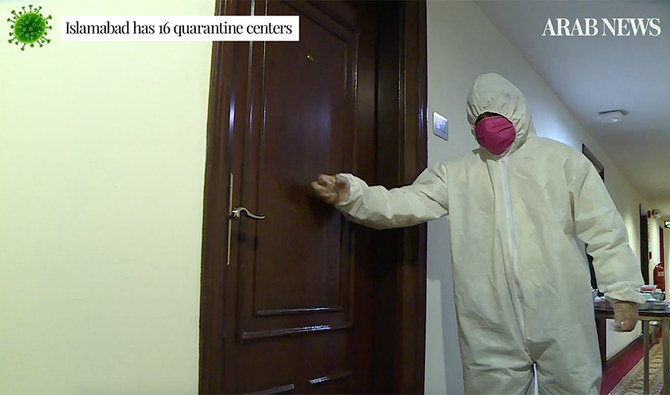
Hospitality staff wearing protective suit knocks on a door of a quarantined hotel guest in Islamabad to serve Iftar during Ramadan. (AN Photo)
Short Url
Updated 08 May 2020
Follow

Inside a quarantine facility: How hotel employees serve potential COVID-19 carriers

  • Only limited staff is allowed at quarantine centers to reduce the chances of infections
  • The National Institute of Health trains the hotel staff and checks them for the infectious disease twice a week

ISLAMABAD: Khurshid Ahmed had never thought he would be risking his life while serving his hotel guests in the heart of the federal capital.

The three-star residential facility where he works as a supervisor was turned into a temporary quarantine center by the government in March to facilitate the stranded Pakistanis returning to their homeland from other countries amid the coronavirus pandemic.

The repatriates get an option to stay at state-run quarantine centers or designated establishments under government control.

Instead of his regular formal wear for work, Ahmed puts on the protective clothing while serving his guests arriving from different countries who are immediately quarantined in separate rooms until the National Institute of Health (NIH) administers COVID-19 tests.

“I have been working for two years at this hotel, but I could not have imagined a situation where my work would become so hazardous,” he told Arab News while getting into his protective attire to prepare and serve the evening iftar meal to his guests who are usually required to stay at the facility for four days before being permitted to leave by the authorities.

“The number of hotel staff dealing with the guests has been deliberately limited by officials to lessen the chances of infections. We work in [three] shifts, and none of us is allowed to step outside the premises until our tests have concluded with negative results,” he said, adding that the NIH, which has given health safety training to the hotel staff, runs COVID-19 tests twice a week to check the employees.

While health professionals and doctors treating the coronavirus patients are acknowledged to be doing high-risk jobs, Ahmed says that hotel employees like him are also putting themselves in harm’s way while working on the front line to meet the needs of people who may be potential carriers of the virus.

According to the city magistrate, Ghulam Murtaza Chandio, Ahmed’s hotel has witnessed the highest number of positive cases among the 16 quarantine centers in Islamabad.

“Praise be to God, none of us has tested positive,” Ahmed told Arab News. “We can’t fear the virus since we have to fight it.”

Despite his enthusiasm to defeat the pathogen that has claimed about 600 lives in Pakistan as the country reports over 25,600 confirmed cases, he faces a string of complaints of his guests who are either unhappy about being quarantined or dissatisfied with the hotel’s curtailed serves.

“We understand their frustration, but the guests are not allowed to leave their rooms. They cannot have visitors, and nothing can be brought for them from outside,” front desk clerk Asif Kiani told Arab News.

Asked if he fears the temporary residents of the facility, Kiani says: “I am definitely fearful of working in this environment. But we have to conceal our emotions since any display of anxiety will only make the atmosphere more burdensome.”


IMF board to approve Pakistan reviews today ‘if all goes well,’ say officials

Updated 08 December 2025
Follow

IMF board to approve Pakistan reviews today ‘if all goes well,’ say officials

  • IMF’s executive board is scheduled to meet today to discuss the disbursement of $1.2 billion
  • Economists say the money will boost Pakistan’s forex reserves, send positive signals to investors

KARACHI: The International Monetary Fund’s (IMF) executive board is scheduled to meet today, Monday, to approve the release of about $1.2 billion for Pakistan under the lender’s two loan facilities, said IMF officials who requested not to be named.

The IMF officials confirmed the executive board was going to decide on the Fund’s second review under the $7 billion Extended Fund Facility (EFF) and first review under the $1.4 billion Resilience and Sustainability Facility (RSF), a financing tool that provides long-term, low-cost loans to help countries address climate risks.

“The board meeting will be taking place as planned,” an IMF official told Arab News.

“The board is on today yes as per the calendar,” said another.

A well-placed official at Pakistan’s finance ministry also confirmed the board meeting was scheduled today to discuss the next tranche for Pakistan.

The IMF executive board’s meeting comes nearly two months after a staff-level agreement (SLA) was signed between the two sides in October.

Procedurally, the SLAs are subject to approval by the executive board, though it is largely viewed as a formality.

“If all goes well, the reviews should pass,” said the second IMF official.

On approval, Pakistan will have access to about $1 billion under the EFF and about $200 million under the RSF, the IMF said in a statement in October after the SLA.

The fresh transfer will bring total disbursements under the two arrangements to about $3.3 billion, it added.

Experts see smooth sailing for Pakistan in terms of the passing of the two reviews, saying the IMF disbursements will help the cash-strapped nation to strengthen its balance of payments position.

Samiullah Tariq, group head of research at Pakistan Kuwait Investment Company Limited, said the IMF board’s approval will show that Pakistan’s economy is on the right path.

“It obviously will help strengthen [the country’s] external sector, the balance of payments,” he told Arab News.

Until recently, Pakistan grappled with a macroeconomic crisis that drained its financial resources and triggered a balance of payments crisis.

Pakistan has reported financial gains since 2022, recording current account surpluses and taming inflation that touched unprecedented levels in mid-2023.

Economists also viewed the IMF’s bailout packages as crucial for cash-strapped Pakistan, which has relied heavily on financing from bilateral partners such as Saudi Arabia, China and the United Arab Emirates, as well as multilateral lenders.

Saudi Arabia, through the Saudi Fund for Development, last week extended the term of its $3 billion deposit for another year to help Pakistan boost its foreign exchange reserves, which stood at $14.5 billion as of November 28, according to State Bank of Pakistan statements.

“In our view this [IMF tranche] will be approved,” said Shankar Talreja, head of research at Karachi-based brokerage Topline Securities Limited.

“This will help strengthen reserves and will eventually help a rating upgrade going forward,” he said.

The IMF board’s nod, Talreja said, would also send a signal to the international and local investors regarding the continuation of the reform agenda by Pakistan’s government.