

Cairo’s Ramadan cannon: A tradition that spread through the Arab world

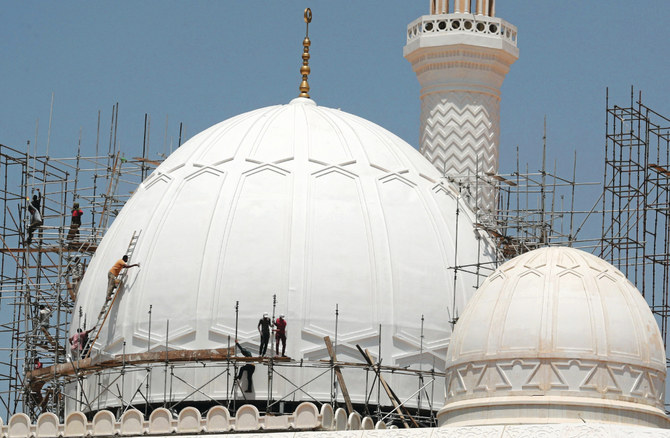
Workers build a mosque in the New Administrative Capital, east of Cairo. (Reuters)
Short Url
Updated 08 May 2020
Follow

Cairo’s Ramadan cannon: A tradition that spread through the Arab world

  • According to ‘The Month of Ramadan in Islam in the Pre-Islamic Era’ by Ahmed El-Manzalawy, the idea of a Ramadan cannon began in Egypt, but there are conflicting stories its origins

CAIRO: Before Maghreb prayers every day during Ramadan, most Cairo residents hear a cannon going off, signaling the breaking of the fast. They call it the Ramadan cannon and it is a tradition now followed in many other Islamic countries.

Since the dawn of Islam, and when the Prophet’s companion Bilal ibn Rabah would offer the adhan for iftar and sahoor, the cannon has alerted the Muslim public when to start eating. According to “The Month of Ramadan in Islam in the Pre-Islamic Era” by Ahmed El-Manzalawy, the idea of a Ramadan cannon began in Egypt. However, there are conflicting stories as to its origins.

One version says the Ramadan cannon began during the Burji Mamluk era in the 15th century, during the reign of Sultan Kho Shoqdum. The sultan wanted to test one of his cannons around sunset on the first day of Ramadan and the people mistakenly believed he had deliberately planned the event to mark iftar. They headed to his palace in the citadel and thanked him. So, he decided to fire the cannon throughout the holy month.

The second story claims the tradition started during the reign of Mohammed Ali Pasha, founder of modern Egypt in 1805, when he wanted to test a cannon he had received from Germany on the first day of Ramadan. The response from people was so positive, that he continued to fire the cannon throughout the month.

Yet another story suggests that the tradition started during the reign of Khedive Ismail, when a cannon went off accidentally at sunset on the first day of Ramadan as maintenance work was being carried out on it. The khedive’s daughter, Princess Fatma Ismail, reportedly ordered that the cannon continue to be fired at sunset each day. As a result, it was called Hajja Fatma Cannon.

During Khedive Ismail’s reign the cannon was moved to Moqattam mountain so that its sound would travel further. People would line the streets to watch the cannon be hauled up the mountain in a chariot with huge wheels. It would return to the citadel on the first day of Eid.

In the middle of the 19th century, during the reign of Abbas Helmy I, there were reportedly two cannon shots for iftar in Cairo — the first from the citadel and the second from Abbas Pasha palace in the suburb of Abbaseya.

Historian Abdel Meguid Abdel Aziz said the Ramadan cannon was silenced in 1987 when the Ministry of Antiquities warned that the blasts were damaging the walls of the citadel and other monuments in the area. However, Interior Minister Ahmed Roshdy ordered that the daily cannon shots recommence from the rooftop of the citadel throughout Ramadan and during Eid holidays.

Abdel Aziz added that, until last year, there were six cannons in Cairo: Two at the citadel, two in Abbaseya, one in Heliopolis and one in Helwan. All are fired simultaneously so that most of Cairo’s residents can hear. Last year, another cannon was added near Cairo University.


Ashi Studio returns to Paris Haute Couture Week with spring/summer 2026 collection

Updated 30 January 2026
Follow

Ashi Studio returns to Paris Haute Couture Week with spring/summer 2026 collection

DUBAI: Ashi Studio, the Saudi haute couture label founded by Mohammed Ashi, presented its spring/summer 2026 collection in Paris as part of Paris Haute Couture Week, joining a growing number of Arab designers showing on the official calendar.

Look 1 by Ashi Studio. (Supplied)

Set against softly draped fabric, the show this week focused on structure and craftsmanship, with garments defined by corsetry, layered surfaces and precise construction.

Corseted bodices appeared throughout the collection, many extending outward at the hips to create architectural silhouettes that framed the body. These shapes were executed in materials ranging from matte fabric to polished, reflective finishes that resembled molded metal or lacquered leather.

Look 2 by Ashi Studio. (Supplied)

In several looks, corsets were paired with sheer skirts, fine tulle layers or elongated panels that exposed the garment’s underlying structure.

Dresses made from feather-like strands, fringe and shredded materials contrasted with the rigidity of sculpted bodices, while embroidery and beadwork were applied in bands and clustered formations across the torso and hem.

The color palette remained restrained, moving between ivory, sand, taupe, bronze, black and deep burgundy. Darker looks included structured gowns and tailored coats with exaggerated shoulders, while lighter tones were used for sculpted white dresses, sheer wrapped pieces and feathered designs.

Look 3 by Ashi Studio. (Supplied)

Accessories were kept minimal, with sculptural clutches and headpieces used sparingly to maintain focus on the garments themselves.

Ashi Studio’s presentation took place alongside shows by Arab designers including Elie Saab, Zuhair Murad, Georges Hobeika, Georges Chakra, Tony Ward and Rami Al-Ali, underscoring the region’s continued presence on the Paris Haute Couture Week schedule.

Look 4 by Ashi Studio. (Supplied)

Ashi’s creations have been worn by the likes of Beyonce, Lady Gaga, Jennifer Hudson, Kylie Minogue, Penelope Cruz, Deepika Padukone, Sonam Kapoor, Queen Rania of Jordan, and more.

Ashi became the first couturier from the Gulf region to join the Federation de la Haute Couture in Paris as a guest member in 2023. He also became the first designer from the Gulf to be included in the BoF 500 list, the Business of Fashion’s index of the people shaping the fashion industry in 2023.

Ashi designed the inaugural fashion line for the cabin crew of the Kingdom’s new airline, Riyadh Air, which is on track to make its maiden flight in 2025.