

Muslims and Christians share Ramadan spirit in Cairo

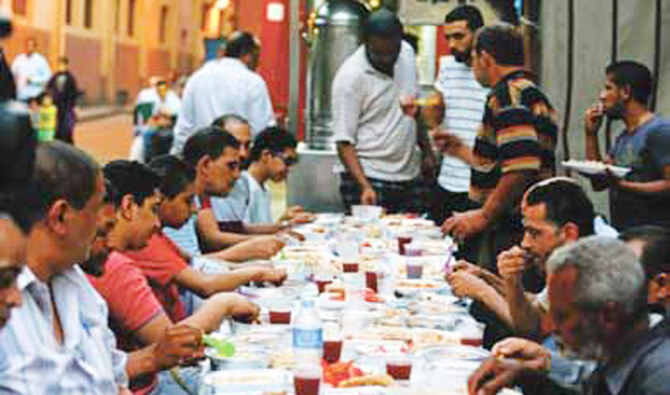
Muslims eat meals prepared by Coptic Christians during Ramadan in Cairo, Egypt. (Reuters)
Short Url
Updated 02 May 2020
Follow

Muslims and Christians share Ramadan spirit in Cairo

  • Coexistence is part of Egyptian life, especially in Shobra, and Ramadan sees the two religious communities come together out of respect and compassion

CAIRO: Christians in Cairo have been sharing Ramadan traditions and rituals alongside their Muslim neighbors, including donating to charity and enjoying iftar meals at sunset.
The Shobra area of the Egyptian capital has around 590,000 Christian residents according to the Cairo governorate.   
“I do not eat in front of fasting people,” Yasmine Tadros told Arab News. “I learned that at an early age. My parents taught me this at home. I have been sharing the rituals of my Muslim brothers for 20 years. In our street in Shobra we used to prepare iftar and have it together, Muslims and Christians. Many people would join in and we were very happy. This year, due to the coronavirus, safety is making us more cautious.”
Her childhood Muslim friends used to want to join her in the Christian fasting months by avoiding certain foods and drinks, she added.
Coexistence is part of Egyptian life, especially in Shobra, and Ramadan sees the two religious communities come together out of respect and compassion.
Magdy Aziz, who owns a popular grocery store on Shobra Street, donates rice and pasta to Ramadan charity banquets on the streets. This year, because the pandemic prevents the holding of such banquets, he decided to donate food to Shobra’s needier residents.  
“What I do comes from the heart,” Aziz told Arab News. “What I do is goodness that I wish for everyone, that is the love of God.”
He remarked that Egyptians loved to do good deeds and were connected to each other on all occasions, especially Ramadan. “Sometimes I sell things in Ramadan at half price to everyone.”
It was a gesture he had practised for years and more so during the holy month because it was a time for charity and good deeds, he added.  
It is not always to tell people from the two faiths apart in Shobra because of the care that some non-Muslims take to avoid offending or upsetting those who are fasting.   
Accountant Gerges Hanna said he was always keen during Ramadan not to hurt those who observed Ramadan, so he abstained from eating and drinking in front of them. He said he felt happy during the month and enjoyed the vibe of Ramadan, especially at sunset just before the fast was broken.  
Hanna told Arab News that he tried as much as he could to exchange shifts with his Muslim co-workers who were unable to work at full capacity while fasting. He added it was the least he could do for his colleagues during the month.
He also said that he stayed with his Muslim friends on the street during iftar to give away dates and juice to passersby.

HIGHLIGHT

Coexistence is part of Egyptian life, especially in Shobra, and Ramadan sees the two religious communities come together out of respect and compassion.

Father Rafik Greish, a spokesman for the Catholic Church in Egypt, said that Copts were instructed every year to take into consideration the feelings of those who were fasting in Ramadan. He added that churches stressed the importance of not eating or drinking in front of fasters between sunrise and sunset.
Copts had “self-awareness” and did not need to be told how to act during Ramadan, he added, but the church issued the instructions as a reminder.  
Greish said that, in the run-up to Ramadan, churches distributed packages containing basic food items to the poor and needy “because churches are keen to share traditions and rituals with Muslims during the month.”  
Mahmoud Abdel-Hai, who is in his 80s, said that he had never in his life seen a fight between a Muslim and a Christian during Ramadan. Abdel-Hai, a former teacher at Shobra Industrial School, said his Christian neighbor usually invited him for iftar at least once during Ramadan. However, the neighbor had apologized for not being able to carry out the tradition this year due to the pandemic.


Tunisia’s famed blue-and-white village threatened after record rains

Updated 31 January 2026
Follow

Tunisia’s famed blue-and-white village threatened after record rains

  • The one-time home of French philosopher Michel Foucault and writer Andre Gide, the village is protected under Tunisian preservation law, pending a UNESCO decision on its bid for World Heritage status

SIDI BOU SAID, Tunisia: Perched on a hill overlooking Carthage, Tunisia’s famed blue-and-white village of Sidi Bou Said now faces the threat of landslides, after record rainfall tore through parts of its slopes.
Last week, Tunisia saw its heaviest downpour in more than 70 years. The storm killed at least five people, with others still missing.
Narrow streets of this village north of Tunis — famed for its pink bougainvillea and studded wooden doors — were cut off by fallen trees, rocks and thick clay. Even more worryingly for residents, parts of the hillside have broken loose.
“The situation is delicate” and “requires urgent intervention,” Mounir Riabi, the regional director of civil defense in Tunis, recently told AFP.
“Some homes are threatened by imminent danger,” he said.
Authorities have banned heavy vehicles from driving into the village and ordered some businesses and institutions to close, such as the Ennejma Ezzahra museum.

- Scared -

Fifty-year-old Maya, who did not give her full name, said she was forced to leave her century-old family villa after the storm.
“Everything happened very fast,” she recalled. “I was with my mother and, suddenly, extremely violent torrents poured down.”
“I saw a mass of mud rushing toward the house, then the electricity cut off. I was really scared.”
Her Moorish-style villa sustained significant damage.
One worker on site, Said Ben Farhat, said waterlogged earth sliding from the hillside destroyed part of a kitchen wall.
“Another rainstorm and it will be a catastrophe,” he said.
Shop owners said the ban on heavy vehicles was another blow to their businesses, as they usually rely on tourist buses to bring in traffic.
When President Kais Saied visited the village on Wednesday, vendors were heard shouting: “We want to work.”
One trader, Mohamed Fedi, told AFP afterwards there were “no more customers.”
“We have closed shop,” he said, adding that the shops provide a livelihood to some 200 families.

- Highly unstable -

Beyond its famous architecture, the village also bears historical and spiritual significance.
The village was named after a 12th-century Sufi saint, Abu Said Al-Baji, who had established a religious center there. His shrine still sits atop the hill.
The one-time home of French philosopher Michel Foucault and writer Andre Gide, the village is protected under Tunisian preservation law, pending a UNESCO decision on its bid for World Heritage status.
Experts say solutions to help preserve Sidi Bou Said could include restricting new development, building more retaining walls and improving drainage to prevent runoff from accumulating.
Chokri Yaich, a geologist speaking to Tunisian radio Mosaique FM, said climate change has made protecting the hill increasingly urgent, warning of more storms like last week’s.
The hill’s clay-rich soil loses up to two thirds of its cohesion when saturated with water, making it highly unstable, Yaich explained.
He also pointed to marine erosion and the growing weight of urbanization, saying that construction had increased by about 40 percent over the past three decades.
For now, authorities have yet to announce a protection plan, leaving home and shop owners anxious, as the weather remains unpredictable.