

UN pushes for Yemen cease-fire as virus cases rise

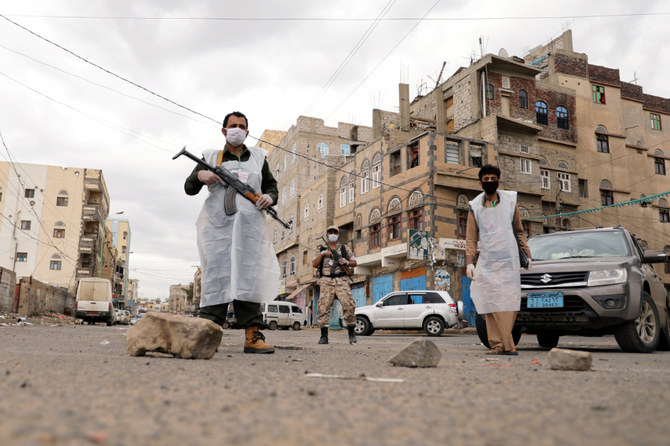
Security men wearing protective masks stand on a street in Sanaa in May, 6, 2020, during a 24-hour curfew amid concerns about the spread of the COVID-19. (REUTERS/Khaled Abdullah)
Short Url
Updated 07 May 2020
Follow

UN pushes for Yemen cease-fire as virus cases rise

  • Health teams in Aden, Taiz and Hadramout reported a new surge in the number of infections

AL-MUKALLA: Envoys of the five permanent members of the UN Security Council to Yemen have renewed their calls for an immediate cease-fire in the country after an alarming surge in the number of coronavirus cases.  

Following a virtual meeting with Yemen’s Foreign Minister, Mohammed Al-Hadrami, and a spokesperson for the Iran-backed Houthis, Mohammed Abdul Salam, the ambassadors urged both parties to “engage positively” with UN proposals to end hostilities and allow the country’s fragile health system to fight the virus outbreak.

“We told both parties that the best defense against COVID-19 is a permanent cease-fire and a resumption of political dialogue,” Michael Aron, the British ambassador to Yemen, said in an online post on Tuesday.

“We urged both parties to engage constructively with the UN texts with a view to adopting the joint declaration and attending the proposed crisis meeting.”  

Local media outlets also reported that the ambassadors voiced strong support for UN Yemen envoy Martin Griffiths’ diplomatic efforts with the separatist Southern Transitional Council, which seized control of Aden. 

In a recent interview with Arab News, Griffiths said that his latest peace proposal is based initially on a nationwide truce, measures to alleviate economic and humanitarian strife, and a commitment to the resumption of peace talks.

Discussions were expected to lead to a comprehensive peace settlement that would address the country’s thorny issues and prevent it from plunging into war again, he said.

The Saudi-led coalition and the internationally recognized government have declared a truce in Yemen to allow health workers to fight the spread of the disease.

Houthi rebels have demanded an end to airstrikes on their forces, the opening of airports and the withdrawal of Saudi-led coalition forces from the country before they adhere to a cease-fire.

Yemen’s Defense Ministry said on Tuesday that the army and allied tribesmen pushed back two Houthi attacks in the mountainous Nehim district, near Sanaa and Al-Bayda.

As fighting raged, the Aden-based supreme national emergency committee announced on Wednesday that four new coronavirus cases had been recorded in Lahj and Aden, bringing the total number of confirmed cases in areas under the government’s control to 25, including five deaths.

Health teams in Aden, Taiz and Hadramout reported a new surge in the number of infections as they continued to trace patients’ contacts despite a severe shortage of personal protective equipment. 

Riyadh Al-Jariri, head of the health ministry’s Hadramout office, said that health workers identified more than 50 people who had direct contact with  three people who tested positive for coronavirus in the province.

Patients’ contacts were asked to stay home and report any health problems to local doctors.

At the same time, authorities in Hadramout reimposed a partial curfew from 4 p.m. to 4 a.m., closed land entries to the province, and advised residents to limit social contact.

The emergency committee in the central province of Marib, headed by Gov. Sultan Al-Aradah, stepped up virus curbs, including extra testing at the province’s entry points, the use of rapid response teams, a ban on large gatherings and the shutting down of markets.

Following reports that the Houthis are concealing the number of coronavirus cases, the rebels failed to report any new cases on Wednesday and announced that 10 districts in Sanaa will be placed in 24-hour lockdown.

The first case of coronavirus inside Houthi-controlled territory was announced on Tuesday after a Somali national was found dead in a hotel in Sanaa.


France, allies preparing bid to ‘gradually’ reopen Strait of Hormuz: Macron

Updated 3 sec ago
Follow

France, allies preparing bid to ‘gradually’ reopen Strait of Hormuz: Macron

ABOARD FRENCH AIRCRAFT CARRIER CHARLES DE GAULLE: France and its allies are preparing a “defensive” mission to reopen the strategically vital Strait of Hormuz, President Emmanuel Macron said Monday as the Middle East war entered its second week.
The French leader landed by helicopter on the Charles de Gaulle aircraft carrier, dispatched to the Mediterranean after US-Israeli strikes on Iran on February 28 triggered a war that has sown regional chaos and which threatens to spill into other parts of the world.
Macron said during a visit to Cyprus earlier in the day that the Hormuz mission would be aimed at escorting container ships and tankers in order to gradually reopen the strait “after the end of the hottest phase of the conflict.”
“This is essential for international trade, but also for the flow of gas and oil, which must be able to leave this (Gulf) region once again,” Macron said during a visit to the island to discuss regional security.
Speaking alongside Cypriot President Nikos Christodoulides and Greek Prime Minister Kyriakos Mitsotakis, Macron said a “purely defensive, purely support mission” will be put together by European and non-European states.
The European Union on Monday said it was ready to “enhance” its operations to protect maritime traffic in the Middle East.
The EU has been discussing reinforcing its naval mission in the Red Sea after the US-Israeli attacks on Iran triggered a broader regional war.
Maritime traffic in the Strait of Hormuz, a key Gulf waterway through which a fifth of global crude passes, has all but halted since the war broke out.
Macron visited Cyprus after the EU member was targeted by Iranian-made drones last week.
The French leader said an attack on Cyprus was an attack on all of Europe.
“When Cyprus is attacked, it is Europe that is attacked,” he said.
The drone attack in Cyprus led to France’s deployment of the Charles de Gaulle carrier to the Mediterranean, as well as a frigate and air defense units to the island.
Paris has insisted its stance in the region is “strictly defensive.”

- Bombing won’t bring change -

The initial US-Israeli strikes on Iran killed supreme leader Ali Khamenei, and the Islamic republic on Monday named his son, Mojtaba Khamanei, as his successor — an appointment US President Donald Trump said he was “not happy” with.
Aboard the Charles de Gaulle, Macron said the conflict’s duration depended on what US-Israeli objectives were, warning that “profound” changes to the Iranian leadership could not occur “through American-Israeli bombings alone.”
“We are putting ourselves in a position to last,” he said, adding that the war, “in this intense phase,” could last “several days, perhaps several weeks.”
The flagship Charles de Gaulle may eventually be deployed to the Strait of Hormuz as part of the announced mission, Macron said.
A French frigate was already taking part in the EU’s Operation Aspides, which was launched in the Red Sea in 2024 to prevent attacks on trade vessels by Iran-backed Houthi rebel forces.
Macron earlier said that France would contribute “in the long term” with two frigates to Operation Aspides.
“What we want to do is to ensure freedom of navigation and maritime security,” he said.
Separately, the French president on Monday morning spoke to Israeli Prime Minister Benjamin Netanyahu about the situation in the Middle East and Lebanon, the Elysee said.