Iraq to emerge as OPEC’s main output cuts laggard

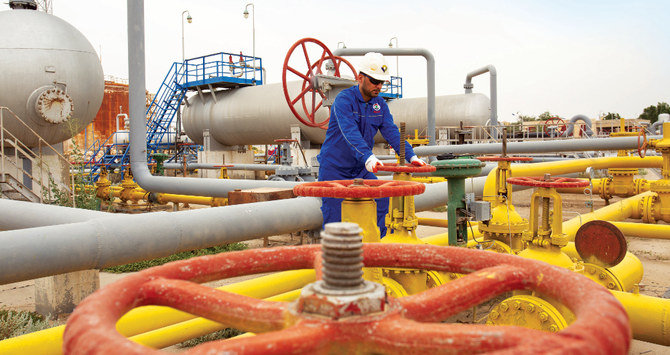
Work at the Nahr Bin Omar natural gas field in Iraq, where major oil production cutbacks are expected. (AFP)
Short Url
Updated 07 May 2020
Follow

Iraq to emerge as OPEC’s main output cuts laggard

BAGHDAD: Iraq has yet to inform its regular oil buyers of cuts to its exports, suggesting it is struggling to fully implement an OPEC deal with Russia and other producers on a record supply cut, traders and industry sources said.

Less than full compliance by Iraq, as well as by smaller producers such as Nigeria and Angola, could hurt the OPEC+ group’s efforts to cut output by 9.7 million barrels per day from May 1, equivalent to about 10 percent of world demand before the coronavirus crisis led to a slide in consumption and prices.

Iraq, OPEC’s second-largest oil producer, has instructed its biggest company, Basra Oil Co. (BOC), to cut output from May as part of its efforts to reduce its output by 1 million bpd, or 1 percent of global supply, an oil ministry source said.

But it has yet to agree an action plan with other oil companies such as BP, Exxon, Eni or Lukoil, which operate the biggest fields in the country, a BOC spokesman said.

“Talks with international oil companies are still continuing to discuss ways of curtailing production that serve all parties and ensure mutual interests
are observed,” the BOC
spokesman said.

“We can’t say talks hit deadlock. We expect a breakthrough to be reached soon.”

Iraq’s oil ministry could not be immediately reached for comment. BP, Exxon, Eni and Lukoil declined to comment.

One industry source active in Iraq said the companies were refusing the cut and that delays in forming a new government in Iraq were complicating the discussions.

“It’s a mess at the moment,” the source said.

OPEC Gulf states, including Saudi Arabia, Kuwait and the United Arab Emirates, have informed their customers of cuts to exports. Kuwait, Oman and the UAE have also officially informed OPEC.

Three trading sources said Iraq has not issued any such statements to its regular oil buyers yet.

Two of the sources said Iraq’s May export plans from the south were broadly in line with April’s at around 3.3 million bpd.

There is no requirement for participating countries to tell OPEC how they will make their cut, but informing customers about their oil allocations is standard practice.

OPEC’s Secretary-General Mohammad Barkindo declined to discuss country compliance: “We are now focused on the full and timely implementation of this.”

The challenge for many OPEC+ countries arises from how much they are asking international oil companies (IOCs) to cut, said Amrita Sen of analyst firm Energy Aspects.

“Beyond logistical shut-ins, some of the cuts needed from Iraq, Nigeria and others when they have barely complied with previous cuts are not going to happen,” she said.

Companies producing in Iraq’s southern oilfields operate service contracts that pay them a fixed dollar fee for their output and are also compensated in
crude cargoes.

This type of contract shields oil companies against sharp falls in oil prices. But it also means that with the OPEC cuts, Iraq ends up with less crude to market itself.


Saudi ministry launches private sector tender to operate sports venues in Makkah region

Updated 7 sec ago
Follow

Saudi ministry launches private sector tender to operate sports venues in Makkah region

RIYADH: New investment opportunities in athletic facilities across the Makkah region have been launched as Saudi Arabia looks to expands private sector participation in the sports economy and improve the commercial performance of its stadiums.

The Kingdom’s Ministry of Sport announced the offering under its “Sports Facilities Investment” initiative, inviting qualified companies to bid for a three-year contract to operate and manage multiple venues, including King Abdullah Sports City Stadium in Jeddah, Prince Abdullah Al-Faisal Stadium in Jeddah, King Abdulaziz Stadium in Makkah, and the indoor arena at King Abdullah Sports City.

The initiative comes amid a wider push by Saudi Arabia to maximize the commercial value of its sports infrastructure as the Kingdom prepares for major international tournaments and expands its domestic sports economy.

Under the proposed arrangement, the selected operator will manage matches, events, and daily venue services to enhance fan experiences and operational quality, while the ministry will retain responsibility for maintenance and oversight. The model is designed to expand partnerships with the private sector and improve the year-round utilization of sports infrastructure.

The investment opportunity offers multiple revenue streams, including ticket sales, food and beverage concessions, and hospitality services, as well as advertising and venue naming rights, excluding King Abdullah Sports City Stadium, and the ability to host non-sporting events and community activities.

Francesca Petriccione, an international sports lawyer and professor at the University of Milan, said the initiative reflects a broader strategy to transform stadiums into long-term economic assets rather than facilities used only for sporting competitions.

“These stadiums are being developed as long-term economic assets rather than simply event venues,” Petriccione told Arab News. “The infrastructure strategy is not only about match-day capacity but also about commercial activation outside football.”

Petriccione advises leading international football clubs on strategic expansion projects in the Middle East, particularly in Saudi Arabia. Her work focuses primarily on football club acquisitions and cross-border investment in the sports sector.

She explained that the Kingdom’s broader sports infrastructure program, linked to its 2034 FIFA World Cup bid, demonstrates a portfolio approach to stadium development.

“Saudi Arabia’s plan is built around 15 proposed stadiums across five cities, including four existing venues, three already under construction and eight planned new builds,” Petriccione said. “The ministry is trying to avoid the classic white elephant problem by embedding stadiums within a broader utilization model.”

According to the professor, the Kingdom’s stadium program is designed to support both international tournament hosting and long-term infrastructure development.

“The ministry is not simply refurbishing legacy stock but selectively creating a next-generation venue network for top-tier international events,” she said.

Petriccione added that the nation’s approach emphasizes multi-purpose venues capable of hosting concerts, conferences and other large-scale events in addition to football matches, improving utilization rates and strengthening the financial model of sports infrastructure.

“Modern stadiums are financially stronger when they function as experience and events platforms rather than simply football grounds,” she said.

Some venues are also being integrated into larger urban development strategies and tourism ecosystems rather than built as standalone athletic projects, aligning sports infrastructure with broader real estate and destination planning. 

Petriccione noted that the ministry’s decision to invite private companies to operate and manage facilities signals a gradual shift toward commercially driven management structures. 

“The value is not only in construction — it also lies in operations, facility management, venue technology, hospitality, naming rights, premium seating and non-match-day monetization,” Petriccione said.

The ministry said the investment initiative aims to create a scalable operating model that could later be applied to additional sports facilities across the Kingdom, while increasing financial efficiency, enhancing commercial rights activation and generating new revenue streams for the sports sector.