

Former Iraqi intelligence chief approved as new premier

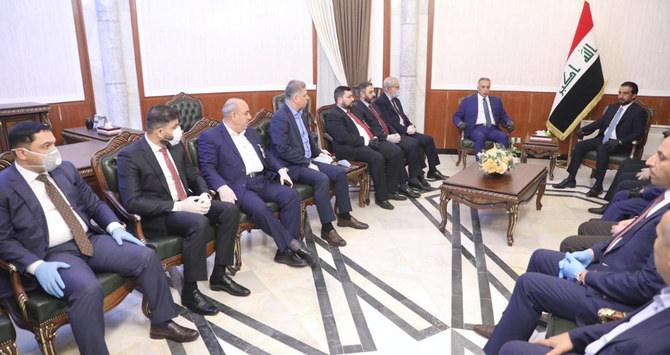
he speaker of Iraq's parliament Mohammed al-Halbousi meets with Iraqi Prime Minister-designate Mustafa Al-Kadhimi before the vote on the new government at the parliament headquarters in Baghdad, Iraq, May 6, 2020. (Reuters)
Short Url
Updated 07 May 2020
Follow

Former Iraqi intelligence chief approved as new premier

BAGHDAD: Iraq’s former spy chief was sworn in as prime minister by lawmakers early Thursday after weeks of tense political negotiations as the country faces a severe economic crisis spurred by plummeting oil prices and the coronavirus pandemic.
The majority of 255 legislators attending the session approved the government plan and the majority of Cabinet ministers proposed by Mustafa Al-Kadhimi, officially inaugurating him as Iraq’s sixth premier since 2003 and ending five months of a leadership void.
Legislators accepted 15 ministers and rejected five, among them the ministries of trade, justice, culture, agriculture and migration. The ministries of oil and foreign affairs also remain vacant pending further political negotiations. According to Iraq’s constitution, a government can pass if over half of a proposed Cabinet is approved.
Al-Kadhimi, who gave up the intelligence post when he became the prime minister-designate, assumes the premiership as Iraq faces unprecedented crises amid falling oil revenues that will likely prompt unpopular austerity measures, a rising daily tally of coronavirus cases, and expected US-Iraq talks.
“This government came as a response to the social, economic and political crises our country is facing,” Al-Kadhimi said during the session, addressing lawmakers. “It is a government that will provide solutions, not add to the crises.”
The road to the premiership has been long and unwieldy for Al-Kadhimi. He was the third candidate chosen by Iraq’s fragmented political blocs after the previous two failed to get broad support. His success is a testament to lessons learned from where others had failed.
Former Communications Minister Mohammed Allawi resigned, citing obstruction from political parties in his attempt to pick an independent Cabinet. Former Najaf Gov. Adnan Al-Zurfi resigned amid political infighting.

Saudi Arabia’s King Salman and Crown Prince Mohammed bin Salman congratulated Al-Kadhimi on forming a government on Thursday. 
Al-Kadhimi’s swearing-in also signifies how crucial the sectarian quota-based political system — called the Muhasassa in Arabic — remains in Iraqi politics. The dismantling of this system was a key demand of mass anti-government protests that broke out in October. Demonstrations died down as measures to contain the coronavirus took hold in the capital early this year.
Al-Kadhimi had to change his list of proposed ministers at least three times in the past week to appease Iraq’s fragmented political blocs. Deals were still being struck over the naming of ministers between political parties minutes before the bell rang to signal the start of the parliament session.
Officials close to Al-Kadhimi said he has strategized to leave ministerial appointments up to political blocs but plans to consolidate his leadership within the prime minister’s office to carry out reforms, similar to former Prime Minister Haidar Al-Abadi.
“If everyone cares about ministries, (Al-Kadhimi) is trying to take back the PMO and run reforms centrally,” said Renad Mansour, senior research fellow at Chatham House.
His government plans to address Iraq’s economic and health crises and pave the way for early elections in line with protest demands.
To do this, he said, the sovereignty of the state must be asserted. “This can be achieved by limiting the use of arms to the state, the armed forces and the commander in chief and not allowing Iraqi territories to be used for settling scores or launching attacks,” he said.
His first weeks in office are likely to be monopolized by the severe economic crisis in the wake of falling oil prices. Prices have hovered between $20-30 per barrel, about half of what was projected to finance the 2020 budget and barely enough for the crude-dependent country to pay public sector wages. Oil sales make up nearly 90% of state revenues.
In April the country made just $1.43 billion in oil sales, and is expected to be further constrained as OPEC production cuts take hold. The World Bank has predicted without adequate reforms, Iraq’s economy will contract by just under 10% this year.
The vacuum in leadership has left the country without an approved budget law, which in turn has limited its ability to borrow from foreign agencies. Al-Kadhimi’s first order of business will likely be passing a budget.
Officials in Abdul-Mahdi’s caretaker government had mulled over an array of cuts to scale down social benefits to public sector employees. But it remains to be seen if Al-Kadhimi will adopt these proposals, which would cut urgent spending by 30%.
Al-Kadhimi will also lead Iraq as negotiations are set to take place with the US in June. Relations suffered after a Washington-directed strike killed top Iranian general Qassim Soleimani in January. The talks will cover, among other things, the presence of the US-led coalition.
The issuance of the latest US sanctions waiver for 30 days enabling Iraq to continue purchasing vital Iranian gas to meet energy needs was also linked to a new government being formed. The current waiver runs out May 26.
According to a statement from the State Department late last month, Secretary of State Mike Pompeo “granted this brief extension of the waiver to allow time for the formation of a credible government.”


How Gaza’s shattered fishing industry deepened the enclave’s food security crisis

Updated 19 February 2026
Follow

How Gaza’s shattered fishing industry deepened the enclave’s food security crisis

  • Once a pillar of local food security, Gaza’s fishing sector has been reduced to a fraction of its prewar capacity
  • UN agencies warn the destruction of boats and ports has deepened aid dependence and worsened protein shortages

DUBAI: Gaza’s fishing industry — once a critical source of food, income and affordable protein — has been largely destroyed as a result of Israel’s war with Hamas, worsening the Palestinian enclave’s food security crisis.

According to the UN Food and Agriculture Organization, fishing activity in Gaza now stands at less than 10 percent of prewar levels following the widespread destruction of boats, ports and equipment, combined with prolonged maritime closures enforced under Israel’s naval blockade.

UN and human rights organizations estimate that up to 72 percent of Gaza’s fishing fleet has been damaged or destroyed, alongside near-total devastation of related infrastructure, including landing sites, storage facilities and repair workshops.

Israel's naval blockade has Gaza's fishing industry to decline to about a tenth of pre-war levels. (Reuters photo)

The remaining vessels are small, damaged skiffs capable of operating only meters from shore.

Ramzy Baroud, a journalist, author and editor of The Palestine Chronicle, said the destruction of Gaza’s fishing sector must be understood as part of a deliberate policy aimed at preventing Palestinians from developing independent food-producing systems.

Baroud says Israel had pursued a strategy since 1967 to foster Palestinian dependency — first on the Israeli economy, and later on humanitarian aid entering Gaza through Israeli-controlled crossings — leaving the population permanently vulnerable to economic collapse.

“This vulnerability is functional for Israel, as it allows the Israeli government and military to leverage their control over Palestinian lives through political pressure in pursuit of concessions,” he told Arab News.

Palestinians were prevented from developing local industry through restrictions on imports and exports, while much of Gaza’s arable land was seized or turned into military targets, he said.

“Likewise, the fishing sector was deliberately crippled through direct attacks on fishermen, including arrests, live fire, confiscation of equipment, and the sinking or destruction of boats,” he added.

FAO has documented widespread destruction across Gaza’s coastal fishing areas.

“In Gaza’s fishing areas now lie broken boats, torn nets, and ruined infrastructure, standing in stark contrast to the once-vibrant industry that supported thousands of fishers for generations,” Beth Bechdol, FAO deputy director-general, said in a statement.

Before the war, more than 4,000 registered fishermen worked along Gaza’s 40-kilometer coastline, supporting tens of thousands of family members and contributing to local food security in an enclave heavily dependent on imports.

Today, the majority have been stripped of their livelihoods, as access to the sea has become sporadic, dangerous, or entirely prohibited.

For decades, fishing off Gaza was restricted to shifting maritime zones — typically between three and 12 nautical miles offshore — often tightened or closed entirely during periods of escalation.

Since October 2023, when the Israel-Hamas conflict began, humanitarian organizations say there have been extended periods of total maritime closure, effectively banning fishing and depriving Gaza’s population of one of its few remaining sources of local food production.

Baroud said the assault on Gaza’s fishing sector was not a by-product of war, but part of a deliberate strategy that intensified during the conflict.

“For Gaza, the sea represents freedom,” he said. “All of Gaza’s other borders are controlled by Israel, either directly or indirectly.”

Israel had consistently worked to deny Palestinians access to the sea, he said. And despite commitments under the Oslo Accords to allow fishing up to 20 nautical miles offshore, those provisions were never honored.

“The assault on Gaza’s fishing sector is therefore not incidental,” Baroud said. “It is about severing Palestinians from one of the few spaces not entirely enclosed by walls, checkpoints, and military control.”

Israel has generally rejected or not accepted accusations that it is unlawfully targeting Gaza’s fishermen, framing incidents at sea as enforcement of security zones or as under investigation rather than deliberate attacks on civilians.​

In past lethal incidents at sea highlighted by Human Rights Watch, the Israel Defense Forces have typically said boats “deviated from the designated fishing zone” and that forces fired after warnings were ignored.

According to FAO, rebuilding Gaza’s fishing sector will be impossible without a fundamental change in access and security conditions.

“For Gazans, the sea was not just a source of food, but a source of livelihood and identity,” Bechdol said.

“FAO can assist to help rebuild Gaza’s fishing industry. But for this to happen, peace must first be established and fishers must be allowed to operate their boats and cast their nets without fear of harm.”

Ciro Fiorillo, head of the FAO office for the West Bank and Gaza, said the agency is primed to offer assistance once the security situation improves.

“FAO is ready to restart projects, replenish damaged boats and equipment, and inject emergency funds as soon as these key fishing inputs for production are allowed to enter the Strip, a sustained ceasefire is in place, and access to the sea is restored,” Fiorillo said in a statement.

Since the Oct. 7, 2023, Hamas-led attack on southern Israel triggered the Israeli military assault on Gaza, much of the enclave has been flattened, tens of thousands killed, and some 90 percent of the population displaced.

Even since the ceasefire came into effect with the exchange of hostages and prisoners in October last year, pockets of violence have continued and humanitarian needs remain dire. The collapse of fishing has only compounded an already catastrophic food crisis.

The UN Office for the Coordination of Humanitarian Affairs has repeatedly warned that the destruction of food-producing systems — including agriculture, fisheries and markets — has pushed Gaza toward famine, with households facing extreme shortages of protein and calories.

With farmland destroyed, livestock killed and imports severely restricted, fish was once among the few foods that could still be sourced locally.

Its near disappearance has driven prices beyond reach for most families and increased dependence on limited humanitarian aid.

“This is about denying Palestinians access to life itself — to survival,” said Baroud.

The destruction of fishing forces Palestinians into deeper dependence on humanitarian aid that Israel itself controls, effectively weaponizing food rather than allowing Palestinians to sustain themselves independently, he said.

Human rights groups documenting maritime enforcement report that fishermen attempting to operate — even close to the shore — face gunfire, pursuit, detention and arrest, contributing to a climate in which fishing has become a life-threatening activity rather than a livelihood.

According to rights monitors, the destruction of larger vessels has eliminated the possibility of reaching deeper waters, forcing the few remaining fishermen to operate in unsafe, shallow zones with damaged equipment, limited fuel and no protection.

Baroud said international law clearly obligates an occupying power to protect civilian livelihoods and ensure access to food and means of survival.

“The systematic targeting of fishermen — who are civilians engaged in subsistence activity — cannot be justified as a military necessity, especially when it results in starvation and famine,” Baroud said.

He said the Fourth Geneva Convention prohibits collective punishment, the destruction of civilian infrastructure and the targeting of livelihoods.

The Palestinian Centre for Human Rights has described the restriction of Gaza’s fishing sector as part of a broader assault on civilian survival systems, warning that the denial of access to the sea has direct implications for nutrition, employment and aid dependency.

Baroud said the recovery of Gaza’s fishing sector could not occur in isolation from the broader economy.

“Only a measure of real freedom for Palestinians — freedom of movement, access to land and sea, and the ability to import, export and produce independently — can allow Gaza’s industries and economy to recover,” he said.

Without ending the system of control governing Palestinian life, Baroud said, any discussion of reconstruction or recovery would remain hollow.

As famine warnings intensify, the fishing sector’s collapse stands as a stark example of how Gaza’s food system has fractured.

What was once a daily livelihood is now reduced to occasional, high-risk attempts to secure food.

With no functioning fleet and no safe access to waters, Gaza’s fishermen are operating at the edge of survival.