

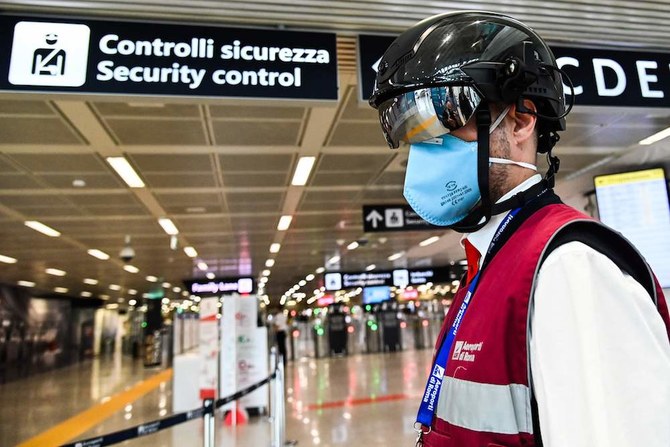

ROME: Italy is “now absolutely ready” to handle a potential second wave of COVID-19 infections, the deputy health minister told Arab News a few days into the easing of the country’s lockdown.
“The health situation in Italy is now much, much better than a few weeks ago,” said Pierpaolo Sileri, adding that the number of infections, deaths and admissions to intensive care units are considerably down.
“This means we’re confident that the partial reopening we decided from May 4 will be under control.”
To date, more than 29,000 people have died from COVID-19 in Italy, according to figures from Johns Hopkins University.
“In the next two or three weeks, we’ll observe if there will be another outbreak,” said Sileri, a surgeon and author of hundreds of scientific publications.
He said he is “well aware” of a study by Imperial College London warning that Italy is at risk of a second wave that could be far deadlier than the first if the country’s lockdown is eased too much.
According to the study, if general movement returned to 20 percent that of pre-lockdown levels — without the introduction of additional measures such as contact tracing — several regions in Italy could experience “a resurgence in the number of deaths far greater than experienced in the current wave.”
Sileri said: “I believe this is a risk for the entire world. There will be a risk to face everywhere openings take place. However, if we all respect social distancing and use face masks, we can minimize the risk of a new COVID-19 outbreak.”
He added: “Probably the Imperial College paper overestimates numbers, but we need certainly to proceed slowly. This is why the Italian government allowed so far only 4.5 million people to go back to work, not the entire population to resume its ordinary life … If we face another outbreak, we may decide to set up ‘red zones’ by sealing areas of the country where new hotbeds are detected.”
Since Italy’s outbreak, Sileri has been on the frontlines, in part due to his medical background. He led the team that in February repatriated 25 Italians from the Chinese city of Wuhan, where the pandemic began. Sileri himself got infected.
“It has been a very hard experience. We had to face emergencies everywhere, from lack of doctors to lack of swabs and masks and hospital beds,” he said. “The entire world will understand better what happened only in a few years.”



