Cali counties with few cases restarting economy

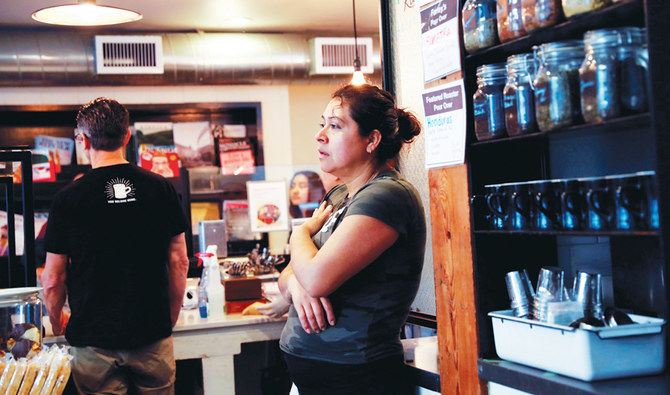
The coronavirus pandemic has led to huge job losses in California, with some restaurants being forced to lay off almost their entire staff. (Reuters)
Short Url
Updated 06 May 2020
Follow

Cali counties with few cases restarting economy

  • Some parts of the west coast state have avoided a big coronavirus impact

YUBA CITY, CALIFORNIA: California state restrictions banning restaurants from offering sit-down meals have not yet been lifted, but you wouldn’t know that in downtown Yuba City, where families queued cheerfully for tables at the Happy Viking Sports Pub and Eatery.

The restaurant opened its doors to the public for the first time in 50 days on Monday, after county officials ruled that restaurants, retail stores and fitness centers could open if patrons and staff obeyed social distancing rules — even though restrictions technically remain in place for the entire state.
“We were tired of being in quarantine,” said Tyler Niesen, who had lunch at the Happy Viking with his wife Sidney, four-year-old daughter and two month old son. “We actually got to see people — family and friends.”
The family, who were not wearing masks, ordered burgers and greeted friends at the bustling restaurant. The couple said they were not worried about contracting the virus while out and about.
The moves by Modoc, Yuba and Sutter counties north of Sacramento to allow businesses to open came as Governor Gavin Newsom, a Democrat, said he would allow some “low-risk” businesses like bookstores to re-open beginning on Friday.
He also said communities with low incidents of COVID-19 infections could apply to be released more quickly from additional restrictions.
The three counties in the north didn’t wait for permission. They’re still calling on residents to cover their faces when they are interacting with others, and asking older people to continue to shelter at home. In Yuba and Sutter counties, schools, places of worship and theaters are still prohibited from opening.
Sandee Drown, who owns the Happy Viking with her husband Chris, wore a black mask with the logo of the San Francisco Giants baseball team on it. Her staff also wore masks, but customers did not.
The restaurant lost a quarter of its business during the shutdown, and laid off all but eight of its 47 employees, Drown said.

FASTFACT

California has the largest economy in the US.

Aware that moves to re-open the economy have taken on a political tinge, with some Republicans pushing against restrictions imposed by the Democratic governor, Drown said that the involvement of health director Phuong Luu gave her confidence that re-opening would be safe.
California is one of about two dozen US states that still have strict coronavirus restrictions in place, and residents have been chafing at the prolonged lockdown.
From birthday parties with social distancing to thronging the beaches on warm weekends, residents have begun to test the limits of the public health restrictions. A few restaurants, hair salons and retail shops have reopened on their own, according to local media reports, even as California’s coronavirus cases and deaths continue an upward trajectory.
Vocal groups of protesters, including right-leaning groups and anti-vaccination activists, have crowded the grounds of the state capitol in Sacramento, demanding that social and economic life be allowed to resume.
Newsom was conciliatory about the moves by Yuba and Sutter counties on Monday, saying they could come into compliance later in the week.
In the Southern California community of Victorville in San Bernardino County, gym owner Jacob Lewis re-opened his business on May 1, without waiting for either state or county officials to give him the green light. On Monday some patrons wore masks and practiced social distancing — and some did not.
“I’m big on the constitution so if you want to wear a mask, wear a mask. If you don’t, don’t,” he said. “At the end of the day, it’s freedom.”
Assemblyman James Gallagher, a Republican who represents Yuba City in the state legislature, said his county was basing its decisions on data and science, and had ordered residents to shelter at home a day before the governor issued his statewide order in March.
But he said that cases in the county had since plateaued, with just one person in the hospital with COVID-19 as of Monday. Social distancing worked, but at a great cost to the economy, he said.
“It put a lot of people out of work,” Gallagher said. “Not to mention the damage it’s going to do to local and state governments and programs that everyone relies on.”


Saudi Maaden reports 156% profit surge to $2bn on strong commodity prices, record production

Updated 05 March 2026
Follow

Saudi Maaden reports 156% profit surge to $2bn on strong commodity prices, record production

RIYADH: Saudi mining and metals company Maaden has reported a 156 percent jump in its net profit attributable to shareholders for 2025, driven by higher commodity prices, record production volumes, and a one-off bargain purchase gain.

The state-backed giant posted a net profit of SR7.35 billion ($1.95 billion) for the full year 2025, an increase from SR2.87 billion in the previous year. The firm’s revenue surged by 19 percent to SR38.58 billion, up from SR32.55 billion in 2024.

This comes as Saudi Arabia steps up efforts to expand its mining sector as a pillar of economic diversification, encouraging international participation and private investment to unlock the Kingdom’s estimated $2.5 trillion in untapped mineral resources under Vision 2030.    

In a statement on Tadawul, the company said: “Performance was led by record phosphate production, near record aluminum production, an increase in all three of Maaden’s main output commodity prices.”

The performance was also fueled by a 60 percent increase in gross profit, which reached SR14.79 billion. In its annual results announcement, Maaden attributed the top-line growth to “higher commodity market prices for phosphate, aluminum and gold business units,” as well as increased sales volumes in its phosphate and aluminum segments. This was partially offset by slightly lower sales volume in the gold unit.

Maaden’s CEO, Bob Wilt, hailed 2025 as a transformative year for the company, marked by strategic growth and operational excellence. “This was a great year for Maaden’s strategic growth. We delivered strong financial results and sustained operational excellence across the business,” he said in a statement.

“This was driven by growth in production across all businesses, including record-breaking DAP (di-ammonium phosphatevolumes), disciplined cost control across and a clear commitment to our role as a cornerstone of the Saudi economy,” Wilt added.

Profitability was further bolstered by an increased share of net profit from joint ventures and an associate. This included a one-off bargain purchase gain of SR768 million related to Maaden’s investment in Aluminium Bahrain B.S.C. The company also benefited from lower finance costs.

The fourth quarter of 2025 was strong, with Maaden swinging to a net profit of SR1.67 billion, compared to a loss of SR106 million in the same period of the prior year. Quarterly revenue rose 7 percent to SR10.64 billion.

The firm achieved record production of di-ammonium phosphate, reaching 6.72 million tonnes for the year, a 9 percent increase. Aluminum production remained near-record levels, while the company added a net 7.8 million ounces to its reportable gold mineral resources through discovery and resource development.

The phosphate division saw sales jump 17 percent to SR20.77 billion, with the earnings before interest, taxes, depreciation, and amortization margin expanding to 47 percent. The aluminum business reported a 9 percent increase in sales to SR10.99 billion, with EBITDA more than doubling in the fourth quarter.

Looking ahead, Wilt emphasized that the pace of growth will accelerate as the company advances key initiatives, including the Phosphate 3 Phase 1 and Ar Rjum projects, which remain on budget and schedule. Maaden has also secured a gas supply for its future Phosphate 4 project.

“This pace of growth will only accelerate. Not only as we advance projects and increase the scale of our exploration program, but as we continue to grow production and implement technology that will further modernize, streamline and unlock value,” Wilt added.

Earnings per share for the year rose sharply to SR1.91, up from SR0.78 in 2024. Total shareholders’ equity increased by 18.7 percent to SR61.59 billion.