

Uber Eats halts services in Saudi Arabia, will transition to Careem in UAE

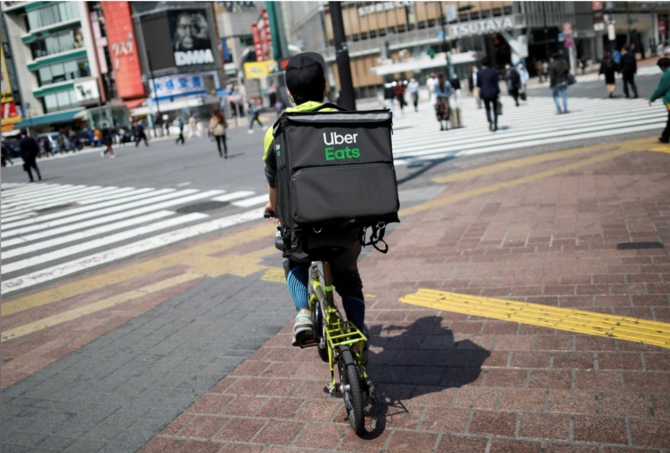
An Uber Eats delivery person rides a bicycle during an outbreak of the coronavirus disease (COVID-19), at Shibuya shopping and amusement district in Tokyo, Japan April 8, 2020. (Reuters)
Short Url
Updated 04 May 2020
Follow

Uber Eats halts services in Saudi Arabia, will transition to Careem in UAE

  • Uber Eats is closing down operations in eight markets, including Saudi Arabia and Egypt
  • Uber says its core rides business was unaffected in all of the markets

JEDDAH: Uber Eats announced the suspension of its services on Monday, considering it their last working day before removing its service completely from the Kingdom.

The food app first launched in Saudi Arabia’s capital in February 2018, followed by a service expansion into Jeddah almost a year later, before it phased into the Eastern Province throughout 2019.

“We have made the decision to discontinue Uber Eats in Saudi Arabia. This will also allow us to commit further energy and resources on our top Eats markets around the world. Looking ahead, we remain committed to growing and investing in Uber’s mobility platform in the Middle East,” an Uber Eats’ spokesperson told Arab News.

The decision came after several studies of the business metrics of delivery services in the competitive market: Uber then chose to concentrate on other areas where Uber Eats is growing.

Frequent users of the app heard the news through an email announcement. “After years of partnering with local restaurants to offer convenient, reliable food delivery, we have made the difficult decision to discontinue Uber Eats in Saudi Arabia at the end of Monday, 4 May,” the statement said.

The company said that it was sad to be leaving its Saudi customers, but would continue to serve them through Uber Rides.

“Our number one priority now is to minimize the impact on the valued employees, restaurant partners, delivery partners and consumers who have supported us,” the statement said.

The suspension came as a shock to app users, who considered it the fastest delivery app among its competitors in Saudi Arabia.

Abdullah Altayyari (@obdoli), a web and mobile designer from Riyadh, tweeted: “What a loss! Honestly speaking it was the best delivery app in my opinion.”

Another user Jawahir (@JawahirM) said that the app had some issues despite its swiftness: “It was a decent app but browsing through it was terrible and it had no variety when it came to restaurants, but their delivery was swift and their pricing was impeccable.”

Others were not as concerned. Ahmed Alqurashi, a barista in Makkah, said that his family used the app often due its fast delivery, “but there are many other apps that deliver food, so it’s not a big deal.”

Khaled, Twitter user (@kali_kali17), based the company’s decision on the current events. “Many US-based companies are limiting their operations, if not stopping them all together, outside the US due to the current crisis.”

“I don’t think Uber Eats would’ve been a hit had it stayed, due to its lack of understanding of the Saudi market and consumer,” he said.


Reforms target sustained growth in Saudi real estate sector, says Al-Hogail

Updated 26 January 2026
Follow

Reforms target sustained growth in Saudi real estate sector, says Al-Hogail

RIYADH: The Real Estate Future Forum opened its doors for its first day at the Four Seasons Riyadh, with prominent global and local figures coming together to engage with one of the Kingdom’s most prospering sectors.

With new regulations, laws, and investments underway, 2026 is expected to be a year of momentous progress for the real estate sector in the Kingdom.

The forum opened with a video highlighting the sector’s progress in the Kingdom, during which an emphasis was placed on the forum’s ability to create global reach, representation, as well as agreements worth a cumulative $50 billion

With the Kingdom now opening up real estate ownership to foreigners, this year’s Real Estate Future Forum is placing a great deal of importance on this new milestone and its desired outcomes and impact on the market. 

Aside from this year’s forum’s unique discussions surrounding those developments, it will also be the first of its kind to launch the Real Estate Excellence Award and announce its finalist during the three-day summit.

Minister of Municipalities and Housing and Chairman of the Real Estate General Authority Majed Al-Hogail took to stage to address the diverse audience on the real estate market’s achievements thus far and its milestones to come.

Of those important milestones, he underscored “real estate balance” as a key pillar of the sector’s decisions to implement regulatory tools “with the aim of constant growth which can maintain the vitality of this sector.” He pointed to examples of those regulatory measures, such as the White Land Tax.

On 2025’s progress, the minister highlighted the jump in Saudi family home ownership, which went from 47 percent in 2016 to 66 percent in 2025, keeping the Kingdom’s Vision 2030 goal of 70 percent by the end of the decade on track.

He said the opening of the real estate market to foreigners is an indicator of the sector’s maturity under the leadership of Crown Prince Mohammed bin Salman. He said his ministry plans to build over 300,000 housing units in Riyadh over the next three years.

Speaking to Arab News,  Al-Hogail elaborated on these achievements, stating: “Today, demand, especially local demand, has grown significantly. The mortgage market has reached record levels, exceeding SR900 billion ($240 billion) in mortgage financing, we are now seeing SRC (Saudi Real Estate Refinance Co.) injecting both local and foreign liquidity on a large scale, reaching more than SR54 billion”

Al-Hogail described Makkah and Madinah as unique and special points in the Kingdom’s real estate market as he spoke of the sector’s attractiveness.

 “Today, the Kingdom of Saudi Arabia has become, in international investment indices, one that takes a good share of the Middle East, and based on this, many real estate investment portfolios have begun to come in,” he said. 

Al-Ahsa Gov. Prince Saud bin Talal bin Badr Al-Saud told Arab News the Kingdom’s ability to balance both heritage sites with real estate is one of its strengths.

He said: “Actually the real estate market supports the whole infrastructure … the whole ecosystem goes back together in the foundation of the real estate; if we have the right infrastructure we can leverage more on tourism plus we can leverage more on the quality of life … we’re looking at 2030, this is the vision … to have the right infrastructure the time for more investors to come in real estate, entertainment, plus tourism and culture.”