AMMAN: Sanctions-hit Syrian tycoon Rami Makhlouf on Sunday said that security forces were arresting employees at his diversified companies in what he said was “mounting pressure” on him days after Syrian authorities asked him to pay hefty taxes.
Makhlouf, a maternal cousin of President Bashar Assad and widely considered part of the president’s inner circle, has a business empire that ranges from telecoms and real estate to construction and oil trading. He played a big role in financing Assad’s war effort, Western officials have said.
“Today pressures began in an unacceptable ways and the security forces, in an inhumane way, are arresting our employees,” Makhlouf said in a video.
The security forces did not immediately reply to a request for comment.
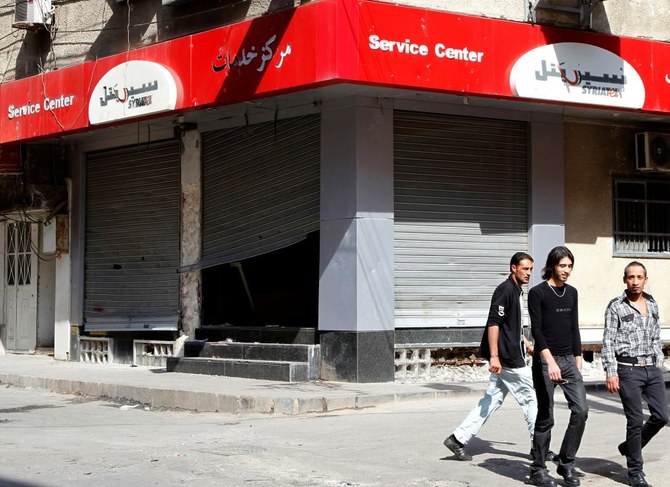
Addressing Assad in the video, Makhlouf said he had been asked to step down from the companies he runs, including Syriatel, the country’s main mobile operator and main source of revenue for the sanctions-hit government.
“Did anyone expect the security forces would pounce on Rami Makhlouf’s companies who were their biggest supporters and their patron during the war?” Makhlouf said.
The billionaire has been under US sanctions since 2008 for what Washington calls public corruption and it has since toughened measures against top businessmen who are close to him.
The European Union has also slapped sanctions on Makhlouf since the Syrian conflict began in 2011, accusing him of bankrolling Assad.
He became a hated figure to many pro-democracy protesters who rose up against corruption and the authoritarian rule of Assad in March 2011.

Syrian tycoon Makhlouf says security forces are arresting his employees
https://arab.news/y3daz
Syrian tycoon Makhlouf says security forces are arresting his employees
- Makhlouf said he had been asked to step down from the companies he runs, including Syriatel
India’s Modi is making his second official visit to Israel to meet with Netanyahu
- In addition to being a powerful ally, India is also Israel’s No. 2 trading partner in Asia
JERUSALEM: Indian Prime Minister Narendra Modi was expected in Israel on Wednesday for a two-day visit focusing on strengthening security, economic and technological cooperation between the two countries.
Modi has said he would hold talks with Israeli Prime Minister Benjamin Netanyahu and President Isaac Herzog and would speak to Israeli parliament on Wednesday evening.
“Our nations share a robust and multifaceted Strategic Partnership,” Modi wrote on X. “Ties have significantly strengthened in the last few years.”
Netanyahu referred to himself and Modi as “personal friends” when he announced the visit earlier this week and the visit is likely to give Israel a boost of international support after seeing relations with many of its allies deteriorate since the war in Gaza began in October 2023.
In addition to being a powerful ally, India is also Israel’s No. 2 trading partner in Asia. Total trade between India and Israel was valued at $3.62 billion in the 2025 fiscal year, according to India’s Ministry of Commerce and Industry.
Modi became India’s first prime minister to travel to Israel in 2017, and Netanyahu reciprocated with a trip to India the following year.
Netanyahu told a Cabinet meeting Sunday that economic and security issues will be high on the leaders’ agenda, as will sharing technology, including artificial intelligence and quantum computing.
“We are partners in innovation, security, and a shared strategic vision,” Netanyahu said on the social platform X ahead of Modi’s arrival. “Together, we are building an axis of nations committed to stability and progress.”
Modi’s embrace of Israel has marked a shift in India’s foreign policy. India has historically supported the Palestinians, and did not establish full diplomatic ties with Israel until 1992.
A staunch Hindu nationalist, Modi was one of the first global leaders to swiftly express solidarity with Israel following the Oct. 7, 2023 attack by the Palestinian militant Hamas group.
India was also among more than 100 countries earlier this month to condemn Israel’s newly approved measures to deepen its control over the occupied West Bank and weaken the already limited powers of the Palestinian Authority.