Senior PTM leader dies after Wana gun attack

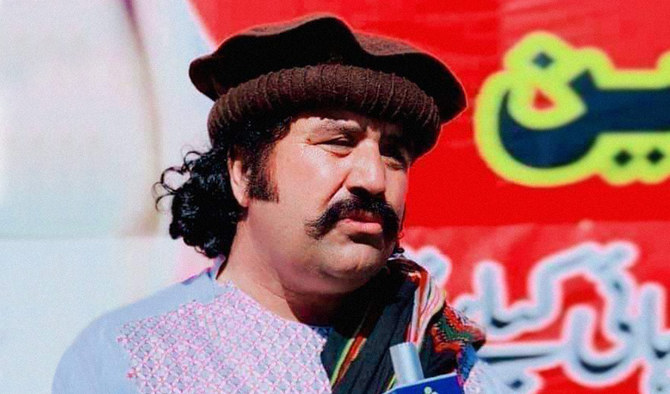
This undated file photo shows slain PTM leader Arif Wazir during an interview with a local news channel. (Photo courtesy: social media)
Short Url
Updated 02 May 2020
Follow

Senior PTM leader dies after Wana gun attack

  • Arif Wazir succumbed to his injuries in Islamabad a day after attack outside his South Waziristan home
  • Was released from prison on bail last month after being charged with making anti-Pakistan speech

PESHAWAR: Arif Wazir, a senior leader of the Pashtun Tahaffuz Movement (PTM) died in an Islamabad hospital on Saturday, a day after he was attacked by unidentified gunmen in the South Waziristan tribal district, senior members of his party said.
The PTM which identifies as a Pashtun rights movement campaigns against what it alleges are military excesses against ethnic populations during anti-terrorism operations.
PTM emerged in 2018, after the killing of an ethnic Pashtun man by police in the port city of Karachi. The killing led to nationwide protests.
On Friday, minutes before iftar, indiscriminate firing from a moving car outside Wazir's home in Wana left the Pashtun leader critically wounded according to PTM leader Abdullah Nangyal. Following this, he was taken to Islamabad for treatment.
"But [I say] with a heavy heart, Arif Wazir embraced martyrdom on Saturday morning," Nangyal told Arab News.
Soon after his killing, rights group Amnesty International said in a statement that Pakistani authorities must carry out an independent and effective investigation into the attack on Wazir.
Mohsin Dawar, a member of Pakistan's national assembly and a PTM founding leader told Arab News that it was the responsibility of the state to ensure the protection of its citizens.
“It’s a failure of the state for not protecting its citizens," he said. 
The deceased, who had been released from prison on bail a month ago after being charged with delivering an "anti-Pakistan" speech in April, was also the first cousin of sitting MNA Ali Wazir from South Waziristan. Nangyal said the lawmaker had lost over a dozen family members in recent years to armed assaults by militants. 
Pakistan says members of the PTM are funded by foreign states and agencies. The PTM denies any external links.
Many PTM supporters are ethnic Pashtuns who hail originally from areas bordering Afghanistan, which used to be the center point of a long insurgency by Taliban and subsequent operations by the Pakistan army.


’Super Flu’: Pakistan confirms presence of fast-spreading H3N2 influenza strain

Updated 4 sec ago
Follow

’Super Flu’: Pakistan confirms presence of fast-spreading H3N2 influenza strain

  • Health authorities say virus is not new but shows higher transmission rate
  • WHO reports global rise in seasonal influenza cases, especially in Europe

ISLAMABAD: Pakistani health authorities on Monday confirmed the presence of the H3N2 influenza strain, often referred to as a fast-spreading “super flu,” in the country, but stressed there was no cause for panic, saying the virus is not new and remains manageable with standard treatment and vaccination.

Officials said the strain is part of seasonal influenza viruses that circulate globally each year and has undergone genetic changes that make it spread more quickly, a pattern health experts say is common for influenza.

The confirmation comes as the World Health Organization (WHO) reports a global increase in seasonal influenza activity in recent months, with a growing proportion of influenza A(H3N2) cases detected, particularly across several European countries, including the United Kingdom.

“Yes, we have witnessed confirmed cases of H3N2 influenza (super Flu) in Pakistan since November this year. Out of total around 1,691 cases reported throughout Pakistan since last month, 12 percent are of the so called super flu,” Dr. Shafiq-Ur-Rahman, Senior Scientific Officer at Pakistan’s Center for Disease Control (CDC), told Arab News.

He said the virus had undergone a genetic drift, a gradual mutation that is typical of influenza viruses. 

“The symptoms are similar to other influenza strains, but speed of transmission is high for H3N2,” Rahman said, adding that treatment remains the same as for other flu types and vaccination is critical to limiting spread.

Seasonal influenza is an acute respiratory infection caused by influenza viruses that circulate year-round worldwide. The WHO has stressed that influenza continues to evolve through gradual genetic changes, making ongoing surveillance and regular vaccine updates essential.

Influenza spreads easily through droplets when infected people cough or sneeze. While most individuals recover within a week without medical treatment, the illness can range from mild to severe and may result in hospitalization or death, particularly among high-risk groups such as young children, older adults, pregnant women and people with underlying health conditions.

Doctors say early symptoms of the flu can resemble those of the common cold, but the progression often differs. Colds typically develop gradually, beginning with a runny or blocked nose, sneezing and sore throat, followed by mild coughing and fatigue.

Flu symptoms, however, tend to appear suddenly and more intensely, with patients often experiencing high fever, extreme tiredness, body aches, headaches and a dry cough.

Health experts say this abrupt and severe onset is usually the clearest indication that an illness is influenza rather than a common cold, which is generally milder and slower to develop.