Libyan central bank reserves to fall 20% as oil revenues sink: Audit bureau

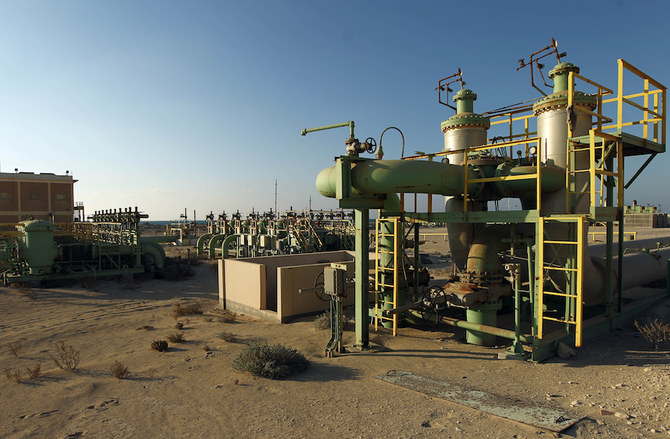
A picture shows a general view at the Zueitina oil terminal. (File/AFP)
Short Url
Updated 02 May 2020
Follow

Libyan central bank reserves to fall 20% as oil revenues sink: Audit bureau

  • Annual oil revenues are expected to fall to $5 billion from $31 billion last year, dragging the central bank reserves down to $50 billion
  • The fiscal deficit is forecast to reach 26.7 billion dinars ($19 billion) this year compared to a surplus of 11 billion dinars in 2019

TUNIS: Libya’s central bank reserves are seen falling by about 20% this year because of a blockade on energy exports by eastern-based forces that has slashed revenues, the audit bureau said.
Annual oil revenues are expected to fall to $5 billion from $31 billion last year, dragging the central bank reserves down to $50 billion, it said.
Eastern-based forces shut down oil exports in January. Global oil prices have also crashed as the coronavirus pandemic hits demand, with no prospect of a quick recovery in sight.
The fiscal deficit is forecast to reach 26.7 billion dinars ($19 billion) this year compared to a surplus of 11 billion dinars in 2019, the Tripoli-based audit bureau said in a video posted on Facebook on Friday.
Libya has been split since 2014 between the internationally recognized Government of National Accord (GNA) in Tripoli and a rival administration in Benghazi that controls eastern Libya and has set up parallel institutions.
Although most oil production and export facilities are in the east, international agreements mean it can only be sold by the National Oil Company (NOC) in Tripoli, with revenue flowing through the Tripoli-based Central Bank of Libya (CBL).
The oil revenue is then used to finance state operations across the country, including the salaries of public sector employees in the east as well as areas controlled by the GNA.
Eastern-based forces shut off exports in January and the oil price has since crashed, leading to an immediate reduction in revenue.
The GNA earlier this year issued a state budget with forecast spending but without giving figures for expected revenues.


Oman property price index jumps 17.3% in Q3 

Updated 28 December 2025
Follow

Oman property price index jumps 17.3% in Q3 

JEDDAH: Oman’s real estate price index recorded a 17.3 percent increase in the third quarter of 2025 compared with the same period in 2024, according to official data. 

The commercial property price index rose 14.6 percent, driven by a 19 percent increase in commercial land prices, while the cost of commercial shops fell by 8.5 percent, as per the country’s National Centre for Statistics and Information, or NCSI, based on figures from the Ministry of Housing and Urban Planning. 

Industrial land prices posted a moderate increase of 5.5 percent, while residential property prices recorded stronger growth of 18.7 percent year on year, the Oman News Agency reported. 

The rise in Oman’s real estate price index comes amid broader momentum across Gulf property markets, where residential activity remained resilient in the third quarter of 2025. Higher demand in major cities across the region, supported by population growth and ongoing infrastructure investment, helped underpin price gains, even as some markets faced tighter financing conditions. 

“As for the residential property price index, it achieved clear growth in the third quarter of 2025, with a rate of 18.7 percent compared to the third quarter of 2024, as residential land prices increased by 19.6 percent, residential apartments by 22.4 percent, in addition to the growth of villa prices by 16.5 percent, while the prices of other houses decreased by 0.5 percent,” the ONA report stated. 

Oman’s residential land prices climbed 19.6 percent, with apartments rising by 22.4 percent, while villas increased by 16.5 percent. Prices of other types of houses saw a slight decline of 0.5 percent. 

At the governorate level, Muscat recorded the highest increase in residential land prices at 48.3 percent, followed by Musandam at 29.7 percent, Al-Dakhiliyah at 12.3 percent, Al-Batinah South at 8.7 percent, North Al Batinah at 8.1 percent, and Dhofar at 4 percent. 

On the other hand, some governorates saw declines in residential land prices, with Al-Dhahirah down 25.8 percent, Al-Buraimi down 24.6 percent, Al-Wusta down 13.3 percent, Al-Sharqiyah North down 4 percent, and Al-Sharqiyah South down 2.2 percent. 

“This increase reflects continued demand in Oman’s real estate market, with residential properties in Muscat and Musandam driving much of the growth,” the ONA report added. 

The data also show clear differences across regions, with price gains concentrated in major urban areas. Strong demand in Muscat and coastal governorates was supported by population growth, investment, and infrastructure spending, while some interior regions recorded declines as market activity softened.