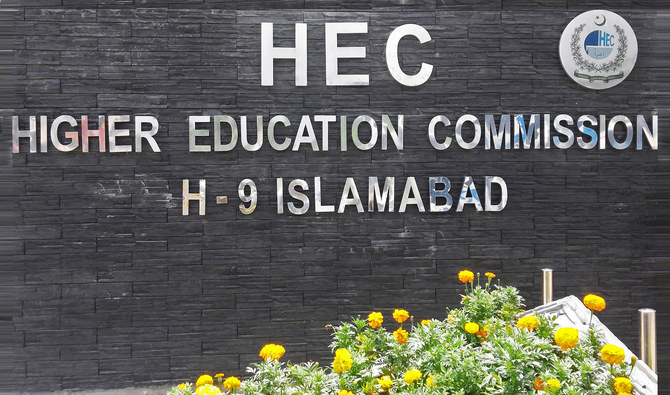
KARACHI: The Higher Education Commission (HEC) has drawn criticism from editors of Pakistani research journals for asking them to register their publications with Scopus and Web of Science, global citation databases which also cover Israeli publications.
“Israeli publications have been included in the system with an intent,” Dr. Syed Bacha Agha, president of Editors Association for Research Journals is Pakistan, alleged. “The HEC’s system offering Israeli publications without any disclaimer means that researchers are open to publish their work there,” he told Arab News on Thursday.
Pakistan is one of the 31 United Nations member states which do not recognize Israel and refuse to establish diplomatic relations with it.
However, the scientific databases recommended by the HEC are not country-specific and cover thousands of journals from all over the world, including Israel.
Ayesha Ikram, publications director at HEC, said that Scopus and Web of Science are globally recognized indexing entities, with publications from internationally acknowledged journals that can come from any country.
“HEC does not select or recommend international journals. HEC’s role is to support quality improvements in Pakistani journals, in order that they get higher rankings in lists prepared by international entities,” she told Arab News on Thursday and clarified that Israeli publications were neither selected nor recommended by the HEC.
“These international entities prepare lists from all countries of the world. Similarly, international entities that prepare rankings of universities from all countries of the world. HEC’s policies and support are meant to help our universities move up in the rankings,” she explained.
The actual problem faced by many Pakistani journals is that they may be simply unable to pass the rigorous editorial selection process the two citation databases have in place, scientists argue.
“There is no need to mix political battles with academic ones, at least in this particular case. The HEC’s new system includes recognized worldwide databases, which of course include journals from countries around the world — including Israel,” US-based Pakistani scholar Mashail Malik told Arab News.
“The criticism coming from Pakistani publications on this point seems at least partially motivated by an underlying concern of being ‘left behind’ due to the lack of resources available to Pakistani researchers. However, that issue should be debated separately, without making this policy change about political battles that are clearly irrelevant to this debate,” he said.
Naufil Shahrukh, associate editor of Policy Perspective, a research journal published by the Institute of Policy Studies in Islamabad, said that the reported presence of Israeli journals in the list of HEC-recognized research publications might be a matter of concern if it was “intentional and not by default.”
“But the real damage being done by the HEC’s policies is due to the fact that its officials are insensitive to our indigenous research culture and environment,” he said.
Since HEC encourages researchers to publish their work in foreign journals instead of local academic publications, according to Shahrukh they “do not really care how the research quality and impact factor should be assessed based on our own national needs.”
“Journals in national and regional languages are to suffer the most from the West-centric approach of HEC officials,” he argued.
While the HEC’s request to Pakistani publishers to register with Scopus and Web of Science came in November last year, calls to review it have been made only recently, when editors of 28 publications wrote a letter to HEC on April 7, asking it to review the expansion of HEC Journal Recognition System, which they said would affect research in the country.
“We don’t have resources to get registered with Scopus or Web of Science, which means that in July 2020 when the new recognition system will be implemented, the majority of Pakistani publications will not be part of the country’s research process,” Agha said.
Ikram dismissed the claims by explaining that the move will only help Pakistani scientific publications improve their standards.
“Web of Science and Socpus are the most recognized indexing agencies for journals. This will help our journals for international visibility and citations,” she said, “Our researchers should get recognized and be quoted internationally. This will raise their profile as well as the rankings of their universities. International indexing is the vehicle for doing so.”


![]()

Pakistan’s education commission under fire over access to Israeli journals
Short Url
https://arab.news/28dwq
Pakistan’s education commission under fire over access to Israeli journals
- Scientific databases are not country-specific and cover thousands of journals from all over the world, including Israel, says HEC
- Researchers say criticism from publishers motivated by a concern of being ‘left behind’
Latest updates






© 2026 SAUDI RESEARCH & PUBLISHING COMPANY, All Rights Reserved And subject to Terms of Use Agreement.