


Focus: US unemployment and Eurozone woes

Short Url
Updated 01 May 2020
Follow

Focus: US unemployment and Eurozone woes

What happened:

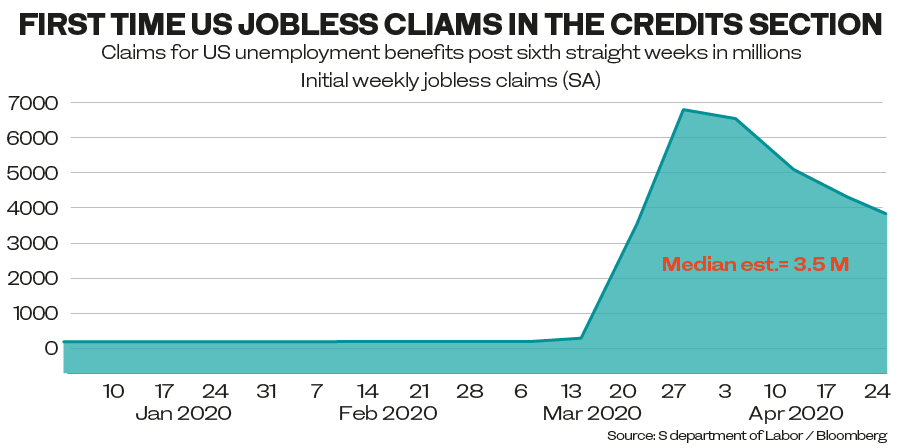
US first-time jobless claims jumped another 3.8 million, topping 30 million over the last six weeks.

Eurozone growth rates were dismal too, coming in at minus 3.8 percent for the eurozone as a whole, minus 5.8 percent for France, minus 5.2 percent for Spain, and minus 4.7 percent for Italy.

The corporate earnings season continued with Apple, Amazon and Twitter all either taking a hit or showing lackluster results.

Apple’s net income stood at $11.2 billion. Revenue was up by 1 percent, which was below guidance. Twitter reported a loss of $8 million, due to slagging advertising revenue, and Amazon reported a net income of $2.5 billion, down 30 percent compared to the first quarter (Q1) of 2019. Sales increased by 26 percent as orders jumped due to the coronavirus disease (COVID-19) lockdowns. Operating amidst lockdown and social distancing increased the cost base, which explains the discrepancy between revenues and profit.

US multinational energy corporation ConocoPhillips reported a loss of $1.7 billion due to the challenging environment in the oil and gas sector.

RBS was forecasting an operating profit of £519 million and beefed up its loan loss provisions to £802 million.

Budget airline Ryanair announced that it would cut 3,000 jobs, representing 15 percent of its workforce. The company’s CEO Michael O’Leary told Bloomberg that the $30 billion in state aid to some carriers but not others would lead to market distortions, penalizing some of the more profitable budget airlines.

BA (British Airways) is temporarily closing its base at Gatwick airport.
Background:

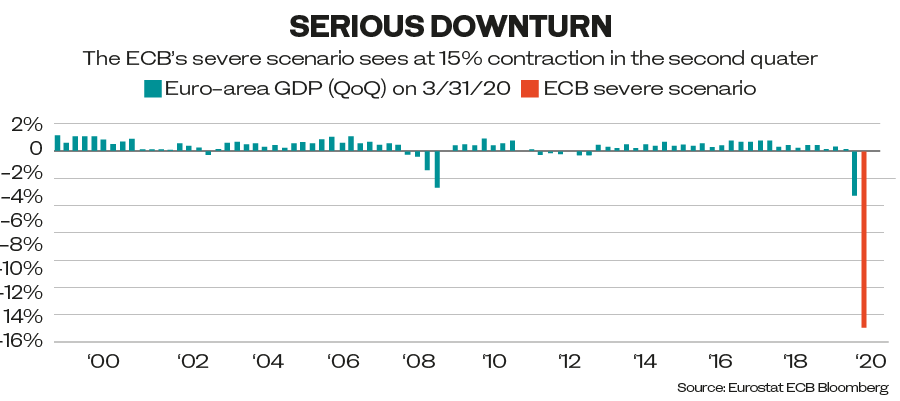
The European Central Bank (ECB) left rates unchanged despite the eurozone’s dismal GDP numbers. ECB president, Christine Lagarde, predicted the eurozone economy to contract between 5 and 12 percent for the full year of 2020. In its downside scenario for the second quarter it sees a contraction of 15 percent.

The bank did not increase its 750 billion-euro emergency asset purchase program, but Lagarde indicated willingness to do so down the line.

The ECB left interest rates prima facie unchanged. Its TLTRO-III program lets banks obtain three-year liquidity between minus 0.5 and minus 1 percent if they meet lending goals.

Under its PELTRO (pandemic emergency longer-term refinancing operations) they can get loans with maturities up to 16 months at an interest rate of minus 0.25 percent. The ECB has also allowed banks in some cases to lower the requirements on collateral to BB. These measures are tantamount to a stealth interest-rate cut and are designed to ease the stress on European lenders.

Decision making is less clear cut at the ECB than it is at the US Federal Reserve, because the eurozone consists of 19 countries with their own fiscal systems. However, both institutions showed a similar trajectory by announcing huge programs last month and only tweaking them at the margins this month, while indicating willingness to do more if necessary and emphasizing the importance of further fiscal stimulus.

The EU has so far spent 3.5 trillion euros in rescue funding. Going forward the institution will frontload its seven-year budget. It will also borrow money for a recovery program, which European Commission President Ursula von der Leyen likened to the Marshall Plan (a 1948 post-war foreign aid scheme for Western Europe) and which will be funneled through the multiannual budget to be frontloaded again.

While US first-time jobless claims for the week ending April 24 are high, new claims seem to be on a downward trajectory. More than 30 million Americans have filed for unemployment benefits over the last six weeks. US Secretary of Labor Eugene Scalia told CNBC that benefits had not trickled through to recipients at the desired speed, because many states had antiquated computer systems rendering processing the sheer number of transactions challenging.

The unemployment rate will be higher than after the financial crisis, which is bound to leave a big dent on consumer confidence and consumer spending in an economy which depends 70 percent on the consumer.

Under any scenario, employment is not going to increase as fast as people have lost jobs over the last two months.
Where we go from here:

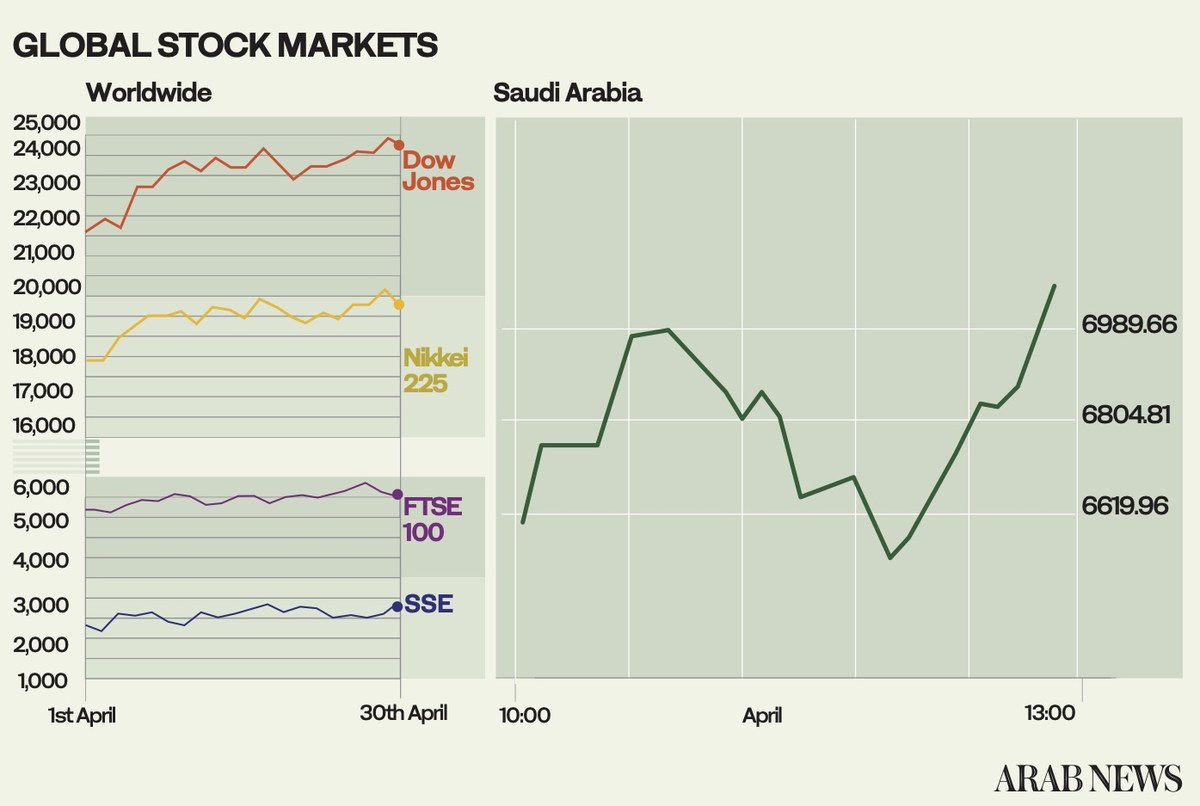
The dismal economic news combined with lackluster earnings reports resulted in markets sliding across the board on Thursday and into Friday. This stands in stark contrast to the April performance of all major stock exchanges. The S&P 500 was up by 18 percent and the Nasdaq by 21 percent.

Again, this is a striking difference with the overall macroeconomic picture, giving rise to the question, if or rather when we shall see a downward adjustment?


— Cornelia Meyer is a Ph.D.-level economist with 30 years of experience in investment banking and industry. She is chairperson and CEO of business consultancy Meyer Resources.
Twitter: @MeyerResources


The perils of comparing T20 franchise cricket leagues

Updated 12 sec ago
Follow

The perils of comparing T20 franchise cricket leagues

  • By most criteria, major cricket outlets consider the IPL the top league, but elsewhere factors such as entertainment and viability play a role in the rankings

LONDON: On occasion, I am asked to compare the franchised cricket leagues — a subjective exercise, given there are no agreed criteria on which to base such analysis.

It was interesting, therefore, to discover last week that The Cricketer magazine has published its own ranking of the leagues. It is not the first to do so — in August 2025, the BBC produced an assessment under the heading “Which franchise league is most entertaining?”

There is an understandable tendency for such rankings to focus on the biggest leagues. According to the World Cricketers Association, there are just short of 50 active short-form cricket leagues around the world. The Cricketer drew up its rules of engagement to include leagues that it judged to be “franchise-style,” excluding the T20 Blast in England and Wales which features the same county clubs that compete in other forms of domestic cricket. Only men’s leagues were included, whilst competitions that were not the biggest within a certain country or territory were excluded. This meant, for example, that the ILT20 was chosen as the UAE's primary league rather than the Abu Dhabi T10.

This pruning reduced the number of leagues under consideration to 10. Three criteria were set: the quality of cricket, entertainment value and viability.

The quality criterion related to the on-field spectacle, including the standard of players on show and the competitiveness of the league. Entertainment related to crowd engagement and spectator experience, both in-ground and through the league's broadcast. Viability focussed on whether each league was likely to not only survive, but tthrive in the long run.

In order to truly apply these criteria, a range of relevant metrics needs to be available. They vary in sufficient quantity and quality, breadth and depth. The BBC analysis did adopt imaginative metrics to create an entertainment index, based on data from CricViz. These included the average number of fours and sixes per game, dot-ball percentage, the impact of home advantage, average strike-rate, the style of bowling taking the wickets and how many games went down to the last over or even the last ball.

The whole ethos of T20 cricket is that it should be entertaining. My observations are that spectators respond most enthusiastically to six-hitting, followed by spectacular catching, the sight of ball breaking wicket and close finishes. One of the criticisms of T20 cricket is that it has become weighted too much in favor of batters, encouraged by the provision of pitches and balls which offer little help to bowlers, along with restrictions on the number of boundary fielders. No bowler likes being hit for six, so they have had to hone new skills in their attempts to reduce the incidence. These attempts may have gone unnoticed by those who only wish to see sixes hit.

This comes back to how should the quality of cricket be defined. Instinctively, it might be assumed that it equates with the quality of the players. Both The Cricketer and the BBC place the Indian Premier League first on this metric. The Cricketer focussed on the IPL’s commercial might and its lasting ability to pull spectators and viewers in over eight long weeks. It is difficult to distinguish whether its attraction is the quality of cricket, the charisma of the players or the entertainment value.

All of India’s best players and emerging talent are available for the whole IPL. Four overseas players are allowed per playing XI. No Pakistanis are invited and, in 2026, no Bangladeshis. It could be argued that their exclusion means that the IPL does not maximize its quality. If an inclusivity criterion were added then the IPL’s rating would be negatively affected.

The BBC’s assessment of quality, as distinct from entertainment levels, focussed on the quality of player in each league, based on international caps across all formats. This was expressed as the average number of international caps held by the starting XIs in each game. Significant variation exists. The IPL had 335 but was behind ILT20 with 423 and the Pakistan Super League with 351. Australia’s Big Bash League was way below with an average of 145. There are structural reasons for these differences.

During the BBL, in which teams are allowed three overseas players in a playing XI, Australia’s best cricketers play an international series. Their unavailability was a factor in the BBC’s seventh placed ranking for the BBL, compared with third place by The Cricketer. Conversely, the PSL was ranked sixth by The Cricketer and third by the BBC. This is despite the challenges which it has faced in its 10 years. One of those challenges is its scheduling in relation to international commitments and other franchise leagues, with which it competes for players.

In 2026, it runs from March 26 until May 3, overlapping with the IPL. Its need for international players has increased with its expansion from eight to 10 teams. In recent days, several high-profile players have announced that they have reversed their original intention to participate, citing personal reasons.

In the ILT20, nine overseas players, one of whom must be from an associate country, are allowed per XI, with the other two places mandated for UAE players. The league had a salary cap of $2.5 million per franchise in its first three seasons, the highest outside of the IPL. In the recent fourth edition, the salary cap was reduced to $2 million, plus $250,000 for two wildcards. Other factors now come into a player’s decision making, such as the length of tournament and being in one place for its duration.

South Africa’s SA20 has a secure base in high quality local talent and a strong base in spectator attendance and involvement. ILT20 does not have that, yet, and it will take time to build up. It was this factor that was influential in The Cricketer placing SA20 second in its overall ranking and ILT20 in eighth place. The panel also downrated ILT20 in terms of its viability. This was based on its reliance on a broadcast deal with an Indian TV company and its dependency on overseas players, suggesting that UAE players “hardly feature beyond fielding.” In the most recent tournament, a UAE player scored the second highest number of runs and another took 13th spot. Two UAE bowlers were in the top four leading wicket-takers.

ILT20 has a clear strategy to develop local talent and has domestic structures in place to underpin this. On the surface, franchise leagues may look as if they have only one goal — to make money and achieve self-sufficiency for the national board. What is not so readily apparent is their investment in talent-hunt programs. Cricket South Africa was quite open about its reasons for introducing SA20. It was in serious financial difficulty and deliberately prioritized the franchise league to address not only that problem but also reawaken interest in the game and uncover new talent. In the last two years the performance of its national team has improved dramatically. Perhaps an additional criterion for ranking franchise leagues should be their success in contributing towards domestic cricket development.

There has been no space to discuss the Caribbean Premier League, The Hundred, the US’s Major League Cricket, the Lanka Premier League or the Bangladesh Premier League. The Cricketer ranked them fourth, fifth, seventh, ninth and 10th, whereas the BBC placed The Hundred at four and the CPL at five. It did not consider the leagues in the US, Sri Lanka or Bangladesh. These variations reflect the use of different criteria and the subjective nature of the assessments. However, by available criteria, it is obvious to all that the IPL is the top league. Until a more rigorous set of criteria is developed, the debate about the relative positions of other leagues will occupy many a cricket conversation.