WASHINGTON/NEW YORK: The White House let its 2-week-old economic reopening guidelines expire on Thursday as half of all US states forged ahead with their own strategies for easing restrictions on restaurants, retail and other businesses shuttered by the coronavirus crisis.
The enormous pressure on states to reopen, despite a lack of wide-scale virus testing and other safeguards urged by health experts, was highlighted in new Labor Department data showing some 30 million Americans have sought unemployment benefits since March 21.
The jobless toll amounts to more than 18.4 percent of the US working-age population, a level not seen since the Great Depression of the 1930s.
Physical separation of people — by closing schools, businesses and other places of social gatherings — remains the chief weapon against a highly contagious respiratory virus with no vaccine and no cure.
But with economic pain reaching historic proportions, agitation to relax stay-at-home orders and mandatory workplace restrictions has mounted.
Weeks after insisting he had “total” authority to decide when and how to reopen the nation’s economy, President Donald Trump has largely left it to each governor to decide on a state-by-state basis.
Although the White House declined to extend its April 16 reopening guidance, which recommended an economic restart in stages only after strict precautions are put in place, medical experts said those conditions remained unmet and that acting prematurely risked a resurgence of the outbreak.
Safely lifting social distancing rules, they insisted, will require vastly expanded virus screening and the means to trace close social contacts of infected people so they too can be tested and isolated.
“You can’t just leap over things to a situation where you’re really tempting (the virus) to rebound. That’s the thing I get concerned about,” Dr. Anthony Fauci, director of the National Institute of Allergy and Infectious Diseases, told NBC’s “Today” show.
As of Thursday, the number of known infections nationwide had climbed to well over 1 million, including more than 62,000 deaths, far exceeding the tally of American war dead from all the years of US military involvement in Vietnam.
But pressures to return to some semblance of normalcy have only grown as the outbreak appears to have waned across much of the county.
About two dozen states, mostly in the South, the Midwest and mountain West, have moved to relax restrictions since Georgia led the way late last week. Texas and Florida, among others this week, outlined plans for doing so in the days ahead.
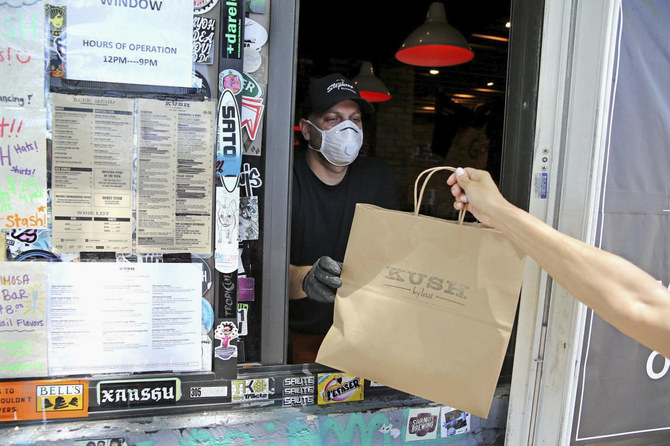
But no companies are required to reopen, and it was not clear how many business owners and their employees would return to work, and how many patrons would venture back into stores and restaurants.
The number of coronavirus cases is still climbing in many parts of the country, although peaks appear to have been reached in New York state, the epicenter of the US outbreak, and other places.
Pennsylvania, Kansas, Wisconsin, Virginia, Arizona, Minnesota and Nebraska all reported a record number of new cases on Thursday, though greater testing could account for some of the increases, revealing infections already present but undetected.
Several states, including New Jersey, Texas, Massachusetts, Ohio, Indiana, West Virginia and New Mexico, posted new highs in their daily death tolls.
In California, Governor Gavin Newsom announced beach and park closures in Orange County, south of Los Angeles, after crowds jammed the popular shoreline last weekend.
In one of the first major reopenings anticipated in US sports, NASCAR announced its auto racing competition would return with 10 races at its North and South Carolina tracks in mid- to late-May.
Some segments of the commercial US workforce kept on the job during the health crisis have begun to push back against what they see as deteriorating conditions.
Workers at leading retailers including Amazon, Walmart and Target, as well as delivery service Instacart and FedEx, were planning strikes on Friday to protest a lack of safety equipment and other protections at a time when their services are deemed essential, according to information circulated on social media.

Half of US states easing coronavirus restrictions as jobless numbers grow
https://arab.news/n677n
Half of US states easing coronavirus restrictions as jobless numbers grow
- Agitation to relax stay-at-home orders and mandatory workplace restrictions has mounted
- Number of known infections in the US had climbed to well over 1 million
The shootings in Minneapolis are upending the politics of immigration in Congress
- Many GOP lawmakers continue to embrace the Trump administration’s deportation strategy
WASHINGTON: The shooting deaths of two American citizens during the Trump administration’s deportation operations in Minneapolis have upended the politics of immigration in Congress, plunging the country toward another government shutdown.
Democrats have awakened to what they see as a moral moment for the country, refusing funds for the Department of Homeland Security’s military-style immigration enforcement operations unless there are new restraints. Two former presidents, Barack Obama and Bill Clinton, have broken from retirement to speak out.
At the same time, Republicans who have championed President Donald Trump’s tough approach to immigration are signaling second thoughts. A growing number of Republicans want a full investigation into the shooting death of Alex Pretti and congressional hearings about US Immigration and Customs Enforcement operations.
“Americans are horrified & don’t want their tax dollars funding this brutality,” Sen. Chris Van Hollen, D-Md., wrote on social media. “Not another dime to this lawless operation.”
The result is a rapidly changing political environment as the nation considers the reach of the Trump administration’s well-funded immigration enforcement machinery and Congress spirals toward a partial federal shutdown if no resolution is reached by midnight Friday.
“The tragic death of Alex Pretti has refocused attention on the Homeland Security bill, and I recognize and share the concerns,” said Sen. Susan Collins of Maine, the GOP chair of the Appropriations Committee, in brief remarks Monday.
Still, she urged colleagues to stick to the funding deal and avoid a “detrimental shutdown.”
Searching for a way out of a crisis
As Congress seeks to defuse a crisis, the next steps are uncertain.
The White House has indicated its own shifting strategy, sending Trump’s border czar Tom Homan to Minneapolis to take over for hard-charging Border Patrol Commander Gregory Bovino, which many Republicans see as a potential turning point to calm operations.
“This is a positive development — one that I hope leads to turning down the temperature and restoring order in Minnesota,” Senate Majority Leader John Thune posted about Homan.
Behind the scenes, the White House is reaching out to congressional leaders, and even individual Democratic senators, in search of a way out of another government shutdown.
At stake is a six-bill government funding package, not just for Homeland Security but for Defense, Health and other departments, making up more than 70 percent of federal operations.
Even though Homeland Security has billions from Trump’s big tax break bill, Democrats are coalescing around changes to ICE operations. “We can still have some legitimate restriction on how these people are conducting themselves,” said Sen. Ruben Gallego, D-Arizona
But it appears doubtful the Trump administration would readily agree to Democrats’ demands to rein in immigration operations. Proposals for unmasking federal agents or limiting their reach into schools, hospitals or churches would be difficult to quickly approve in Congress.
White House press secretary Karoline Leavitt said that while conversations are underway, Trump wants to see the bipartisan spending package approved to avoid the possibility of a government shutdown.
“We absolutely do not want to see that funding lapse,” Leavitt said.
Politics reflect changing attitudes on Trump’s immigration agenda
The political climate is a turnaround from just a year ago, when Congress easily passed the Laken Riley Act, the first bill Trump signed into law in his second term.
At the time, dozens of Democrats joined the GOP majority in passing the bill named after a Georgia nursing student who was killed by a Venezuelan man who had entered the country illegally.
Many Democrats had worried about the Biden administration’s record of having allowed untold immigrants into the country. The party was increasingly seen as soft on crime following the “defund the police” protests and the aftermath of the death of George Floyd at the the hands of law enforcement.
But the Trump administrations tactics changed all that.
Just 38 percent of US adults approve of how Trump is handling immigration, down from 49 percent in March, according to an AP-NORC poll conducted in January, shortly after the death of Renee Good, who was shot and killed by a ICE officer in Minnesota.
Last week, almost all House Democrats voted against the Homeland Security bill, as the package was sent the Senate.
Then there was the shooting death of Pretti over the weekend in Minneapolis.
Rep. Tom Suozzi of New York, who was among the seven Democrats who had voted to approve the Homeland Security funds, reversed course Monday in a Facebook post.
“I hear the anger from my constituents, and I take responsibility for that,” Suozzi wrote.
He said he “failed to view the DHS funding vote as a referendum on the illegal and immoral conduct of ICE in Minneapolis.”
Voting ahead as shutdown risk grows
Senate Democratic Leader Chuck Schumer said Monday the responsibility for averting another shutdown falls to Republicans, who have majority control, to break apart the six-bill package, removing the homeland funds while allowing the others to go forward.
“We can pass them right away,” Schumer said.
But the White House panned that approach and House Speaker Mike Johnson, who has blamed Democrats for last year’s shutdown, the longest in history, has been mum. The GOP speaker would need to recall lawmakers to Washington to vote.
Republicans believe they will be able to portray Democrats as radical if the government shuts down over Homeland Security funds, and certain centrist Democrats have warned the party against strong anti-ICE language.
A memo from centrist Democratic group Third Way had earlier warned lawmakers against proposals to “abolish” ICE as “emotionally satisfying, politically lethal.” In a new memo Monday it proposed “Overhauling ICE” with top-to-bottom changes, including removing Homeland Security Secretary Kristi Noem from her job.
GOP faces a divide on deportations
But Republicans also risk being sideways with public opinion over Trump’s immigration and deportation agenda.
Republicans prefer to keep the focus on Trump’s ability to secure the US-Mexico border, with illegal crossings at all-time lows, instead of the military-style deportation agenda. They are particularly sensitive to concerns from gun owners’ groups that Pretti, who was apparently licensed to carry a firearm, is being criticized for having a gun with him before he was killed.
GOP Sen. Rand Paul, the chairman of the Homeland Security and Government Oversight Committee, demanded that acting ICE director Todd Lyons appear for a hearing — joining a similar demand from House Republicans over the weekend.
At the same time, many GOP lawmakers continue to embrace the Trump administration’s deportation strategy.
“I want to be very clear,” said Sen. Rick Scott, R-Fla., in a post. “I will not support any efforts to strip DHS of its funding.”
And pressure from their own right flank was bearing down on Republicans.
The Heritage Foundation chastised those Republicans who were “jubilant” at the prospect of slowing down ICE operations. “Deport every illegal alien,” it said in a post. “Nothing less.”


